Cold email, LinkedIn outreach or cold calling: which should you use?
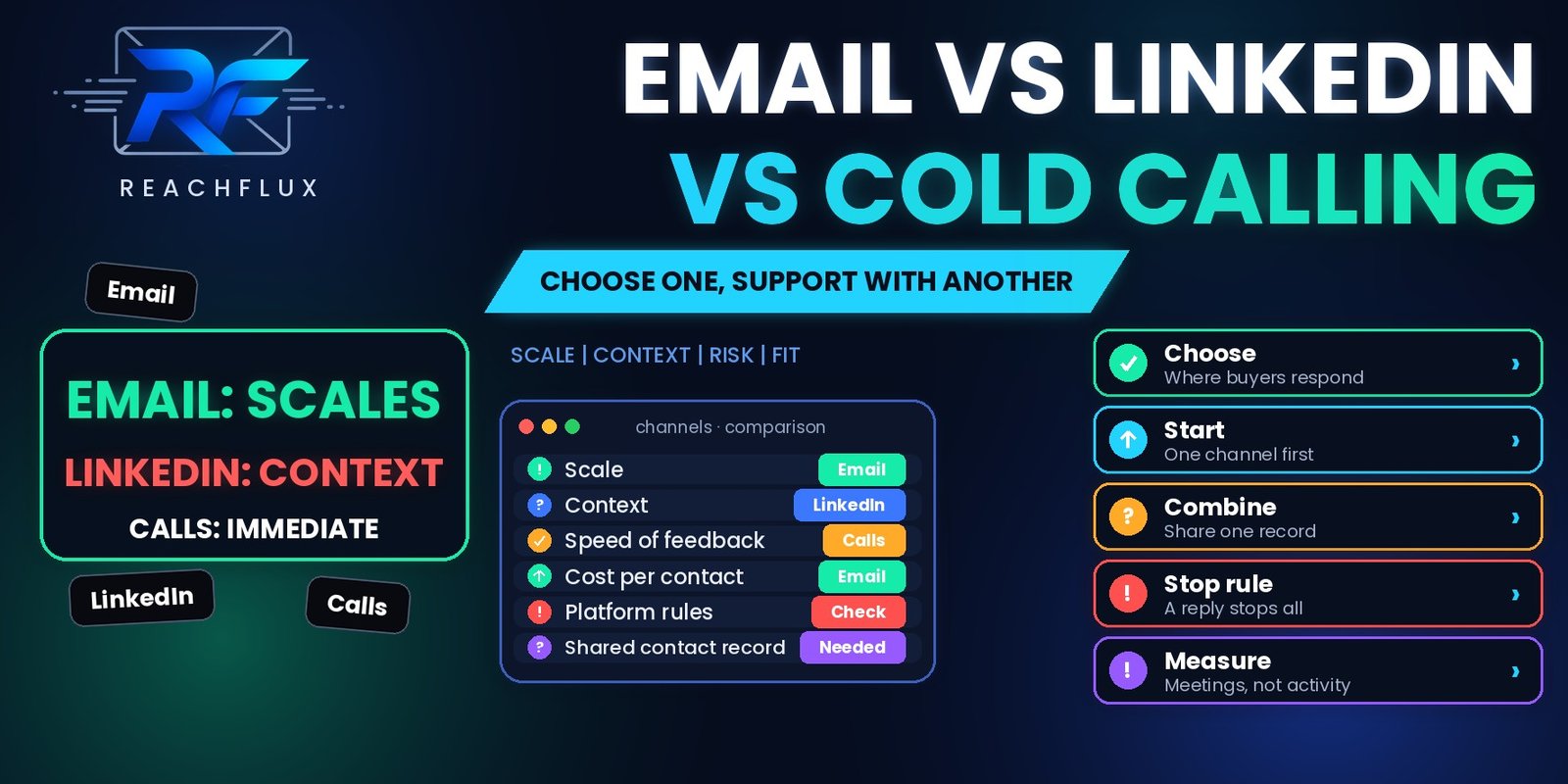
Choose by audience, scale and risk. Cold email scales well, is easy to personalise and measure and works for most B2B audiences, but it depends on healthy sending infrastructure and a clean list. LinkedIn outreach suits audiences that are active there and reaches people with context, but it is hard to scale and is bound by the platform’s rules. Cold calling gives immediate, human feedback and suits some high-value, time-sensitive offers, but it is time-intensive and often regulated.
Most teams do best with one primary channel done well, and a second used to support it. This guide compares the three honestly, shows when each fits and explains how to combine them without annoying the same person three times.
The three channels side by side
| Factor | Cold email | LinkedIn outreach | Cold calling |
|---|---|---|---|
| Scale | High | Limited by platform rules and effort | Low, limited by hours |
| Personalization | Easy to add context | Built-in profile context | Real-time, in conversation |
| Speed of feedback | Replies over days | Replies over days | Immediate |
| Cost per contact | Low once infrastructure exists | Moderate, mostly time | High, mostly time |
| Main risks | Deliverability, complaints, compliance | Platform restrictions, connection limits | Call rules, rejection fatigue, regulation |
| Best fit | Most B2B audiences, scalable outreach | Roles that are active on the platform | High-value, time-sensitive or relationship-led offers |
Where cold email wins, and where it struggles
Cold email is the most scalable of the three, and the easiest to measure and improve. It lets you send relevant messages to many people, follow up automatically and test changes systematically. It works particularly well when your audience is defined and reachable by business email.
Its weaknesses are practical. You need healthy domains, authentication and a clean list, and you need to keep volume sensible. Deliverability problems can silently hide good messages. The map of those problems is in the Cold Email Deliverability: The Complete Guide to Inbox Placement, Reputation and Fixes.
Where LinkedIn fits
LinkedIn gives you context for free: roles, history and activity are visible before you write. That makes it good for reaching specific people in roles that use the platform, and for warming up a conversation. It also tends to feel more personal than a cold email.
The limits are scale and rules. Platform terms restrict automated activity, and automation that breaks those terms can lead to restricted accounts, so check the current terms before you rely on any tool. Message and connection limits also cap volume. Treat it as a high-touch channel for your best accounts rather than a bulk one.
Where calling fits
A phone call is immediate and human. You hear objections in real time, can adapt on the spot and can build rapport quickly. It suits high-value offers, short sales cycles and audiences that answer the phone.
It is also the most demanding. It takes time and resilience, and it is regulated in many places, with do-not-call rules and consent requirements that vary by country. Check what applies before you start, and be prepared for a low connect rate. Many teams use calling selectively, after an email or message has created some familiarity.
A simple way to choose
Look at how your customers actually find and evaluate suppliers, and which channel they respond to.
High volume favours email. Small numbers of high-value accounts can justify calls and personal messages.
Email needs good infrastructure. LinkedIn needs respect for platform rules. Calling needs regulatory care.
Get one working before you add another, so you understand what produces results.
Use it to reinforce, not to duplicate, what the first is doing.
How to use more than one without being annoying
Multichannel outreach works when it feels like one coherent effort, not a barrage. Keep a single record of who has been contacted, by which route and when, and make sure a reply on any channel stops outreach on all of them. Space touches out, and make each add something new rather than repeating the same pitch in a different place.
| Principle | Why it matters |
|---|---|
| One shared contact record | Prevents duplicate or conflicting messages across channels |
| A reply stops everything | Avoids contacting someone who has already answered |
| One owner per account | Keeps the conversation consistent |
| Different angles per touch | Each message adds something new |
| One suppression list across channels | Honours opt-outs wherever they were made |
The collision risks and how to avoid them are covered in How to Prevent Campaign Collisions: Stop Prospects Getting Conflicting Emails From Multiple Sequences.
A coordinated, light-touch sequence
Imagine a consultant targeting heads of operations at mid-sized firms. They send a short, relevant first email. If there is no reply after a few days, they view the person’s profile and send a brief, personal connection note that references the email. A later follow-up email adds a concrete detail. Only for the highest-value accounts, and where the rules allow, do they place a call.
At each step, a reply anywhere stops the sequence. The contact never receives the same pitch twice, and the touches feel like a considered effort rather than automation. The structure of the email steps themselves is in Cold Email Follow-Up Sequence Examples: Structures, Templates and What Each Step Should Do.
Three scenarios and the channel mix that fits
A founder reaching fifty specialist buyers
A personal LinkedIn note and a short email, supported by a call for the most interested. Volume is low and personalisation matters most.
A small team reaching a few hundred mid-market firms
Email as the primary channel, with LinkedIn as a light supporting touch for responders. This scales and stays measurable.
A company selling high-value, time-sensitive offers to a small list
A mix of email and calling, coordinated through a shared record, because the value of each conversation justifies the effort.
Compare channels fairly
Judge each channel on the same outcomes: qualified conversations, meetings and customers, relative to the time and money spent. Avoid comparing a channel’s activity numbers with another’s, since a call and an email are not equivalent units. Track cost per meeting for each, as described in Cold Email ROI: How to Calculate Cost per Reply, Cost per Meeting and Payback, and be honest about the hours you spend.
Where ReachFlux fits
ReachFlux focuses on the email channel: preparing lead lists, validating addresses, sending campaigns across connected accounts, handling replies and tracking leads. It does not run LinkedIn outreach or calling. If you use several channels, use ReachFlux for the email side and keep a shared record of contacts so channels stay coordinated.
Mistakes when mixing channels
Running all channels at once
Without coordination, one person receives the same pitch three ways, which feels like pressure.
Not sharing opt-outs across channels
A request to stop on one channel must stop everything.
Automating beyond the platform rules
Breaking a platform’s terms can restrict your account and harm results.
Comparing activity rather than outcomes
Compare meetings and customers, not sends, messages and calls.
Channel choice checklist
- You know which channel your buyers actually respond to.
- You have matched the channel to your volume, resources and risk tolerance.
- You checked platform terms and calling rules that apply to you.
- One channel is working before a second is added.
- A shared contact record prevents duplicate or conflicting outreach.
- A reply on any channel stops outreach on all of them.
- One suppression list covers every channel.
- Channels are compared on meetings and customers, not activity.
Questions about outreach channels
Is cold email better than LinkedIn outreach?
It depends. Cold email scales better and is easier to measure, while LinkedIn provides context and suits roles active on the platform. Many teams use one as the main channel and the other to support it.
Is cold calling still effective?
It can be, especially for high-value, time-sensitive offers, but it is time-intensive and regulated in many places. Check the rules that apply and consider using it selectively after an email or message.
Can I automate LinkedIn outreach?
Platform terms restrict automated activity, and automation that breaches them can lead to restrictions. Check the current terms before relying on any tool.
Should I use all three channels at once?
Usually not at the start. Get one channel working, then add a second to support it, with a shared contact record and a rule that a reply on any channel stops all outreach.
Which channel has the lowest cost per contact?
Cold email usually has the lowest cost once infrastructure is in place. Calling is the most expensive per contact, mostly because of time.
Does ReachFlux support LinkedIn or calling?
No. ReachFlux focuses on email: lead preparation, validation, sending, reply management and lead tracking.
One channel done well beats three done badly.
Choose by where your buyers pay attention, how many people you need to reach and which risks you can manage. Get one channel working, add a second to support it and keep everything coordinated with one contact record and one suppression list.
Measure by meetings and customers, not by activity.
Prepare leads, send campaigns and manage replies in one workflow.
ReachFlux focuses on email outreach: lead preparation, validation, multi-account sending, replies and pipeline.