What does a good cold email follow-up sequence look like?
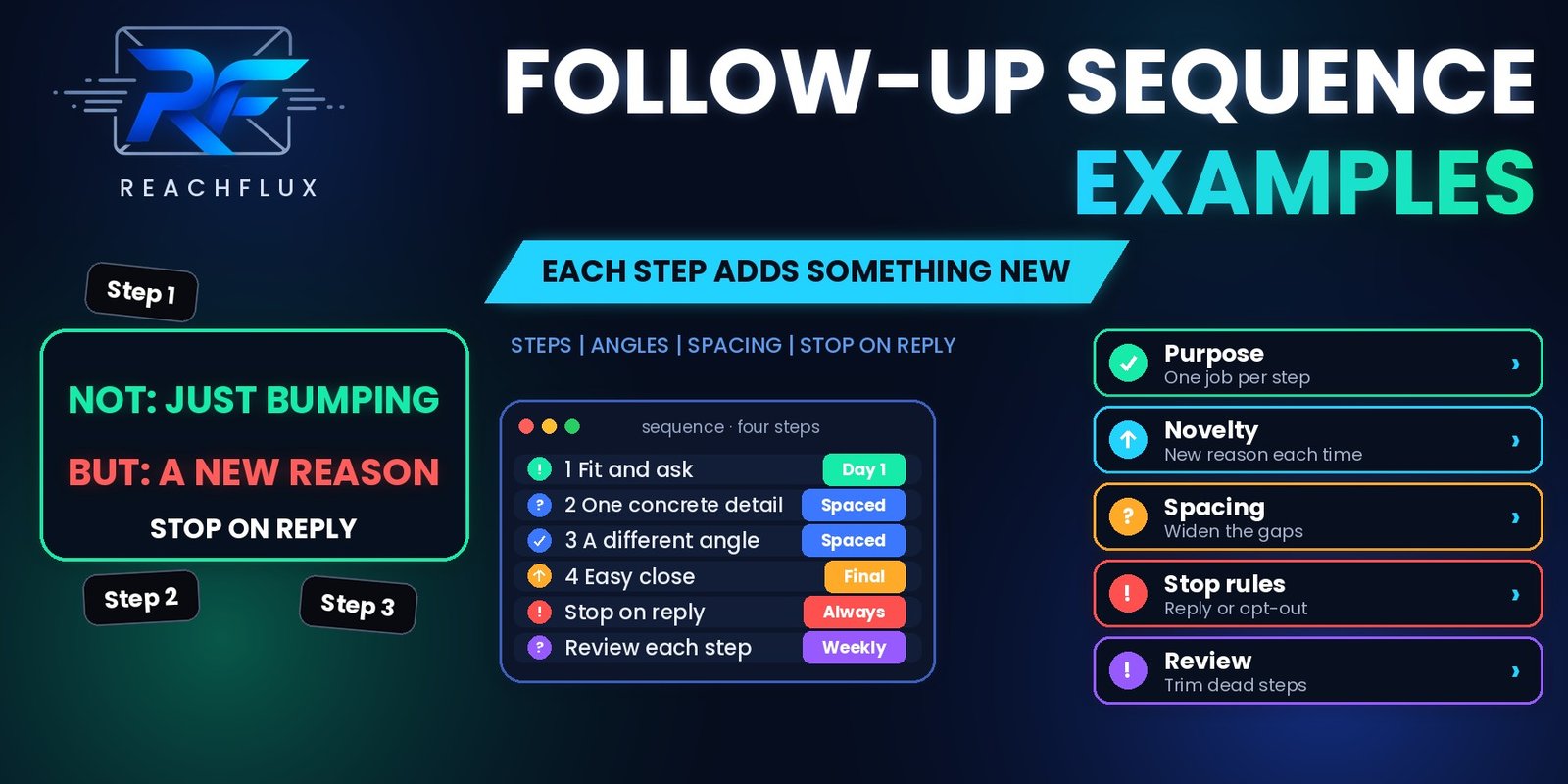
A good sequence has a small number of emails, each with its own job, spaced out with growing gaps, and it stops the moment someone replies. The first email establishes fit and asks for permission to share more. Each follow-up adds something new, such as a concrete detail, a different angle or an easier question, rather than repeating the first message in smaller words. The last one closes politely and leaves the door open.
This guide gives you structures of different lengths, templates with placeholders, the purpose of each step and the rules that keep a sequence respectful. Adapt every template to your audience, and make sure each statement is true.
What each step is for
| Step | Purpose | What it contains |
|---|---|---|
| 1. Opening email | Show fit and ask permission | A relevant reason you are writing and one low-effort ask |
| 2. First follow-up | Add one concrete detail | A specific fact, example or capability that makes the fit easier to picture |
| 3. Second follow-up | Offer a different angle | A new reason, such as a related problem, a timing factor or a short resource |
| 4. Closing note | Make it easy to say yes or no | A polite close that leaves the door open and removes pressure |
A four-step sequence with templates
This structure suits most outreach. Placeholders are in square brackets, and the content must be adapted to the person.
Hi [first name], [one relevant observation or shared situation]. We help [type of team] with [problem]. Would it be useful if I sent a short summary of how it works?
Each step has a different job, and none of them asks the reader to do much. Keep each short. If your first email already asks a direct question, make sure follow-ups add information rather than repeat it.
A shorter sequence for cautious or high-value contacts
For top-tier accounts, or when you want to keep a light touch, three emails can be enough. Use an opening email with a strong, specific reason, a single follow-up that adds a concrete detail, and a polite closing note. Fewer touches mean fewer chances to annoy, and they pair well with deeper personalization, as described in Cold Email Personalization That Does Not Look Scripted: First Lines, Research and Scale.
The trade-off is that you give up some of the replies that arrive on later touches. Review your own data to see where replies actually come from, and set the length accordingly.
A longer sequence, and when it makes sense
Longer sequences suit audiences that are slow to respond or where timing matters, such as annual planning cycles. Add a step that offers a useful, relevant resource, and another that raises a timing reason. Keep the gaps wider as you go, and be honest in the closing note.
Be cautious about length. More touches increase the chance of complaints and unsubscribes, and they only help if each adds something real. If steps four and five never produce replies, remove them.
Angles that add something new
| Angle | What it does | Example idea (placeholders) |
|---|---|---|
| A concrete detail | Makes the offer easier to picture | A specific capability relevant to [their situation] |
| A short example | Shows how it works in practice | A brief description of a typical use for [type of team] |
| A related problem | Reaches the reader from another side | [Related challenge] that often accompanies [problem] |
| A timing reason | Explains why now | [Seasonal or planning factor] approaching |
| A useful resource | Gives something without asking | A short guide or checklist relevant to [topic] |
| An easier question | Lowers the effort to reply | A yes or no question about [one thing] |
Follow-up habits that do not work
“Just bumping this”
It adds nothing and signals that you have nothing new to say.
Repeating the first email
Copying the same text in a smaller form reads as automated.
Guilt or pressure
Language such as “I have not heard back” in a reproachful tone pushes people away.
Too many steps too close together
Rapid follow-ups feel relentless and invite complaints.
Ignoring replies
A sequence that carries on after a reply damages the conversation and your reputation.
Rules that keep a sequence respectful
The sequence ends for that contact the moment a human replies, in any campaign.
Pause or delay the sequence until the person returns, and do not count it as engagement.
Remove the person everywhere and add them to your suppression list. See Cold Email Suppression List: What to Include, How to Build It and How to Keep It Clean.
Decide the length in advance and do not extend it on a whim.
Avoid contacting many people at one company at once. See How to Prevent Campaign Collisions: Stop Prospects Getting Conflicting Emails From Multiple Sequences.
How far apart to send the steps
There is no universal schedule. A common approach is to start with shorter gaps and widen them, so the sequence feels attentive early and unobtrusive later. Match the pace to your audience and your offer, and avoid weekends and holidays where they are not appropriate. The reasoning, with more on how to choose, is in Cold Email Follow-Up Timing: How Long Should You Wait Before Following Up?.
Whatever you choose, apply it consistently so you can compare results across campaigns. Inconsistent follow-ups are one of the most common reasons outreach feels unpredictable, as discussed in Why Is Cold Email Outreach Inconsistent? 9 Problems to Check.
Review which steps earn their place
Every few weeks, look at where your replies come from. Count positive replies by step, not just in total. If the third follow-up produces nothing across several campaigns, shorten the sequence or rewrite it with a fresh angle. If a particular step consistently produces replies, learn from it and apply the lesson elsewhere.
Test changes one at a time, using the method in Cold Email A/B Testing: How to Test Copy, Offers and Lists Without Fooling Yourself, and keep a log so your sequence improves over time instead of resetting with every campaign.
A follow-up sequence for wholesale buyers
Here is how the structure adapts to a concrete situation, using the invented scenario of a food brand approaching independent grocers. The details are illustrative, and every claim must be true for your product.
| Step | Purpose | Idea |
|---|---|---|
| 1 | Show fit and ask permission | Explain why the range suits their customers and offer to send wholesale terms |
| 2 | Add a concrete detail | Mention a specific product, pack size or minimum that makes the offer concrete |
| 3 | A different angle | Raise a seasonal window or a pairing with something they already stock |
| 4 | Easy close | Make clear you will stop writing, and keep the door open for when they plan the next range |
Across all four steps the buyer is never asked to do much. The goal is to make a yes easy and a no painless. The wider playbook for this audience is in How to Email Retail Buyers and Stockists: A Wholesale Outreach Playbook for Ecommerce Brands.
Follow-up sequence checklist
- Every step has a clear, different purpose.
- Each follow-up adds something new for the reader.
- The sequence has a fixed, modest length that suits the audience.
- Gaps widen as the sequence continues.
- A real reply stops all sequences for that contact.
- Out-of-office replies pause the sequence rather than ending it or counting as engagement.
- Opt-outs are honoured immediately and everywhere.
- You review positive replies by step and remove steps that never earn replies.
Questions about follow-up sequences
What should a cold email follow-up sequence look like?
A small number of emails, each with its own purpose, spaced with widening gaps. The first shows fit and asks permission, follow-ups add something new, the last closes politely, and the sequence stops as soon as someone replies.
How many follow-ups should I send?
Enough to be persistent without being annoying. Many sequences use three or four emails in total, but review where your replies actually come from and cut steps that never earn any.
What should I write in a follow-up email?
Something new: a concrete detail, a short example, a related problem, a timing reason, a useful resource or an easier question. Avoid “just bumping this” and repeating the first email.
Should follow-ups be in the same email thread?
Often yes, because it mirrors how people normally follow up. Never fake a thread that does not exist.
When should a follow-up sequence stop?
Immediately on any real reply, on an opt-out, and at the end of the planned length. Out-of-office replies should pause or delay the sequence rather than end it.
How do I make my follow-ups consistent?
Write the sequence in advance, automate the schedule, stop on reply, give each conversation one owner and review results weekly. Inconsistent manual follow-ups are a common cause of unpredictable results.
Give every follow-up a job.
A sequence works when each step adds a new reason to reply and the whole thing stops the moment someone does. Keep it short, widen the gaps, review which steps earn their place and be honest in every line.
Consistency is the quiet advantage: a well-built sequence runs the same way every time.
Run follow-ups that stop on reply and keep replies in one place.
ReachFlux processes campaigns in the background and brings replies into one workflow, so follow-ups stay consistent.