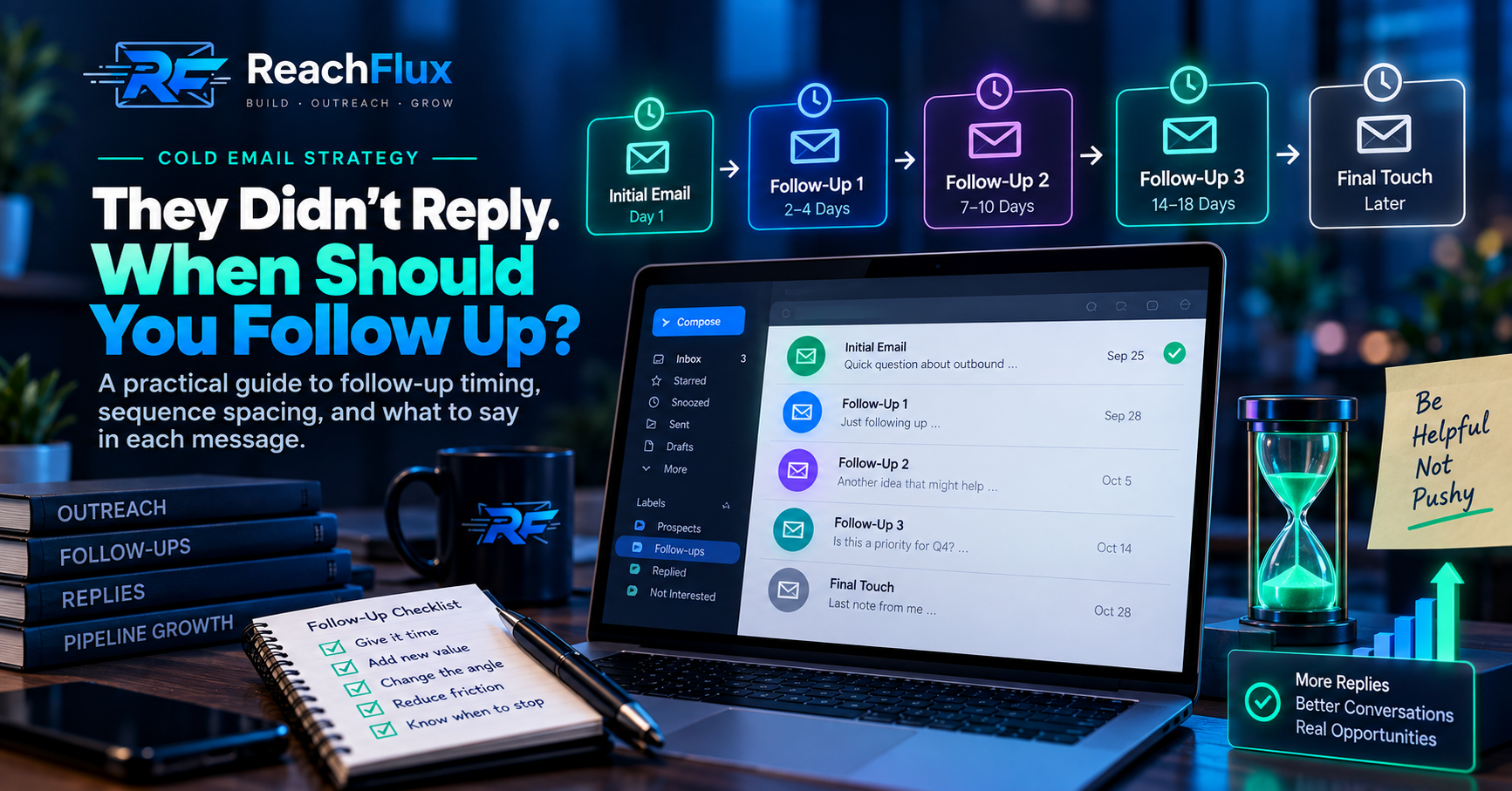
For many B2B cold email campaigns, waiting roughly 2–4 business days before the first follow-up is a sensible starting point — not a universal rule. Later follow-ups can usually be spaced farther apart. The goal is to stay visible without turning the sequence into repeated pressure.
But the number of days is only one part of the decision.
A follow-up sent at the “perfect” time can still fail if it repeats the first email word for word, ignores a previous response, targets the wrong person, or gives the prospect no new reason to reply.
And waiting longer will not rescue an irrelevant first email.
Good follow-up strategy combines three things:
Timing
Give the prospect enough room to see and process the previous message.
Context
Change the message when new information or a different angle can improve the conversation.
Restraint
Know when another message adds value and when it simply creates more inbox pressure.
How long should you wait before following up on a cold email?
If you need a practical starting point, wait around 2–4 business days after the first cold email before sending the first follow-up.
Then consider widening the gap for later touches rather than repeating the same interval indefinitely.
That might mean the sequence begins relatively close together, then gradually becomes less frequent.
For example:
This is a planning framework, not a deliverability guarantee.
There is no mailbox-provider rule saying a cold email must be followed up after exactly two, three, five, or seven days.
Your actual cadence should reflect the type of prospect, the urgency of the offer, the sales cycle, the quality of the first email, and any signal the prospect has already given you.
Timing controls when you appear again. It does not create relevance. If the prospect had no reason to care about the first message, sending the same idea again three days later rarely fixes the underlying problem.
Why follow-ups matter in cold outreach
No reply does not always mean “not interested.”
Your email may have arrived during a meeting.
The prospect may have opened it, intended to reply later, and forgotten.
The message may have been relevant but not urgent enough to interrupt their current work.
Or the email may simply have been missed.
That is the legitimate role of a follow-up: bringing a potentially relevant conversation back into view.
The problem starts when follow-ups are treated as permission to send the same request repeatedly until the prospect responds.
There is a major difference between:
“Just following up.”
“Checking again.”
“Bringing this to the top of your inbox.”
Add useful context.
Introduce a different pain point.
Make the next step easier.
A good sequence progresses.
A bad sequence nags.
When should you send the first cold email follow-up?
For a typical B2B campaign, the first follow-up usually should not arrive a few hours after the initial message.
The recipient needs a reasonable opportunity to encounter the first email.
This is why a gap of roughly 2–4 business days is often a useful starting point.
It keeps the conversation recent without making the sequence feel immediate or impatient.
There are exceptions.
If the email relates to a genuinely time-sensitive event, a shorter window may make sense.
If you are contacting senior executives about a complex, non-urgent offer, a little more space may be appropriate.
The mistake is turning one interval into a universal formula.
Start with a few business days between the initial message and first follow-up. Then evaluate actual replies, objections, unsubscribes, complaints, and campaign quality before deciding whether your sequence needs to become faster or slower.
Should every follow-up use the same delay?
Usually, no.
A sequence that sends every message at exactly the same short interval can become increasingly aggressive as the number of touches grows.
The first follow-up has a simple purpose: resurface a recent conversation.
The fourth follow-up is different.
By that point, the recipient has had several opportunities to respond.
Continuing to contact them at the same frequency creates diminishing value.
A better pattern is often to increase spacing as the sequence progresses.
A practical cold email follow-up schedule
There is no single schedule that fits every campaign, but the following structure gives you a sensible starting point.
Initial cold email
Introduce one relevant problem or opportunity and make the next step easy.
Follow-up #1
Keep it short. Resurface the original idea without rewriting the entire first email.
Follow-up #2
Introduce a different angle, useful context, or a clearer reason the conversation may matter.
Follow-up #3
Reduce friction. Ask whether the topic belongs with someone else or whether the timing is simply wrong.
Final touch
Close the sequence politely rather than keeping the prospect in an indefinite loop.
What should change in each cold email follow-up?
Timing gets too much attention when the bigger problem is often message progression.
If every follow-up says the same thing, changing the delay from three days to four days will not suddenly make the sequence good.
Each message should have a job.
Follow-up #1: reduce the message
Do not paste the original pitch again.
The prospect already has it in the thread.
Bring the central point back into view and make the response easy.
Follow-up #2: add another reason to care
This is where the sequence should progress.
Instead of saying “following up again,” introduce another useful angle.
Maybe the first email focused on sending capacity.
The next message could focus on reply management, lead follow-through, or the operational cost of managing outreach manually.
The exact angle depends on what you actually sell.
Follow-up #3: lower the commitment
Sometimes the offer is relevant but the requested next step is too large.
Instead of asking for a call again, ask a smaller question.
For example:
That question can reveal whether the problem is interest, ownership, or timing.
The final touch: close the loop
The final message should not threaten to disappear or use a fake “breakup email” gimmick.
Keep it normal.
You can simply acknowledge that the timing may not be right and stop the active sequence.
Follow-up timing should change when the prospect gives you a signal
A static sequence makes sense only while you have no better information.
Once the prospect responds, the situation changes.
The reply becomes more important than the original schedule.
No response
Continue the planned sequence if the prospect still fits and no negative signal has appeared.
“Try me next month”
Stop the generic sequence and follow the timing the prospect actually gave you.
“Speak to Sarah”
Do not keep following up with the original person as if they never replied. Move the conversation appropriately.
Not interested
Stop the active sales sequence. A clear negative response is not an invitation to keep automating follow-ups.
Automation should handle silence. Humans should respect context. The moment a real reply changes the state of the conversation, your sequence should react to that state instead of blindly continuing on schedule.
When should you not send another follow-up?
More touches are not automatically better.
There are several situations where the correct next step is to stop rather than schedule another email.
The purpose of automation is not to remove judgment.
It is to make repeatable parts of the workflow easier to manage.
How many cold email follow-ups should you send?
There is no universal number that every B2B sequence should use.
A simple offer to a narrowly defined audience may not need a long sequence.
A more complex B2B sale may justify several touches spread across a longer period.
The decision should be based on whether each additional email has a legitimate role.
Ask:
Does the next email add information or merely repeat the request?
Is this prospect still a strong fit for the offer?
Has the recipient already provided a signal that should stop or change the sequence?
Are sender-health and provider responses still normal?
Would a reasonable person see the next message as useful persistence or unnecessary pressure?
Once the sequence runs out of meaningful reasons to contact the prospect, stop.
An endless sequence is not a strategy.
Do cold email follow-ups affect deliverability?
Follow-ups are still emails.
They contribute to the total traffic associated with your sending accounts and domains.
If a campaign has 1,000 prospects and every prospect receives four additional automated touches, you have not built a 1,000-email campaign.
You have potentially created several thousand message events across the sequence.
That matters when planning sender capacity.
Plan capacity around the entire sequence, not only the number of new prospects added each day.
Sending frequency also affects recipient experience.
Google advises senders to use a frequency their audience finds reasonable and warns that recipients who find messages unhelpful are more likely to unsubscribe or mark them as spam. Google also recommends consistent sending patterns rather than sudden bursts. Yahoo similarly advises senders to send timely, relevant mail and keep complaint rates low.
That does not create a special “three-day follow-up rule.”
It reinforces the larger point: frequency and recipient reaction are connected.
What should be automated in a follow-up sequence?
Automation is useful when it manages predictable workflow.
For example:
- Waiting between scheduled sequence steps
- Sending the next planned message after silence
- Tracking campaign state
- Distributing sending workload
- Stopping sequence activity after relevant state changes
- Real prospect objections
- Pricing questions
- Meeting requests
- Referral to another person
- Unusual or ambiguous replies
ReachFlux is designed around this distinction.
Campaigns can handle scheduled outreach in the background, while replies return to the application and interested conversations can move into the lead workflow.
AI Assist can help draft replies, and Auto-Pilot can handle supported conversation actions for leads where the user enables it, including supported meeting-scheduling flows.
The goal is not to automate persistence for its own sake.
It is to automate predictable work while preserving context when a conversation becomes real.
CONTINUE READING Your Cold Email Domain Has a Reputation. Here’s How to Protect It. Follow-up strategy adds more traffic to your sending system. Learn what builds domain reputation and what can weaken it over time.A practical framework for choosing your follow-up timing
Instead of searching for one perfect cadence, make the decision from the campaign itself.
Start with the buying context
How urgent is the problem? How senior is the prospect? How large is the decision you are asking them to make?
Give the first email room
For ordinary B2B outreach, a few business days is a sensible starting point before the first follow-up.
Change the reason to respond
Do not use timing as a substitute for message quality. Later touches should progress the conversation.
Increase spacing over time
As the prospect receives more touches without replying, reduce the frequency instead of increasing pressure.
Let replies override automation
A real response is new information. Use it. Do not let the original schedule continue blindly.
Stop when another message adds nothing
Persistence has value only while the next touch still has a legitimate reason to exist.
A good follow-up sequence is not aggressive. It is deliberate. Give the first email time, make each later touch earn its place, widen the spacing as the sequence progresses, and stop when the prospect or the campaign signals tell you to stop.
Follow up with context, not just another reminder.
ReachFlux brings campaign sending, account distribution, replies, lead management, AI assistance, and follow-through into one outbound workflow.