How should you reply to cold email responses?
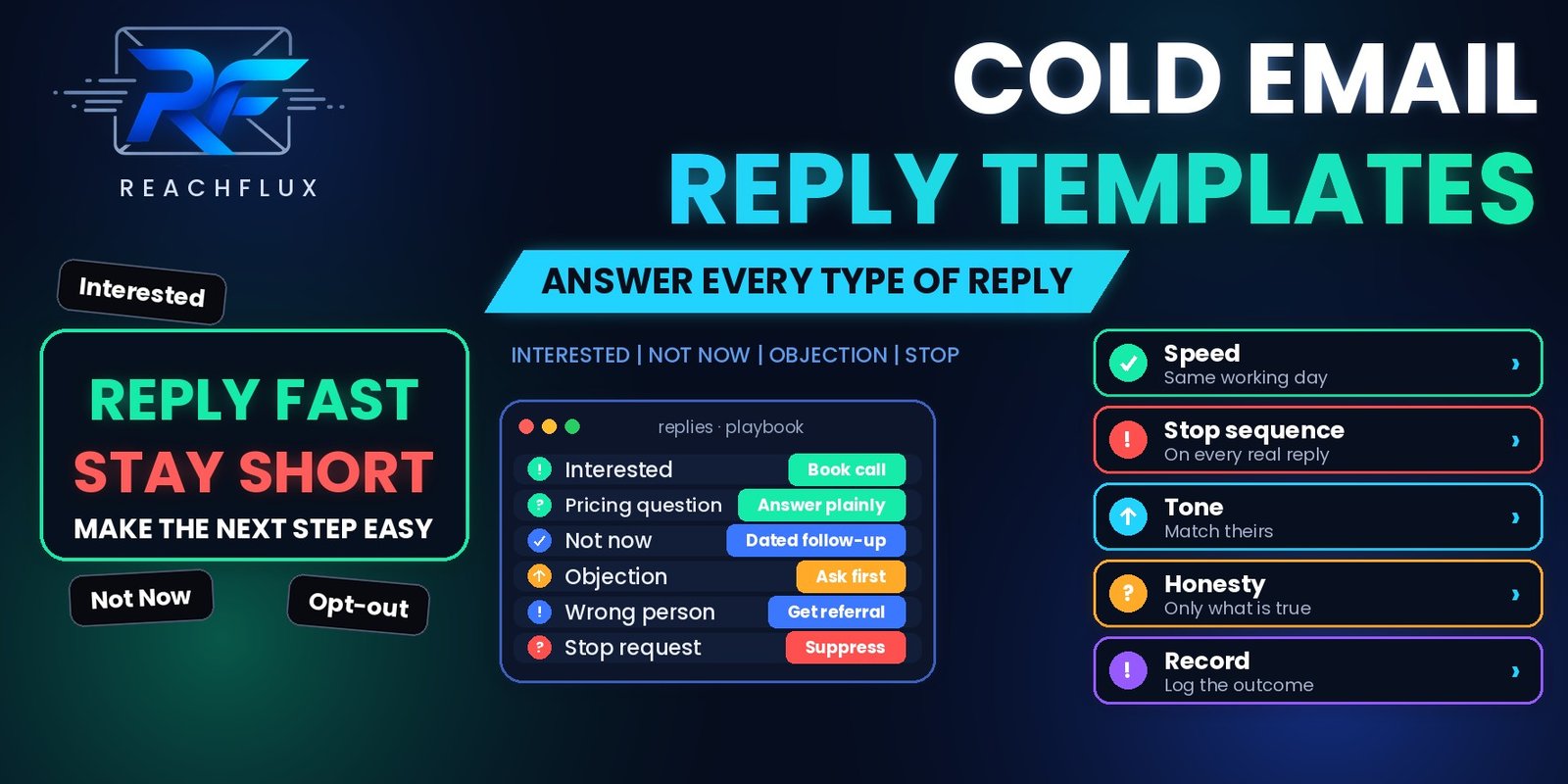
Reply quickly, briefly and in your own voice, and make the next step easy. Most replies fall into a handful of types: interested, asking for pricing or details, not now, an objection, wrong person or a referral, a request to stop, and an automatic response. Each type has a goal, and the best reply is the shortest one that moves toward it.
This guide gives you a template for each type, written with placeholders so you can adapt it, plus the principles behind them. The templates are starting points. They only work if you change them to fit the person, the conversation and your own way of writing, and if every claim in them is true.
Five principles that apply to every reply
Speed matters
Interested prospects cool quickly. Answer positive replies the same working day if you can.
Stop the sequence first
The moment a real reply arrives, stop all automated follow-ups for that contact, so no scheduled message lands after the answer.
Match their length and tone
A two-line question deserves a short answer, not a pitch. Mirror how they write.
Make the next step small
Offer one clear, low-effort option, such as two times for a call or a short summary by return.
Say only what is true
Never promise what you cannot deliver to keep a conversation going. Honesty protects both the deal and your reputation.
Reply types, goals and the shape of a good answer
| Reply type | Your goal | Shape of the answer |
|---|---|---|
| Interested | Book the conversation | Thank them, offer specific times, keep it short |
| Asking for pricing or details | Give useful information without losing the conversation | Answer plainly, then ask one question or offer a call |
| Not now | Keep the door open politely | Acknowledge, ask when to follow up, then honour it |
| Objection | Understand the concern | Ask a question before you answer |
| Wrong person or referral | Reach the right contact | Thank them, ask for the right name, mention the referral |
| Not interested or please stop | Respect the request | Confirm briefly, remove them everywhere, do not argue |
| Automatic reply | Handle correctly | Pause or delay the sequence; do not treat it as engagement |
When someone says yes or maybe
This is the moment the whole campaign exists for, so keep it simple. Thank them, confirm what they asked for, and offer a concrete next step. Offering two specific times in their time zone is usually easier to answer than a vague suggestion, and a plain booking link can sit beside it for convenience.
[Name]
Avoid the temptation to send a long explanation of everything. A short reply keeps momentum and leaves room for them to say what matters to them. If the booking path has friction, fix it, because losing a prospect after a yes is the most avoidable failure. See Cold Outreach Conversion Rates Dropping? How to Diagnose the Funnel From Sent to Booked.
When they ask for prices or information
A request for pricing is a buying signal, not a trap. Answer it plainly, with enough context that the numbers make sense, then ask a question that moves things forward. Hiding the price tends to lose people. Dumping a full catalogue tends to lose them too.
[Name]
If pricing depends on factors you need to know, say so honestly and ask for them. Do not invent a number to avoid the question.
When the timing is wrong
“Not now” is not a no. It is information about timing. Acknowledge it, ask when it would make sense to follow up, and then keep that promise. A specific, polite follow-up date turns a soft refusal into a scheduled conversation.
[Name]
Set a reminder and honour it. A follow-up that arrives exactly when you said it would builds trust. One that never arrives wastes the goodwill you earned.
When they push back
Objections are usually questions in disguise. Ask before you argue, because the stated reason is often not the real one. Keep your tone curious rather than defensive.
| They say | What it often means | How to reply |
|---|---|---|
| We already use something similar | They have a solution and need a reason to look | Ask what works well and what they would change, then mention one real difference without criticising |
| It is too expensive | The value is not clear yet, or the budget is tight | Ask what they were expecting and explain what the price covers |
| Send me more information | Mild interest, or a polite way to end the call | Send one short, relevant summary and ask a question about their situation |
| I need to check with my team | A real step in their process | Offer to help, such as a short summary they can forward |
| We do not have time right now | Timing or priorities | Acknowledge, and propose a specific later date |
[Name]
When you reached the wrong contact
A reply saying “you want someone else” is a gift. Thank them, ask who the right person is, and mention that they pointed you there. Do not email the new contact as if the first conversation never happened, and make sure the original contact stops receiving your sequence.
[Name]
Keep an owner for the account so the referral stays within one conversation, as described in How to Prevent Campaign Collisions: Stop Prospects Getting Conflicting Emails From Multiple Sequences.
When someone asks you to stop
Respect the request immediately and completely. Confirm briefly, remove them from every campaign, and add them to your suppression list so nothing can email them again. Do not argue, ask them to reconsider or send one last message. A clean, quick response protects your reputation and keeps you on the right side of the rules.
[Name]
The mechanics of honouring opt-outs everywhere are in Cold Email Compliance and Deliverability: Opt-Outs, Sender Identity and Complaint Rates and Cold Email Suppression List: What to Include, How to Build It and How to Keep It Clean.
Out-of-office and other automatic responses
Automatic replies are not conversations. An out-of-office message should normally pause or delay your sequence until the person returns, not count as engagement and not trigger a reply from you. Other automatic messages, such as delivery notices and verification requests, should be classified separately so they do not distort your reply numbers.
If your tool cannot distinguish them, review automatic replies manually and tag them. Otherwise your reply rate looks healthier than it is, and you may answer a robot.
Build a simple reply workflow
Look at fixed points in the day so nothing sits unanswered.
Use the same categories every time: interested, details, not now, objection, wrong person, stop, automatic.
Do this before you write the answer.
Adapt the template to the person, and keep it short.
Log what happened so numbers and follow-ups stay accurate.
Things to avoid in any reply
Pushing after a refusal
If someone declines, thank them and stop. Pressure turns a polite no into a complaint.
Overpromising to keep the conversation going
Never claim features, results or timelines you cannot deliver.
Pasting a wall of text
Long replies bury the one thing you want them to do.
Sounding like a template
Reusing a block of text without adapting it signals that nobody is really reading their reply.
Ignoring what they actually asked
Answer the question first, then steer the conversation.
Letting replies sit
Silence after a positive reply is the most common way interest is lost.
Reply handling checklist
- Replies are checked at fixed times and answered quickly.
- A real reply stops every sequence for that contact.
- Replies are classified the same way each time.
- Templates are adapted to the person and kept short.
- Opt-outs are honoured immediately and added to the suppression list.
- Automatic replies are handled separately from human ones.
- Not-now replies get a dated follow-up that you honour.
- Every claim in a reply is true and can be delivered.
Questions about replying to cold emails
How should I reply to a cold email response?
Reply quickly, briefly and in your own voice, stop the sequence for that contact, and offer one clear next step. Adapt the approach to the type of reply: interested, details, not now, objection, wrong person or stop.
What should I say when a prospect says not now?
Acknowledge it, ask when it would make sense to follow up, and then honour that date. A specific follow-up turns a soft refusal into a scheduled conversation.
How do I handle objections in cold email replies?
Ask a question before you answer, because the stated objection is often not the real one. Stay curious and honest, and be willing to say when you are not a fit.
How fast should I reply to an interested prospect?
As quickly as you can, ideally the same working day. Interested prospects cool fast, and slow handling is a common cause of lost opportunities.
What do I do when someone asks me to stop emailing?
Confirm briefly, remove them from every campaign immediately and add them to your suppression list. Do not argue or send a last message.
Should an out-of-office reply count as a response?
No. Treat it as an automatic message that pauses or delays the sequence, and keep it out of your reply and engagement numbers.
Reply like a person, and make the next step easy.
The best reply is short, quick and specific. Classify each response, stop the sequence, answer in your own words and offer one clear next step. Templates save time, but they only work when you adapt them.
Treat every reply, including a refusal, as a chance to leave a good impression.
Handle replies in context and move interested prospects through lead stages.
ReachFlux brings replies, conversation history and lead stages into one workflow so nothing sits unanswered.