How are cold email compliance and deliverability connected?
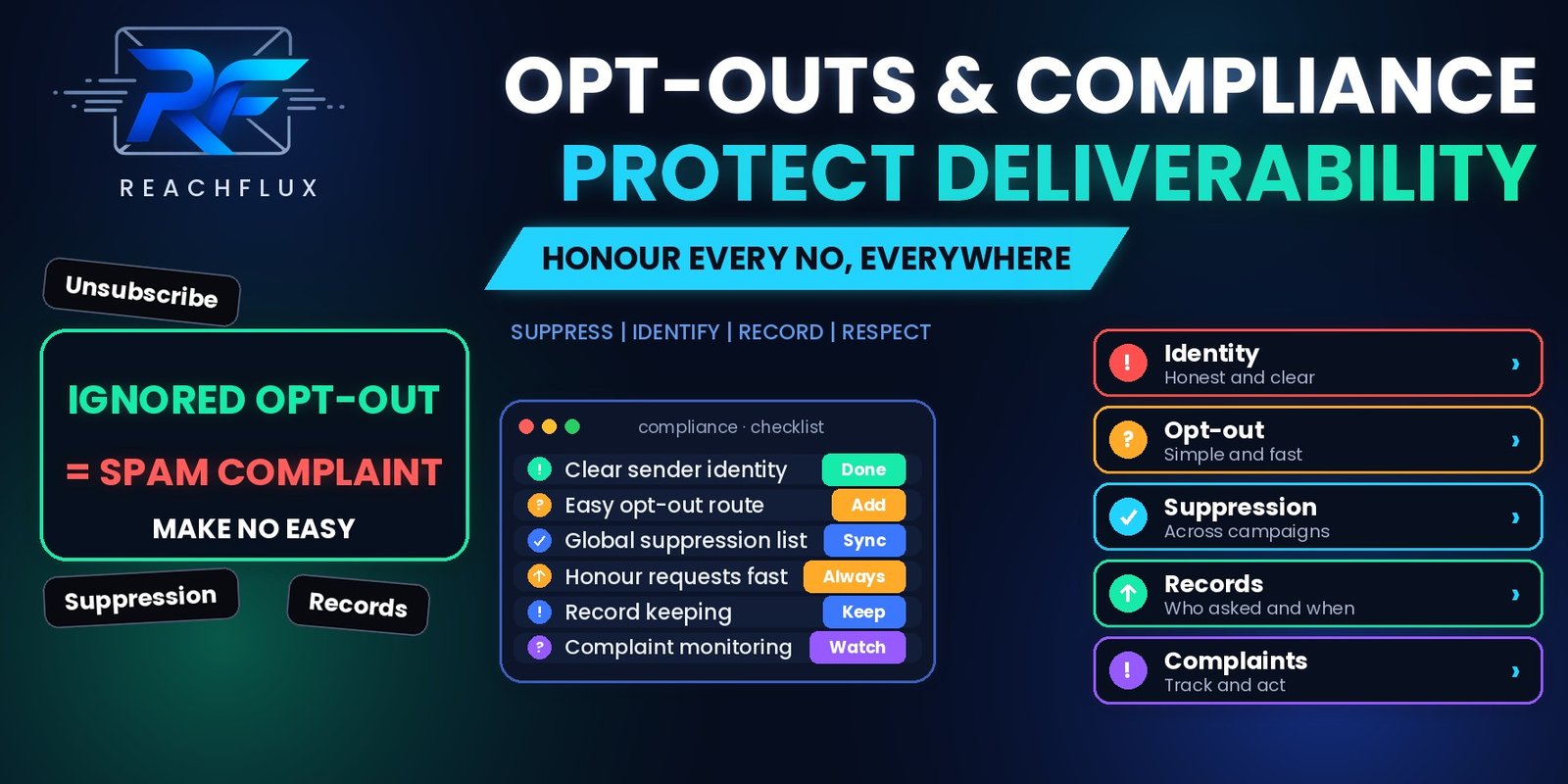
Cold email compliance and deliverability overlap almost completely in practice. Honest sender information, a clear and quickly honored opt-out, careful targeting and clean suppression handling are what regulators expect, and they are also what keep spam complaints low. Complaints are one of the strongest signals mailbox providers use when deciding where your mail goes.
That makes compliance a deliverability tool, not a legal chore. A sender who makes it easy to say no, respects the answer everywhere and writes only to relevant people will usually see fewer complaints, fewer blocks and steadier placement.
Why regulators and mailbox providers want the same things
Regulators and mailbox providers approach cold email from different directions and arrive at similar demands, because both are trying to protect recipients from unwanted or deceptive mail.
Look at what each side tends to care about. Recipients should know who is writing. They should not be tricked by a misleading subject line or header. They should be able to stop receiving mail easily, and the sender should honor that. They should not be mailed repeatedly after saying no. Every one of these is also a complaint-reduction measure.
| Practice | Compliance angle | Deliverability angle |
|---|---|---|
| Honest sender identity | Recipients can tell who is sending | Fewer "I do not know this sender" complaints |
| Truthful subject lines and headers | Avoids deceptive practice | Reduces spam reports and filter suspicion |
| Clear, working opt-out | Often a legal expectation | Gives unhappy recipients an alternative to reporting spam |
| Prompt honoring of opt-outs | Legal requirement in many places | Prevents repeat mail that drives complaints |
| Global suppression | Consistency across campaigns | Stops cross-campaign repeat sends |
| Documented data source | Supports lawful basis and requests | Encourages cleaner, more relevant lists |
When a practice appears in the right-hand column as well, it is easier to justify the time it takes to implement.
What Gmail and Yahoo expect from senders
In early 2024, Google and Yahoo began enforcing stronger requirements for bulk senders. Google defines a bulk sender as one that sends close to 5,000 or more messages a day to Gmail addresses, though some basic requirements apply to everyone sending to Gmail.
- Authentication: SPF or DKIM for all senders to personal Gmail accounts, and SPF, DKIM and DMARC for bulk senders.
- One-click unsubscribe: bulk senders of commercial or promotional mail are expected to support one-click unsubscribe and honor requests within about two days.
- Low spam rates: Google recommends keeping the Postmaster Tools spam rate below 0.1 percent and avoiding 0.3 percent or higher; Yahoo expects complaint rates below 0.3 percent.
- Valid forward and reverse DNS, and proper formatting: basic technical hygiene that makes your mail look like it belongs.
Many cold senders fall below the bulk threshold on any single provider, but the logic applies regardless of size. Providers watch complaints and engagement, not only volume, and a small sender with a high complaint rate still looks like a problem.
Provider requirements evolve, so confirm current rules in each provider's official sender guidelines rather than relying on a summary, including this one.
For the authentication basics, see SPF vs DKIM vs DMARC: What Cold Email Senders Need to Know.
Seven practices that protect compliance and deliverability
1. Identify yourself clearly
Use a real sender name and a signature with your company, role and website. A message whose sender cannot be understood within seconds is far more likely to be reported. Keep header information accurate and consistent with the domain you send from.
2. Write truthful subject lines
A subject that promises something the message does not deliver may earn an open and cost you a complaint. Keep it relevant and honest.
3. Make opt-out obvious and easy
Include a plain, readable way to decline, and recognize replies like "stop", "remove me" or "unsubscribe" as opt-outs even when they arrive as free text. An easy exit reduces the temptation to hit the spam button.
4. Honor opt-outs fast and everywhere
Add the address to a global suppression list that applies to every campaign, mailbox and sending domain, and make sure sequences stop immediately. Many regimes set a maximum time to honor requests, and faster is better in every case.
Shared suppression across campaigns is covered in How to Manage Multiple Cold Email Campaigns Without Losing Control.
5. Target relevant recipients only
Relevance is the best complaint-prevention tool there is. If you cannot explain why a recipient might care, they should not be in the list.
6. Record where each contact came from
Keep a note of the source and date for every contact. It helps you answer data requests, evaluate sources and remove people quickly when asked.
7. Track complaints and act on them
Where feedback loops or reporting tools exist, use them, and treat every complaint as a reason to review targeting, frequency and message. A rising complaint rate is an early warning, not a statistic.
Handling opt-outs properly: wording, replies and suppression
The mechanics of opt-out handling are where good intentions most often fail. Three details make the difference.
Keep the opt-out wording plain
A simple, readable line works better than a legal-sounding paragraph or a tiny link buried in a footer. Examples of clear approaches are a brief sentence inviting the person to reply with a request to stop, or a visible unsubscribe link. Choose a method you can actually process reliably.
Recognize free-text opt-outs
People rarely use the exact word you expect. Replies like "stop", "please remove me", "not interested, do not contact again" or an angry one-liner are all opt-outs. Make sure your reply handling flags them, ends the sequence and adds the address to suppression automatically, rather than leaving it to someone to notice.
Apply suppression globally and permanently
Suppression should cover every campaign, mailbox and sending domain, and it should survive tool changes and list imports. A common failure is re-importing an old list that still contains someone who opted out. Check every import against suppression before it enters a sequence.
| Opt-out scenario | What should happen | Common failure |
|---|---|---|
| Recipient clicks unsubscribe | Immediately suppressed everywhere | Only suppressed in one campaign |
| Recipient replies "remove me" | Detected, sequence stopped, suppressed | Treated as a normal reply and followed up |
| Recipient complains via a feedback loop | Suppressed and the campaign reviewed | Complaint ignored |
| Old list re-imported | Checked against suppression first | Opted-out contacts emailed again |
| Colleague at the same company opts out | Review whether to contact others there | Whole company contacted again regardless |
What to do when complaints rise
A rising complaint rate is the earliest signal that targeting or frequency is hurting recipients. Respond to it like an incident.
Stop sending to the audience or sender producing complaints while you investigate.
Check whether complaints cluster by segment, message, sender, sequence step or data source.
Tighten targeting, shorten the sequence, improve the opt-out or retire the data source behind the complaints.
Make sure each complaining address is suppressed everywhere.
Restart at lower volume and watch the signals closely before returning to normal.
If complaints are part of a broader reputation problem, follow the recovery steps in Cold Email Domain Reputation: How to Protect It and Recover When It Drops.
Why one-size-fits-all compliance does not work
Cold email rules are not uniform, and mistakes tend to come from assuming they are.
- In the United States, the main federal rule for commercial email focuses on truthful headers and subject lines, a valid physical postal address, a clear opt-out and honoring opt-outs promptly.
- In the European Union and the United Kingdom, data protection law and separate electronic communications rules apply, and the treatment of business addresses differs between countries and between corporate and individual subscribers.
- Some countries require prior consent even for B2B email, while others allow outreach with identification and opt-out.
- Canada and several other regions have their own consent-based frameworks with their own penalties.
The practical consequence is that an international campaign needs a market-by-market view. Segment by country, apply the strictest sensible standard to unclear cases and take advice for markets where you are unsure. It is far cheaper than discovering the rule after a complaint.
A compliance and deliverability checklist for every campaign
- Sender name, signature and domain clearly identify the company.
- Subject line and headers are truthful.
- A clear opt-out is included and tested.
- Free-text opt-out replies are detected and processed.
- Opt-outs go to a global suppression list.
- Every contact has a recorded source and date.
- Complaints and opt-out rates are reviewed weekly.
- Each market has been checked against local rules.
ReachFlux helps with the operational side: suppression handling, reply processing and activity tracking sit in the same workflow, so honoring an opt-out in one place takes effect everywhere. It supports good practice but does not replace legal advice.
For the broader pre-send review, use Cold Email Deliverability Checklist: 25 Things to Check Before Sending.
Questions about cold email compliance and deliverability
Is cold email legal?
It depends on where you and your recipients are and on how you do it. Many jurisdictions allow B2B outreach with conditions such as honest sender identification and a working opt-out, while others require prior consent. Rules differ widely, so confirm the requirements for each market with qualified advice.
What must a cold email include to be compliant?
Requirements vary, but common expectations include accurate sender and header information, a subject line that is not deceptive, a way to identify who is sending, and a clear, working way to opt out that you honor promptly. Some regions also require a postal address. Check the rules for your specific audience.
Does a one-click unsubscribe affect deliverability?
It can help. Google and Yahoo require one-click unsubscribe for bulk senders of promotional mail, and a clear opt-out in general reduces the chance recipients hit the spam button instead. Easy opt-outs lower complaint rates.
What spam complaint rate is acceptable?
Google asks senders to keep their reported spam rate below 0.1 percent and to avoid reaching 0.3 percent, and Yahoo sets similar expectations for bulk senders. Treat those as limits to stay well away from, not targets to approach.
Do I need a global suppression list?
Yes. An opt-out should apply across every campaign, mailbox and sending domain. Honoring it in one campaign while another keeps emailing the same person is a common cause of complaints.
Does this article count as legal advice?
No. It explains how common compliance practices connect to deliverability. Laws differ by country and change over time, so get qualified legal advice for your situation.
Treat the opt-out as a feature, not a risk.
Many senders hide the opt-out because they fear losing contacts. It works the other way. Recipients who cannot leave quietly will leave loudly, and loud exits are what damage sender reputation.
Identify yourself honestly, make saying no easy, honor it everywhere and target people who might actually care. You will meet most compliance expectations and give your campaigns the steadier placement that comes from low complaints.
Keep suppression, replies and campaign activity in one workflow.
ReachFlux helps teams handle opt-outs and replies consistently across campaigns and senders.