What laws apply to cold email?
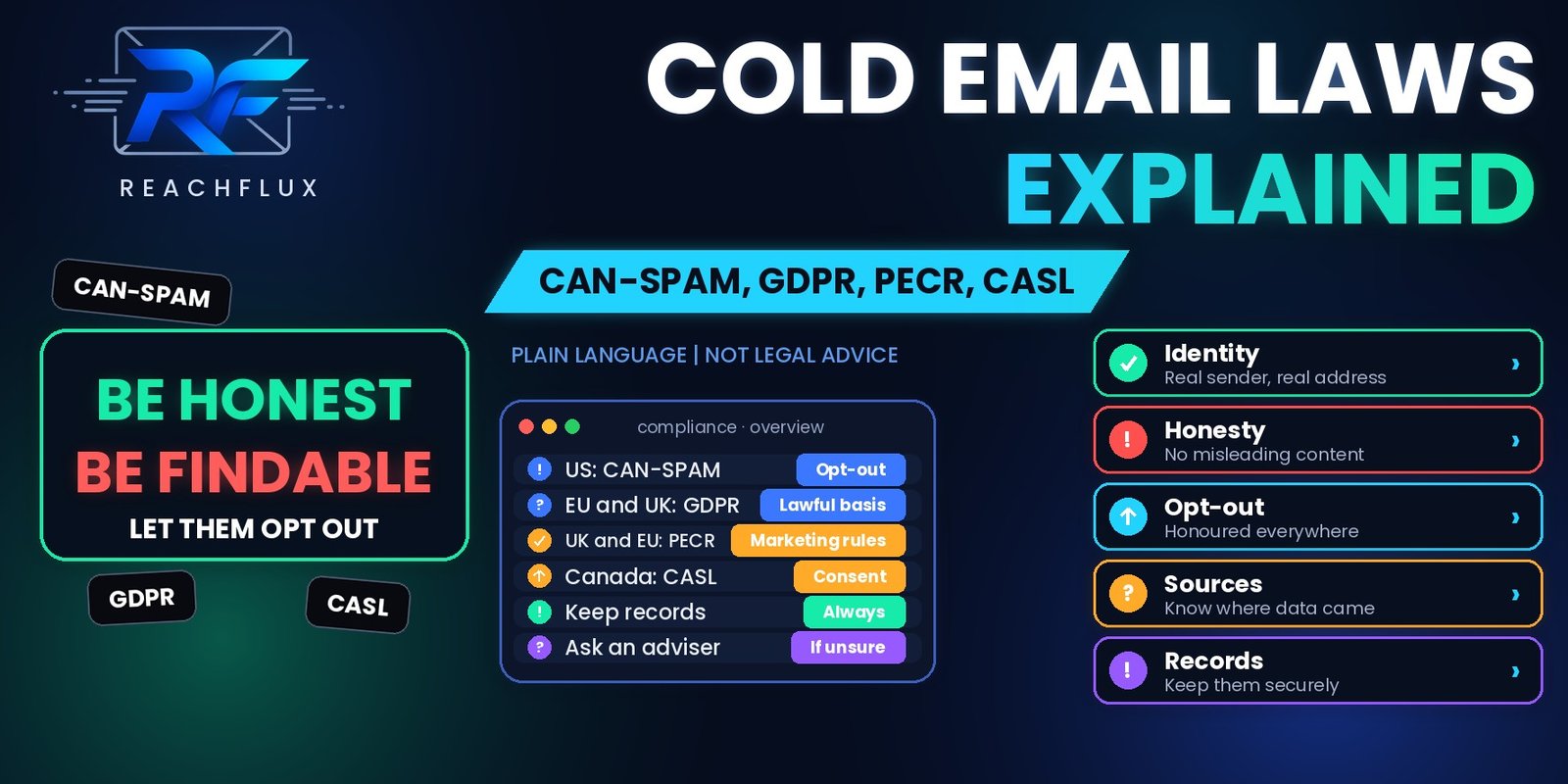
It depends on where you and your recipients are. In the United States, CAN-SPAM allows commercial email without prior consent but requires honest headers and subject lines, a physical address and a working opt-out. In the European Union and the United Kingdom, privacy and electronic marketing rules, including GDPR and PECR, add requirements around lawful basis, transparency and consent, and they treat business recipients differently depending on the type of organisation. In Canada, CASL generally requires consent, either express or implied, before sending commercial messages.
This guide is a plain-language overview, not legal advice. Rules change, differ between countries and have exceptions, so check the requirements for your own markets and ask a qualified adviser if you are unsure. The good news is that a handful of habits keep you in good shape almost everywhere, and they also help deliverability.
The main frameworks side by side
| Framework | Where it applies | Core idea for cold email |
|---|---|---|
| CAN-SPAM | United States | No prior consent needed for commercial email, but you must be honest, identify yourself, include a postal address and honour opt-outs |
| GDPR and UK GDPR | EU and UK, when processing personal data | You need a lawful basis, must be transparent about your use of data and must respect objections |
| PECR and ePrivacy rules | UK and EU member states | Rules on electronic marketing, often differing for companies and individuals |
| CASL | Canada | Generally consent-based, with express and implied consent categories, plus identification and unsubscribe requirements |
| Spam Act | Australia | Consent-based, with identification and unsubscribe requirements |
CAN-SPAM in plain language
CAN-SPAM covers commercial email, including business-to-business messages. It does not require recipients to opt in first, which is why cold email is lawful in principle in the United States. But it sets clear rules, and the penalties for breaking them can be substantial.
Do not use false or misleading headers
The From, To and routing information must be accurate and must identify the sender.
Do not use deceptive subject lines
The subject must reflect the content. Fake replies and misleading claims can breach this. See Cold Email Subject Lines: How to Write Them, Test Them and Avoid the Traps.
Identify the message where required
Commercial messages should be clearly identifiable as such, in a way that suits the context.
Include a valid physical postal address
Recipients should be able to see where the sender is located.
Offer a clear opt-out and honour it promptly
The opt-out must work, and requests must be processed within a short statutory period, commonly ten business days.
GDPR, UK GDPR and PECR
GDPR and its UK counterpart apply when you process personal data about people in those regions, and a named work email address is personal data. To use it, you need a lawful basis. Many businesses rely on legitimate interests for relevant business-to-business outreach, but that requires a documented balancing of your interests against the individual’s rights, transparency about who you are and where you got their data, and a simple way to object.
Electronic marketing rules sit alongside this. In the UK, PECR generally treats limited companies differently from individuals and some other business types, with stricter consent expectations for the latter. Rules in EU member states vary. Because of that variation, check the specific country and recipient type before you send, and keep records of your reasoning and sources.
CASL in plain language
Canada’s anti-spam law is among the strictest. It generally requires consent before you send a commercial electronic message. Consent can be express, where the person has clearly agreed, or implied in certain situations, such as an existing business relationship or, with conditions, where the recipient has publicly published their address without a no-solicitation notice and your message is relevant to their role.
Messages must identify the sender and include an unsubscribe mechanism that is honoured within a short period. Penalties can be significant, and records of consent matter. If you send to Canadian recipients, take extra care and seek advice before launching a campaign.
Other places have their own rules
Australia, New Zealand and many other countries have anti-spam or privacy laws, and several are consent-based. Some regions regulate specific sectors more tightly. Where you send, who you send to and what you are selling can all change what is required. If you contact people internationally, identify the strictest rules that apply to your audience and use them as your default.
Do not assume that because something is common practice, it is permitted. Check, and keep a record of what you checked.
Habits that keep you in good shape almost everywhere
Use a real sender name, accurate headers and a signature that identifies you and your company.
Never mislead about the nature of the message, your relationship or your claims.
Make it simple for people to say no, and process requests promptly and everywhere. See Cold Email Compliance and Deliverability: Opt-Outs, Sender Identity and Complaint Rates.
Apply it to every campaign and tool. See Cold Email Suppression List: What to Include, How to Build It and How to Keep It Clean.
Record the source and date, and use only data you are entitled to use. See How to Build a Cold Email Prospect List: Sources, Research and Validation.
Contact people for whom your message is genuinely relevant to their role.
Keep records you could show if asked
If a regulator or a recipient asks questions, records are your best protection. Keep a note of the source and date of each contact, your reasoning for contacting them, the content of your messages, opt-out requests and when you processed them. A simple, organised record is far better than reconstructing events later.
Keep personal data secure and only as long as you need it, subject to the retention rules that apply to you. The suppression data itself is an exception, since you need it to avoid contacting someone who has asked you to stop.
Some sectors and situations need extra care
Regulated industries, such as financial services and healthcare, often have additional rules on marketing communications, record keeping and the claims you can make. Public sector recipients, and individuals contacted at personal addresses, can also raise different issues. If you operate in or sell to such a sector, involve your compliance lead early, as discussed in Why Do My Finance Cold Emails Keep Landing in Spam? 9 Causes and Fixes for Financial Services Outreach.
Myths about cold email and the law
“B2B email is always exempt”
Some rules treat business email differently, but not universally, and personal data in a work address can still be regulated.
“If it is public, I can use it”
Public availability does not remove your obligations about how you use someone’s data.
“An unsubscribe link makes everything legal”
It is one requirement among several, and not every framework works that way.
“Small senders are never checked”
Complaints can come from any recipient, and rules apply regardless of size.
“Buying a list transfers the permission”
Purchased data does not automatically carry consent, and you remain responsible for your use of it.
Compliance habits checklist
- You know which countries your recipients are in and which rules apply.
- Sender identity, headers and subject lines are accurate and honest.
- Every message includes a physical address and a working opt-out.
- Opt-outs are honoured promptly and across all campaigns.
- You can explain where each contact came from and why you contacted them.
- Sensitive sectors and the strictest applicable rules are handled with extra care.
- Records of sources, messages and opt-outs are kept securely.
- You have asked a qualified adviser about any market you are unsure of.
Questions about cold email and the law
Is cold email legal?
In many places it is lawful if you follow the rules, but the rules vary. The US allows commercial email without prior consent under CAN-SPAM if you are honest and offer an opt-out. Canada and some other countries are more consent-based, and the EU and UK add privacy requirements. Check the rules for your markets.
Does CAN-SPAM apply to B2B cold email?
Yes. It applies to commercial email in general, including business-to-business messages, requiring honest headers and subject lines, a physical address and a working opt-out.
Does GDPR apply to business email addresses?
It can. A named work email address is personal data, so processing it needs a lawful basis, transparency and respect for objections when GDPR or UK GDPR applies.
Do I need consent to cold email in Canada?
Generally yes. CASL requires express or implied consent before sending commercial electronic messages, with identification and unsubscribe requirements. Seek advice if you contact Canadian recipients.
What is the safest approach to cold email compliance?
Be honest about who you are, avoid misleading content, include a physical address and a working opt-out, keep one suppression list, know where your data came from and follow the strictest rules that apply to your audience.
Is this guide legal advice?
No. It is a general overview. Laws vary and change, so confirm the requirements for your situation with a qualified professional.
Be honest, be findable and make it easy to say no.
The details differ, but the spirit is consistent: tell people who you are, do not mislead them, give them a clear way out and respect their choice. Keep records, use data you are entitled to use and follow the strictest rules that apply to your audience.
When in doubt, ask a qualified adviser before you send.
Prepare recipients, validate lists and manage replies in one workflow.
ReachFlux helps you prepare and validate lists and manage replies, while you remain responsible for compliance in your markets.