How do you build a good cold email prospect list?
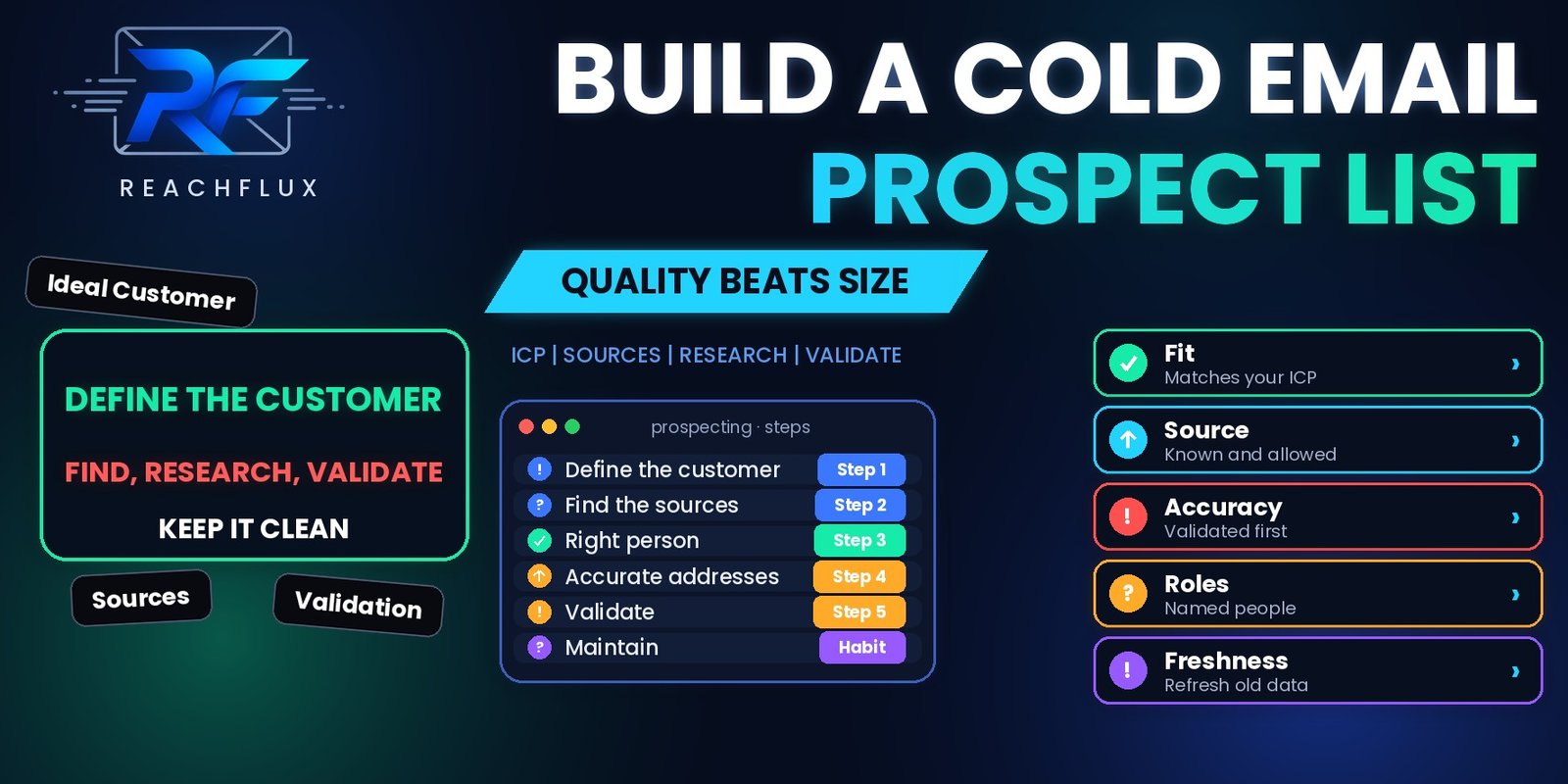
Start with a clear ideal customer, find sources where businesses have already signalled they fit, research the right person at each company, validate every address and keep the list clean over time. Quality matters far more than size. A smaller list of well-matched, current contacts produces more replies and fewer bounces than a large list built from stale or irrelevant data.
Most deliverability and conversion problems begin at this stage. A poor list damages sender reputation through bounces and complaints, and a poorly matched one produces silence even when the email is excellent. This guide walks through the process step by step, including where to look, how to research and how to validate.
Define your ideal customer in plain terms
Write down who you want to reach: the type of business, size, location, situation and the role of the person who feels the problem. The more specific you are, the easier every later step becomes. “Operations teams at mid-sized logistics firms planning to expand” is workable. “Businesses that need efficiency” is not.
Also write down who you do not want to reach, such as existing customers, competitors and businesses outside your market. Those exclusions belong on your suppression list from the start, as described in Cold Email Suppression List: What to Include, How to Build It and How to Keep It Clean.
Where to find prospects
| Source | What it gives you | Cautions |
|---|---|---|
| Your own website enquiries and customers | People who already know you | Respect consent and avoid contacting current customers with outreach |
| Industry directories and associations | Lists of relevant businesses | Check terms of use and data freshness |
| Competitor and peer stockist or customer pages | Businesses that buy products like yours | Use public information only and do not misrepresent |
| Trade shows and event listings | Companies active in your market | Respect the event’s terms on using attendee data |
| Company websites and public announcements | Context for personalization | Takes time, so reserve for higher-value accounts |
| Professional networks and public profiles | Roles and context | Follow the platform’s terms and applicable rules |
| Specialist data providers | Large volumes quickly | Quality varies. See Why Do Half of Your Prospect Emails Bounce? Fixing Bad Data From Paid Databases and LinkedIn |
Find the right person at each company
A relevant company is not enough. You need the person who feels the problem or can decide about it. Look at the company’s own team page, public announcements and professional profiles to find the right role. Prefer named individuals over shared addresses such as info or sales, which are more likely to produce complaints and rarely reach a decision maker.
For larger companies, you may want more than one contact, but be careful not to contact many people at once. Set per-company limits and coordinate who writes to whom, as explained in How to Prevent Campaign Collisions: Stop Prospects Getting Conflicting Emails From Multiple Sequences.
Get accurate email addresses
Addresses should come from sources you trust. Guessing patterns from a company’s known format is common but risky, because a wrong guess bounces, and a pattern that works at one company often fails at the next. If you do infer addresses, validate them before sending, and treat uncertain ones cautiously.
Never scrape or collect addresses in ways that breach the source’s terms or the rules of your market. Where an address came from matters, both for accuracy and for your ability to explain your outreach if asked. Record the source for each contact.
Validate before you send
Remove addresses with typos and domains that do not exist.
Use a validation step to detect addresses that appear invalid or risky. It reduces bounces but cannot catch everything. See Why Do Verified Emails Still Bounce? 11 Reasons Verification Misses Bad Addresses.
Treat catch-all domains and role addresses with extra caution, or exclude them.
Check against your suppression list so nobody who opted out is included.
Group contacts by situation so each message can be relevant.
Judge the list on quality, not size
| Measure | What good looks like |
|---|---|
| Fit | Most contacts match your ideal customer description |
| Freshness | Data is recent, and you know the source and date |
| Accuracy | Bounce rate stays low after validation. See Cold Email Bounce Rate: What’s Too High, Why It Happens & How to Reduce It |
| Role match | Contacts are named people in relevant roles |
| Cleanliness | No duplicates, suppressed contacts or obvious role addresses |
| Segmentation | Contacts are grouped so messages can be specific |
Building a list for a niche offer
Imagine a small software company selling shift-scheduling tools to independent care homes. They define the ideal customer as independent care homes with more than one site. They find candidates through a regulator’s public register and a trade association directory, narrowing by size and location. They then check each home’s website to identify the manager or operations lead, record the source for each contact and validate every address.
The final list has a few hundred contacts instead of thousands, each with a reason to be there. They segment it into homes with two sites and homes with three or more, because the opening line will differ. Because every contact is relevant, the team can write short, specific emails and expect low bounces. Quality did the work that volume could not.
Lists decay, so maintain them
People change jobs, companies restructure and domains change. A list that was good three months ago is a different list today. Refresh older segments before reuse, re-validate addresses and remove bounced and unresponsive contacts. Update the suppression list after every campaign.
Keep a simple record of when each contact was added and where it came from, so you can see which sources produce good results and drop the ones that do not. The same discipline applies to the operating routine in Cold Email Operating Rhythm: Daily, Weekly and Monthly Routines for Managing Outreach at Scale.
Respect the rules and the people
Collecting and using contact data is regulated in many places, and rules differ by country and by the type of data. Use sources you are entitled to use, be able to explain where each contact came from, and honour opt-outs. This is not legal advice, so check what applies in your market. An overview of the main frameworks is in Cold Email Laws Explained: CAN-SPAM, GDPR, PECR and CASL in Plain Language.
Budget your research time realistically
Researching a list takes longer than most people expect. A few minutes per contact for top-tier accounts adds up quickly, so decide in advance how much time you will spend per tier and stick to it. If research for a contact takes more than a few minutes and yields nothing useful, move on. Time spent on weak-fit accounts is better spent on the strongest ones.
Prospecting mistakes that cost you replies
Building the list before defining the customer
You end up with contacts that fit nothing in particular.
Prioritising size over fit
A big list of poor matches produces bounces and silence.
Skipping validation to save time
The time saved is repaid in bounces and reputation damage.
Losing track of sources
Later you cannot explain, refresh or improve the list. See How Did You Get My Email? How to Answer This Cold Email Reply and Prevent It.
Never refreshing old data
People move on, and old addresses bounce.
Prospect list checklist
- You have a written description of the ideal customer and who to exclude.
- Every contact comes from a source you can identify and are entitled to use.
- Contacts are named people in relevant roles, not shared addresses.
- Addresses are validated, and risky ones are handled or excluded.
- Duplicates and suppressed contacts are removed before import.
- The list is segmented so messages can be specific.
- Each contact records its source and date.
- Older segments are refreshed before reuse.
Questions about building prospect lists
How do I build a cold email prospect list?
Define your ideal customer, find sources where businesses have signalled they fit, identify the right person at each company, get accurate addresses, validate them and segment the list. Quality matters more than size.
Where can I find prospects for cold email?
Your own enquiries, industry directories and associations, peer stockist or customer pages, trade show listings, company websites and public announcements, professional networks and specialist data providers, each with its own cautions.
Is it okay to guess email addresses?
It is risky. Wrong guesses bounce, and patterns differ between companies. If you infer addresses, validate them before sending and treat uncertain ones cautiously.
Should I buy a prospect list?
Be cautious. Purchased data decays, bounces and attracts complaints, and its source may be unclear. If you use a provider, validate everything and check how the data was collected.
How big should my prospect list be?
Big enough to learn from, small enough to be relevant. A smaller, well-matched list usually outperforms a large one, because it produces more replies and fewer bounces.
How often should I refresh my prospect list?
Regularly. Contact data decays as people change roles, so refresh and re-validate older segments before reusing them.
A smaller, better list beats a bigger, older one.
Prospecting is the quiet foundation of outreach. Define who you want, find them where they have signalled fit, research the right person, validate every address and keep the list fresh.
Do that, and the rest of your outreach, from copy to deliverability, becomes much easier.
Import, detect and validate your own lead lists in one workflow.
ReachFlux works from the lead data you already own, with CSV and Excel import and email validation before sending. It does not supply a contact database.