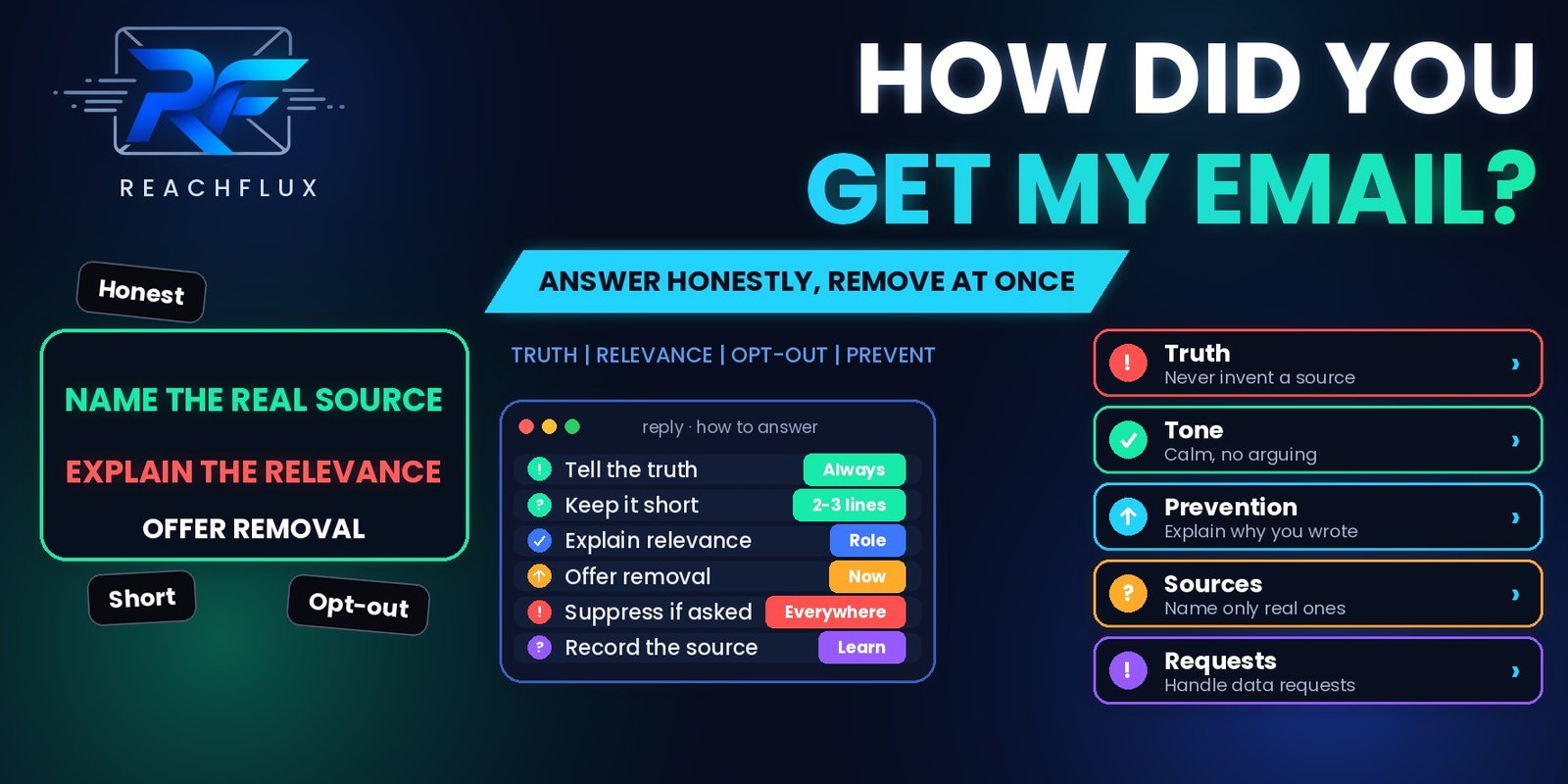
How should you answer “How did you get my email?”
Answer honestly, briefly and without defensiveness. Say where you found the address, why you thought it was relevant to them, and offer to remove them straight away. The question is rarely a request for information. It is usually a mix of curiosity, mild irritation and a test of whether you are trustworthy, and a calm, truthful answer turns most of those into either a conversation or a clean exit.
The best defence is prevention. If your outreach explains why you are writing to this person, uses data from sources you can name and respects opt-outs, the question comes up less and is easy to answer when it does. This guide gives you reply templates, the principles behind them and ways to make your outreach transparent.
What the person is really asking
| The tone behind the question | What they usually want | How to respond |
|---|---|---|
| Curious | To understand how you found them | Explain simply and move to why you wrote |
| Mildly annoyed | Reassurance that this is legitimate | Be honest, brief and offer removal |
| Suspicious or alarmed | To know whether their data is safe or misused | Be transparent, apologise for any worry and remove them promptly |
| Testing you | To see whether you are honest | Tell the truth, plainly |
Five principles for the reply
Tell the truth
Name the real source, such as a public company page, a directory or a professional profile. Never invent one.
Keep it short
A long defence sounds defensive. Two or three lines are enough.
Explain the relevance
Say why you thought the message mattered to their role.
Offer removal immediately
Make it easy to opt out, and then honour it everywhere.
Do not argue
You are not trying to win. You are trying to be honest and respectful.
Reply templates, with placeholders
Adapt these to your situation. They only work if the source you state is the real one.
[Name]
[Name]
[Name]
What to do after you reply
Pause any scheduled follow-ups for that contact immediately.
Add them to your suppression list so no campaign can email them again. See Cold Email Suppression List: What to Include, How to Build It and How to Keep It Clean.
Note where the address came from, so you can learn which sources cause friction.
If many people ask this, the source or the opening line needs attention.
Two replies to the same question
Imagine two senders receive the same message: “How did you get my email?” The first replies, “We have a database of business contacts, and you were on it. Let me know if you would like to talk.” It is vague, a little defensive and gives the reader no reason to trust the sender. The second replies, “I found your details on your company’s team page and wrote because you lead operations there. If you would rather not hear from me, tell me and I will remove you straight away.”
The second answer names a real, checkable source, links it to the person’s role and offers removal immediately. It is also more likely to get a friendly response, or at least no complaint. The difference is not clever phrasing. It is that the second sender actually knew where the address came from.
Make your outreach easy to explain
People ask how you got their email when the message gives no clue why they are receiving it. A single honest line in the opening, such as the specific, relevant reason you chose this person, removes most of the mystery. Being specific about role and relevance also shows that you did not simply blast a list.
Alongside that, keep records of where each contact came from, as described in How to Build a Cold Email Prospect List: Sources, Research and Validation. If you cannot trace a contact to a legitimate, explainable source, do not email them.
Say who you are and how to opt out
Identify yourself clearly, with a real name, company and signature, and include an easy way to opt out. In many places this is a legal expectation, and in all places it builds trust. The rules differ by country, and an overview is in Cold Email Laws Explained: CAN-SPAM, GDPR, PECR and CASL in Plain Language, with practical opt-out mechanics in Cold Email Compliance and Deliverability: Opt-Outs, Sender Identity and Complaint Rates.
Know which sources are safe to name
Public company websites and directories
Easy to name and usually uncontroversial.
Industry associations and event listings
Fine when you respect their terms and the event rules.
Professional profiles
Acceptable to mention when you follow the platform terms and keep the message relevant.
Purchased lists
Hard to explain. If you cannot name where the data came from, the question becomes a problem. See Why Do Half of Your Prospect Emails Bounce? Fixing Bad Data From Paid Databases and LinkedIn.
Guessed addresses
You cannot honestly say where it came from. Avoid or validate carefully.
When the question is a data request
In some regions, people have a right to ask what data you hold about them and where you got it. If the message sounds like a formal request, treat it seriously. Respond within the time your local rules require, give an accurate account of the source and respect any request to delete or object. This is not legal advice, so involve a qualified adviser if you receive a formal request you are unsure about.
Opening lines that explain why you are writing
Name the role
“I am writing to you because you lead [function] at [company].”
Name the trigger
“I saw that [company] recently [specific change], which is why I thought of you.”
Name the shared situation
“Teams like [company] often deal with [problem], so I wanted to check whether it applies to you.”
State the purpose honestly
“I am reaching out about [topic], and I would value your view.”
Transparency checklist
- You can name the source of every contact you email.
- The first email explains why this person was chosen.
- Your sender name, company and signature are clear and real.
- A simple opt-out is included and honoured everywhere.
- Replies to this question are honest, short and calm.
- Contacts who object are suppressed immediately.
- Sources that cause friction are reviewed or dropped.
- Formal data requests are handled promptly and properly.
Questions about how you got their email
How should I answer how did you get my email?
Tell the truth briefly. Name the real source, explain why you thought it was relevant to their role and offer to remove them immediately. Do not invent a source or argue.
What if I cannot remember where I got an address?
Treat it as a warning. If you cannot trace a contact to a legitimate, explainable source, remove it and do not email it again.
Should I apologise when someone asks how I got their email?
A brief, genuine apology for any concern is usually appropriate, especially if they sound upset, followed by prompt removal.
How can I prevent people asking how I got their email?
Explain in the opening why you chose them, use sources you can name and keep records of where each contact came from.
Is it okay to use professional profiles to find contacts?
Often, if you follow the platform’s terms and the rules of your market, and keep the message relevant. Be ready to say where you found them.
What if the person sends a formal data request?
Take it seriously. Respond within the time your local rules require, give an accurate account of the source and respect any request to delete or object. Seek advice if unsure.
If you cannot name the source, do not send.
Honesty is both the right answer and the best strategy. Name the real source, explain the relevance, offer removal and act on it. Better still, make your outreach transparent enough that the question rarely arises.
Keep records, respect opt-outs and drop any source you cannot explain.
Prepare lists from data you own and manage replies in one place.
ReachFlux works from the lead data you already own, so you stay in control of where contacts come from.