How do you write a good cold email subject line?
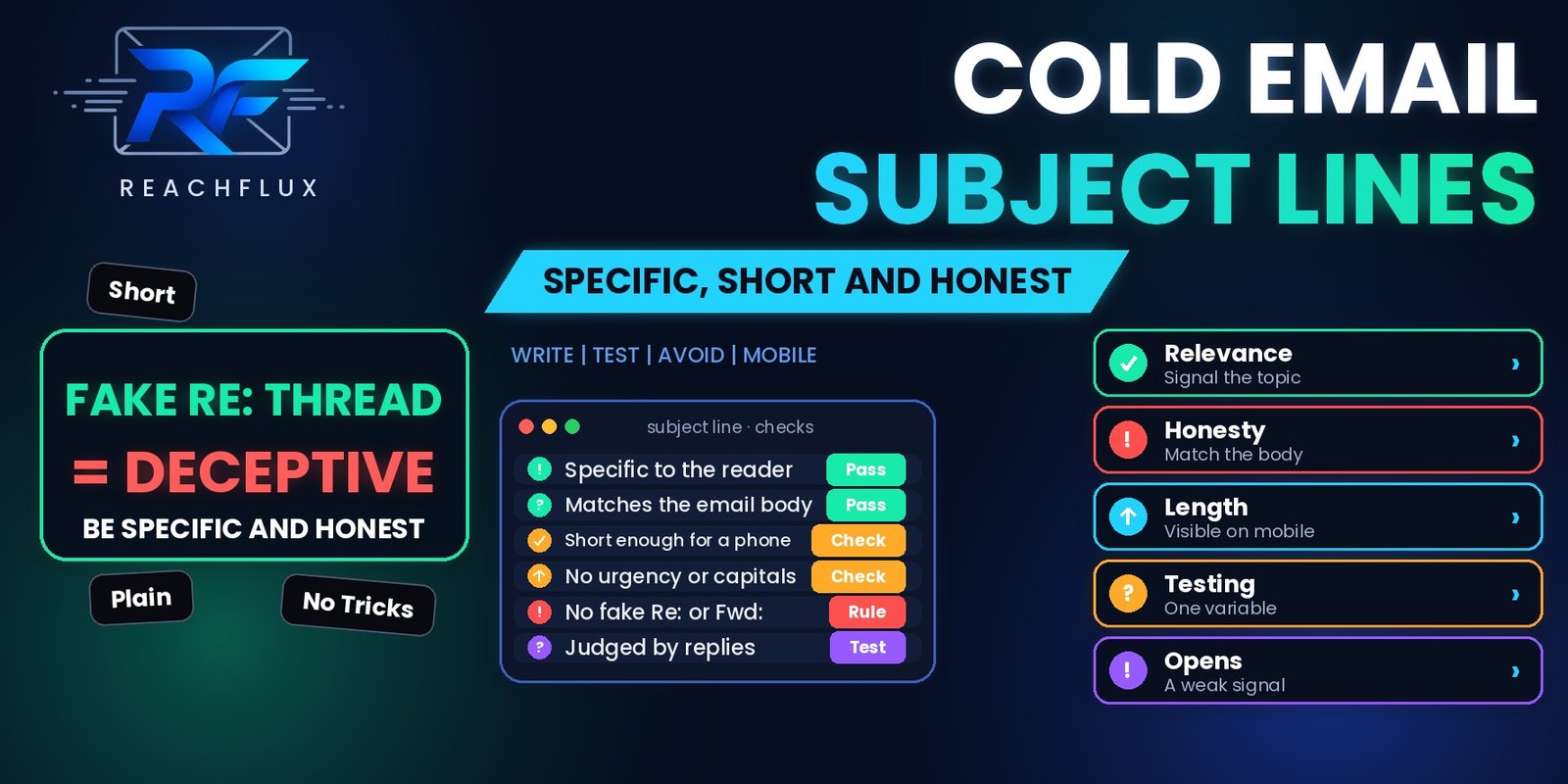
Write a subject line that is short, specific to the reader and honest about what is inside. It should tell the right person what the email concerns, match the body of the message, and avoid anything that looks like a trick, such as fake replies, urgency or capital letters. Its job is to signal relevance and earn a read, not to disguise a pitch.
Be careful about measuring it. Open rates are unreliable because privacy features and link scanning can record opens that no person made, so judge subject lines by replies over the whole sequence. This guide covers the principles, patterns you can adapt with placeholders, habits to avoid and how to test properly.
What a subject line is actually for
A subject line has three jobs. It tells the reader what the message concerns, so the right person recognises relevance. It sets an expectation that the body must meet. And it is part of what filters and people use to judge the sender, alongside the From name and the first line of the email.
It does not need to be exciting. Most business recipients are scanning a full inbox on a phone, and a plain, specific line that reads like internal or peer correspondence tends to fit that environment better than a promotional hook.
Seven principles for subject lines
Be specific
Name the topic or the reader’s situation. A vague line gives no reason to open.
Keep it short
Many people read on a phone, where long lines are cut off. Put the most important words first.
Sound like a person
Plain language reads like correspondence. Marketing language reads like a promotion.
Match the body
The email must deliver what the subject suggests. A mismatch is the fastest route to a complaint.
Avoid tricks
No fake replies, forwarded markers, false urgency or invented relationships.
Keep formatting calm
Avoid capital letters, repeated punctuation and heavy symbols.
Do not rely on personalization tokens alone
A subject that only inserts a name or company is a template, and broken fields look worse.
Patterns you can adapt, with placeholders
Every example below only works if it is true for the reader. Replace the placeholders with something real, and do not use a pattern whose claim you cannot back up.
| Pattern | Example | When it fits |
|---|---|---|
| Topic-based | Question about [specific process] at [company] | When you can name something relevant and real |
| Observation | [Company] and [recent change] | When you have verified the change |
| Short and direct | Quick question on [topic] | Common, so use sparingly and make the topic specific |
| Referral-based | [Mutual contact] suggested I get in touch | Only when it is true and the person agreed |
| Problem-focused | [Problem] for [type of team] | When it matches a real, shared situation |
| Plain statement | [Topic] for [role] | When a simple label is enough |
Habits that hurt trust and deliverability
Fake replies and forwards
Starting a subject with a false “Re:” or “Fwd:” pretends a conversation exists. It is deceptive, can fall foul of rules on misleading subject lines, and recipients spot it immediately.
Capital letters and urgency
“URGENT”, “ACT NOW” and similar phrases look like promotions or scams. They are especially risky in sensitive sectors. See Why Do My Finance Cold Emails Keep Landing in Spam? 9 Causes and Fixes for Financial Services Outreach.
Over-promising
Claims about results or guarantees invite scepticism and can breach advertising rules.
Clickbait
Curiosity gaps and teasers that the email does not satisfy feel manipulative.
Emoji and symbols overload
A little can be fine in some audiences, but heavy use looks promotional.
Subject and body mismatch
If the subject promises one thing and the email delivers another, trust is lost.
Do certain words trigger spam filters?
There is a persistent belief that particular words, such as “free” or “guarantee”, send an email to spam. Modern filters weigh many signals together, including authentication, reputation, links, formatting and recipient behaviour, so a single word rarely decides the outcome. But such words often appear alongside the patterns that do matter, and they make a message read like a promotion, which affects people even if it does not affect a filter.
The sensible approach is not to memorise a banned list but to write plainly and honestly, and to fix the foundations first. If your email lands in spam, the cause is far more likely to be authentication, reputation or list quality. The diagnostic order is in the Cold Email Deliverability: The Complete Guide to Inbox Placement, Reputation and Fixes.
Keep it readable on a small screen
A phone shows only part of a long subject line, so the opening words carry the meaning. Put the topic first and trim anything that does not change the message. Many senders find that a subject of a few words reads best, though there is no magic number. The test is whether the line makes sense, and tells the reader what the email is about, when it is cut off.
Remember the preview text too. The first line of your email often appears beside or beneath the subject, so the two should work together. A subject that sets up a question followed by a first line that answers the ‘why you’ works better than two lines that repeat each other.
Adjust for who you are writing to
| Audience | What tends to work | Watch out for |
|---|---|---|
| Senior executives | Short, plain and specific, with no hype | Anything that sounds like a pitch or a mass mailing |
| Operations and technical roles | A clear, factual topic line | Vague benefits and buzzwords |
| Wholesale and retail buyers | Category and fit stated plainly. See How to Email Retail Buyers and Stockists: A Wholesale Outreach Playbook for Ecommerce Brands | Catalogue-style promotion |
| Finance and regulated sectors | Calm, factual and conservative | Urgent or account-related wording. See Why Do My Finance Cold Emails Keep Landing in Spam? 9 Causes and Fixes for Financial Services Outreach |
| Agencies and consultants | A concrete, relevant topic | Generic offers that could apply to anyone |
Subject lines for follow-up emails
Follow-ups raise a choice: keep the same subject so the message sits in the same conversation, or write a new one. Staying in the same thread mirrors how people normally follow up, and often reads more naturally. A new subject can make sense when the angle genuinely changes. Whatever you choose, do not fake a thread that does not exist.
The content of each follow-up matters more than its subject. Each should add something new, as shown in Cold Email Follow-Up Sequence Examples: Structures, Templates and What Each Step Should Do and discussed in Cold Email Follow-Up Timing: How Long Should You Wait Before Following Up?.
Test subject lines fairly
Test one variable at a time, on comparable groups, and judge by replies rather than opens. Because replies are rare, small differences are usually noise, so repeat promising results before you adopt them. The full method, including sample size and a test log, is in Cold Email A/B Testing: How to Test Copy, Offers and Lists Without Fooling Yourself.
A useful discipline is to write down your hypothesis first, such as “a topic-specific line will beat a generic one”, so you learn something even when you are wrong.
A quick process for writing one
Know exactly what the message says and asks.
Summarise it as a colleague would label it.
Make sure the email delivers what the line suggests.
See what survives truncation, and put key words first.
Cut fake markers, urgency, capitals and hype.
Weak and strong subject lines side by side
Here are invented examples, using placeholders, showing how the same email can be labelled well or badly. The weak versions fail for reasons covered above.
| Weak | Why it fails | Stronger |
|---|---|---|
| URGENT: act now on [topic]!!! | Capitals, urgency and punctuation read as a scam | Question about [topic] at [company] |
| Re: our conversation | A fake thread that never existed | [Topic] for [role] |
| Amazing opportunity for [company] | Vague, promotional and unspecific | [Specific problem] for [type of team] |
| Hi [first name] | Says nothing about the topic | Quick question on [specific process] |
| Free guaranteed results | Promises that invite scepticism and look like spam | A short note on [specific topic] |
The stronger versions are not clever. They are plain labels that a colleague might write, and that is exactly why they work in a busy inbox. Check every one against the email body before you send it.
Subject line checklist
- The line is specific to the reader or situation.
- It matches the content and the ask in the body.
- It stays readable when cut off on a phone.
- It uses plain language, with no capitals, urgency or hype.
- It does not use fake Re: or Fwd: markers or an invented relationship.
- Personalization tokens are previewed and have sensible fallbacks.
- Tests change one variable and are judged by replies.
- Opens are treated as a weak signal.
Questions about cold email subject lines
How do I write a good cold email subject line?
Make it short, specific to the reader and honest about the content. Name the topic or situation in plain language, put key words first and make sure the email delivers what the line suggests.
How long should a cold email subject line be?
There is no magic number, but many people read on phones, where long lines are cut off. Keep it short and put the most important words first.
Do spam trigger words affect cold emails?
Modern filters weigh many signals together, so a single word rarely decides placement. Such words often appear with promotional patterns and make a message read like marketing, so plain, honest language is the better approach.
Should I use Re: or Fwd: in a cold email subject?
No. Faking a reply or forward is deceptive, can fall foul of rules on misleading subject lines and is easy for recipients to spot.
How do I test cold email subject lines?
Change one variable at a time on comparable groups, judge by replies rather than opens and repeat promising results, because small differences in reply counts are usually noise.
Should follow-up emails use the same subject line?
Often yes, since staying in the same thread mirrors how people normally follow up. Use a new subject only when the angle genuinely changes, and never fake a thread.
Promise only what the email delivers.
Plain, specific and honest subject lines fit the way business people read email. Avoid tricks, keep key words first and match the body, then test by replies and repeat what looks promising.
Treat the subject as the first sentence of the conversation, not as an advertisement for it.
Write, vary and preview subject lines and email copy in one place.
ReachFlux supports subject prefix and suffix variation and AI-assisted drafting that you review before anything is sent.