How do ecommerce brands get stockists and wholesale buyers by email?
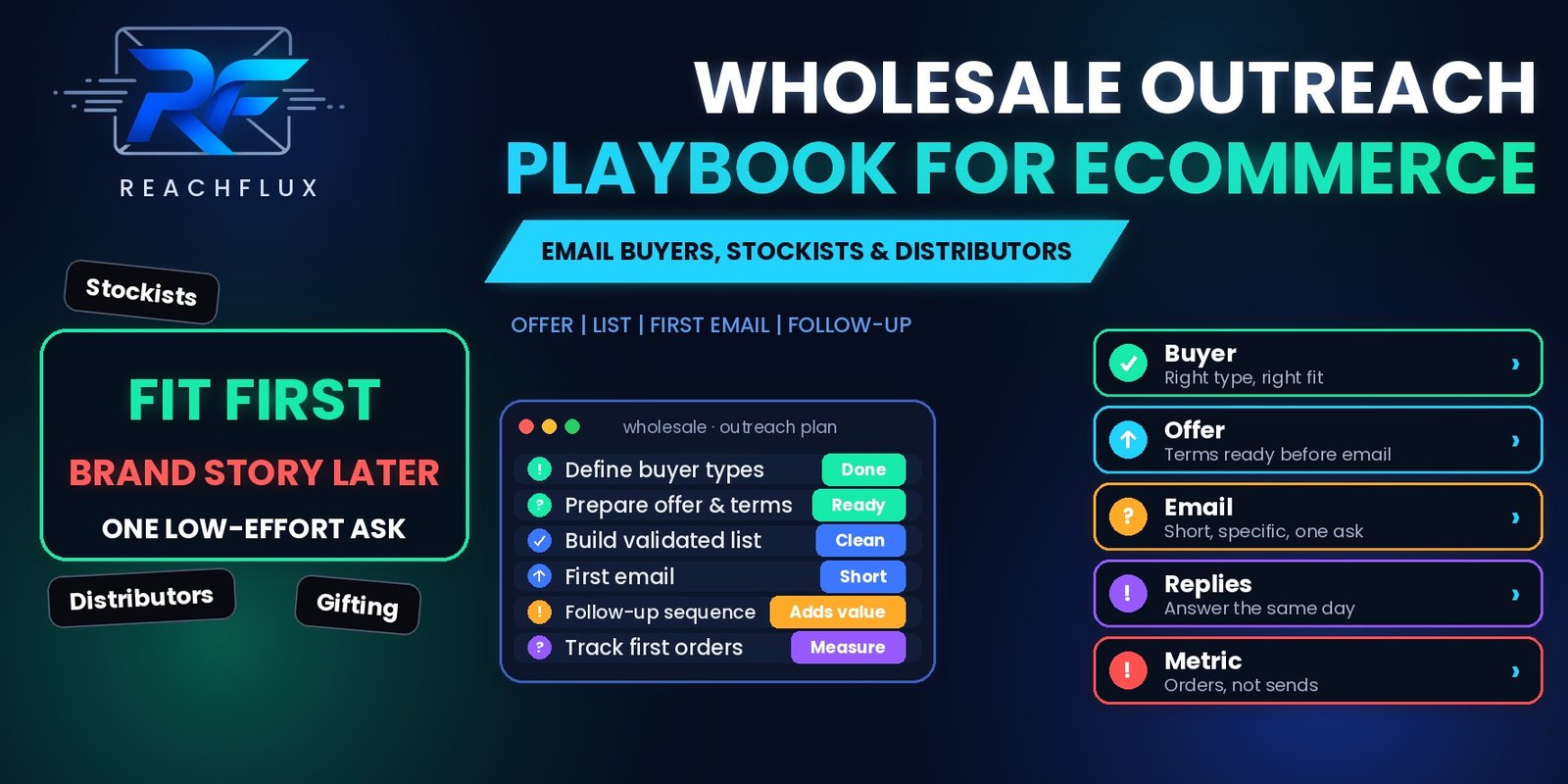
Wholesale outreach works when you contact the right kind of business with a specific reason your product fits its shelves, customers or catalogue, and you make the next step small. The process has six parts: define the buyer, build a clean and appropriately sourced list, prepare your wholesale offer, send a short first email with a few useful follow-ups, answer replies quickly, and measure by qualified conversations and first orders rather than emails sent.
It is slower than paid ads and less glamorous than a launch, but stockists, distributors and corporate buyers can open channels that advertising cannot buy. The catch is that busy buyers see many brand introductions, so the email has to earn its place in a few lines.
If you are still choosing software for this, start with Outreach Automation for Ecommerce Brands: What to Look For and How to Keep Follow-Ups Consistent.
Different buyers care about different things
“Buyers” is not one audience. Each type judges your email by a different yardstick, so the opening line should change with them.
| Buyer type | What they care about | What to lead with |
|---|---|---|
| Independent boutiques and specialty shops | Fit with their customers, curation and margin | Why your product suits their category and what the wholesale margin looks like |
| Online retailers and marketplace sellers | Catalogue fit, reliable fulfilment and clear pricing | Product range, lead times and how easy you are to reorder from |
| Regional distributors and wholesalers | Gaps in their range, volume and logistics | The gap you fill and the minimums and pack sizes you work with |
| Corporate gifting and bulk buyers | Customisation, lead time and bulk pricing | What can be personalised, how quickly, and at what quantity |
| Subscription box and bundle companies | Unit cost, uniqueness and consistent supply | Cost per unit, exclusivity options and supply reliability |
Prepare the offer before you write a single email
The fastest way to lose a warm reply is to be unprepared for the answer. If a buyer says “send me your terms” and you need three days to work out your minimum, the moment has gone. Settle these points first.
Wholesale pricing and margin
Decide the wholesale price and the retail price you recommend, so the buyer can see the margin at a glance.
Minimum order and pack sizes
State the minimum order value or quantity and any case sizes. Ambiguity here creates back-and-forth that kills momentum.
Lead times and fulfilment
Know how long an order takes to produce or ship and how you handle reorders.
Sample policy
Decide whether samples are free, paid or credited against a first order, and for whom. Samples cost real money, so set rules rather than improvising.
Exclusivity and territory
Decide whether you will offer exclusivity, and on what conditions. Some buyers will ask immediately.
Payment terms
Know what you accept, such as prepayment or net terms, and how you handle new accounts.
Materials ready to send
Keep a line sheet or catalogue, product images and a price list ready, to send after the buyer replies rather than attached to the first email.
Where to find buyers, appropriately
Good wholesale lists are usually built, not bought. The best sources are the ones where a business has already signalled that it sells products like yours. Look at the stockist pages of similar brands, trade directories, trade-show exhibitor and attendee information, retail association member lists, and your own inbox for retailers who have already enquired. Manual research on a buyer’s role takes longer but produces far better lists.
Whatever the source, validate addresses, prefer named buyers over shared addresses such as info or sales, and follow the rules for business contact in your market and the recipient’s. ReachFlux does not supply a retail-buyer database, so this stage happens before you import anything. If you are tempted by a purchased list, read Why Do Half of Your Prospect Emails Bounce? Fixing Bad Data From Paid Databases and LinkedIn and Why Do Verified Emails Still Bounce? 11 Reasons Verification Misses Bad Addresses first.
First emails that retail buyers actually read
Keep it to a few lines, make the fit obvious, and ask only for permission to send more. Here are three versions for different buyers. Placeholders appear in square brackets, and every claim must be true for your brand.
Hi [first name], your shop focuses on [category], and we make [product] for [customer type]. If the range looks relevant I can send wholesale terms and product details. If not, no problem at all.
[Name], [Brand]
Hi [first name], I noticed [distributor] carries [related range] but not [gap]. We make [product] in [pack size] with a minimum order of [minimum]. Would a short summary of terms be useful?
[Name], [Brand]
Hi [first name], we make [product] that can be personalised with [option], with lead times of [time] for orders of [quantity] or more. If client gifting is something your team handles, I can send examples and pricing.
[Name], [Brand]
Notice what they share: one reason this buyer might care, one specific fact about the offer, and one low-effort ask. None of them attaches a catalogue or tells the whole brand story. For more on balancing list quality against copy, see Cold Email List vs Copy: How to Find What’s Hurting Results.
A follow-up sequence that adds something each time
Most buyers reply, if they reply at all, to the second or third touch. That only works if each follow-up adds a reason to answer rather than repeating the first message.
Explain why the product suits this buyer and ask whether you may send terms.
Add a specific product, bestseller or customer-type fact that makes the fit easier to picture.
Try a new reason, such as a pairing with something they already stock, a seasonal window, or a lead-time advantage.
Make clear you will stop writing unless they would like the details, and keep the door open politely.
How far apart to space these is covered in Cold Email Follow-Up Timing: How Long Should You Wait Before Following Up?. Whatever you choose, stop the sequence the moment a real reply arrives and answer it yourself.
Common replies and how to answer them
Replies are rarely a straight yes or no. Most are questions or soft objections, and a helpful answer keeps the conversation going.
| What they say | What it usually means | A helpful reply |
|---|---|---|
| Send me your prices | Mild interest; they want to compare | Send the price list and line sheet the same day, with one sentence on margin and minimums |
| Your minimum is too high | They like it but the risk feels large | Explain what the minimum covers and whether a smaller trial order or mixed case is possible |
| We already carry something similar | They have a supplier and need a reason to switch | Ask what they like about it, then point to one real difference without criticising the competitor |
| Not right now | Timing, budget or season | Ask when they plan next season’s range and set a specific, polite follow-up |
| Can I get a sample? | Real interest, with a test in mind | Follow your sample policy and ask what they would like to evaluate |
| Do you offer exclusivity? | Serious buyer thinking about positioning | Explain the conditions you can offer, in terms of region, volume or term |
Set up sending so the emails arrive
A perfect wholesale pitch is worthless in a spam folder. Send from a dedicated outreach domain rather than your store’s main one, so any bounce or complaint risk stays away from customer and order emails. Make sure SPF, DKIM and DMARC pass and align, ramp volume gradually, and cap how many people at one company you contact in the same period.
The reasoning and the details are in Primary Domain vs Cold Email Domain: Which Should You Use for Outreach?, Cold Email Infrastructure: Domains, Inboxes, DNS and Sending Limits and Cold Email Deliverability Checklist: 25 Things to Check Before Sending. Many of the buyers you want sit behind company filters, so How to Get Cold Emails Past Corporate Spam Filters and Secure Email Gateways is also worth reading.
Business outreach still has rules
Emailing a business is treated differently from emailing a consumer in many places, but not everywhere, and not without conditions. Identify yourself and your company honestly, give people a simple way to opt out, honour opt-outs everywhere, and keep records of who asked not to be contacted. Rules differ by country and by the recipient’s location, and this guide is not legal advice, so check your market’s requirements. The practical mechanics are in Cold Email Compliance and Deliverability: Opt-Outs, Sender Identity and Complaint Rates.
What to measure, and what not to
Emails sent is a cost, not a result. Track the stages that matter for wholesale.
| Metric | Why it matters |
|---|---|
| Qualified conversations | Replies from the right kind of buyer, which is the real top-of-funnel measure |
| Requests for terms or line sheet | Shows genuine buying interest, not politeness |
| Sample requests | A strong signal, and a cost you should track |
| First orders | The outcome that proves the channel works |
| Reorders | Shows whether the account is worth the effort |
| Time from first reply to first order | Reveals friction in your terms or process |
If results slip, diagnose by stage using Cold Outreach Conversion Rates Dropping? How to Diagnose the Funnel From Sent to Booked rather than rewriting copy blindly.
Where ReachFlux fits in a wholesale workflow
ReachFlux’s ecommerce page describes it as built for the B2B side of ecommerce: contacting prospective retailers, distributors, resellers and corporate buyers by email, working from lead data you already own. It supports CSV and Excel import, email validation, sending across connected accounts, randomised delays, AI-assisted drafting, reply handling and a lead pipeline.
It does not replace your store, your cart-recovery flows or your customer-marketing system, and it does not supply a buyer database. Bring the list, and use the platform to run the campaign and manage the conversations that follow.
Wholesale outreach checklist
- You have named the buyer types you want and a reason your product fits each.
- Wholesale pricing, minimums, lead times, sample policy and payment terms are decided.
- A line sheet and price list are ready to send after a reply.
- The list is validated, appropriately sourced and uses named buyers where possible.
- Outreach runs from a dedicated domain with authentication passing.
- The first email is short, specific and has one easy ask.
- Follow-ups add new reasons and stop on reply.
- You track qualified conversations, sample requests and first orders.
Questions about wholesale outreach
How do I find retail buyers and stockists for my ecommerce brand?
Look at the stockist pages of similar brands, trade directories, trade-show exhibitor information, retail association member lists and retailers who have already contacted you. Build a list of named buyers and validate the addresses before sending.
What should a wholesale outreach email include?
Why the product fits this particular buyer, one concrete fact about your offer, and a low-effort ask such as permission to send terms. Keep catalogues and attachments for after they reply.
Should I offer free samples in the first email?
Usually not. Samples cost money, so qualify interest first and follow a clear sample policy. Offering to send details is a better first ask.
How many follow-ups should I send to a buyer?
A small number of touches that each add a new reason to reply is usually enough. Review which steps get replies and remove the ones that do not.
Can I use my store’s main email domain for wholesale outreach?
It is better not to. A dedicated outreach domain keeps bounce and complaint risk away from the domain that handles customer and order emails.
Does ReachFlux provide a list of retail buyers?
No. You bring your own prospect data. ReachFlux helps you validate it, send campaigns across connected accounts and manage replies and pipeline.
Win the buyer’s attention with fit, then keep it with preparation.
Wholesale outreach rewards brands that do the unglamorous work first: a clear buyer type, a ready offer, a clean list and a short email that shows fit. Do that and each reply becomes a real conversation instead of a scramble.
Start small, learn from the replies, and let first orders, not emails sent, tell you whether to scale.
Prepare leads, run campaigns and continue buyer conversations in one place.
ReachFlux helps ecommerce brands run structured B2B outreach to retailers, distributors and partners.