How do you personalize cold emails without sounding scripted?
Personalize with one true, relevant observation that connects to your offer, not with a string of inserted fields. A first line that mentions something specific about the person’s company or role, and says why it matters to what you are offering, reads as human. A line that only swaps in a name and a company is recognised instantly as a template, by readers and by filters alike.
The practical challenge is scale. You cannot hand-research every contact in a large campaign. The answer is to personalize at different levels for different audiences: deep for your best accounts, structured for the middle, and segment-level relevance for the rest. This guide shows how to do each, how to find genuine observations, and how to use AI assistance without inventing facts.
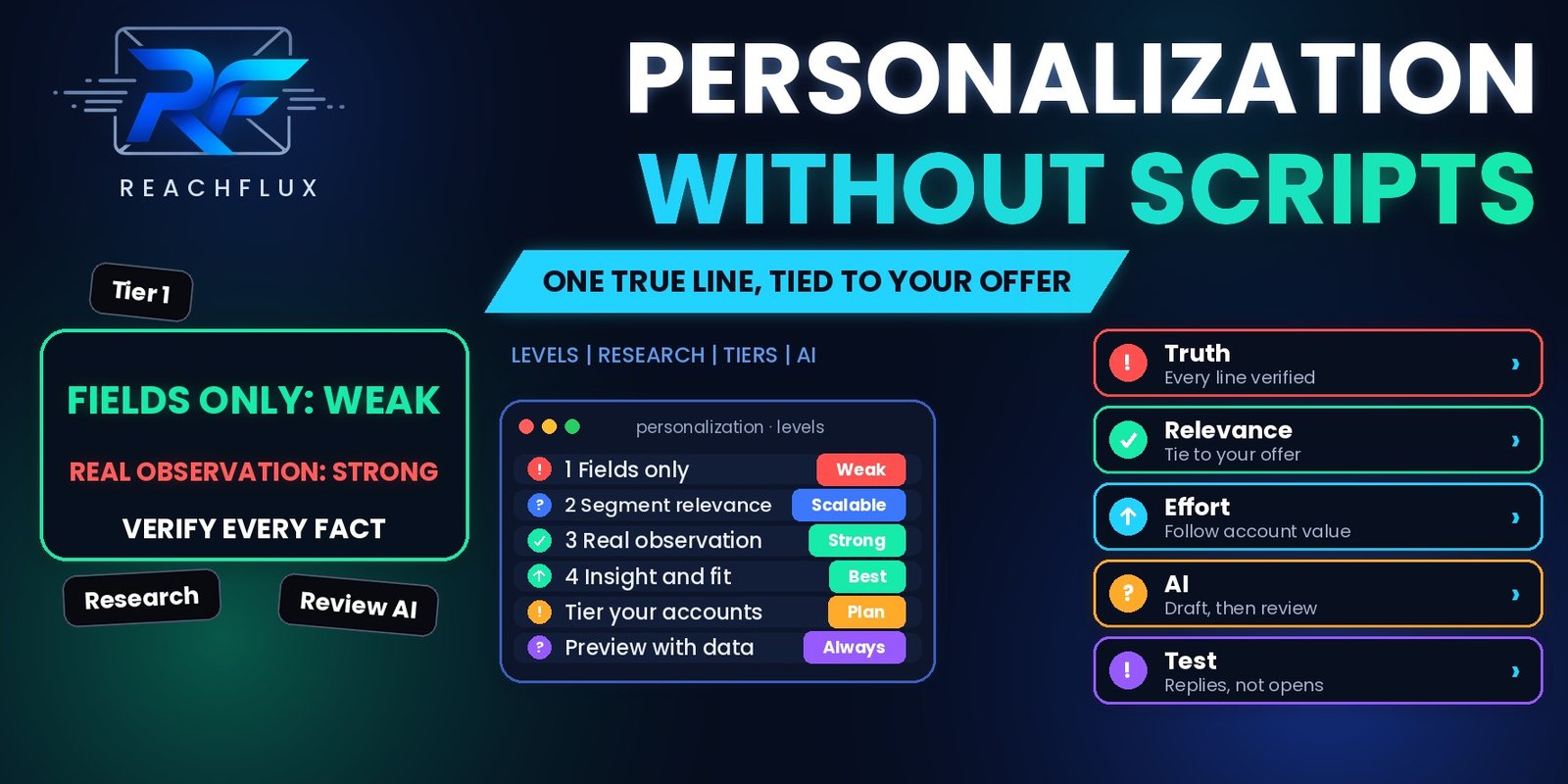
Four levels of personalization
| Level | What it is | Example (placeholders) | Effort |
|---|---|---|---|
| 1. Fields only | Name and company inserted into a template | Hi [first name], I noticed [company] | Very low; weakest |
| 2. Segment relevance | The message speaks to a shared situation of the segment | Teams running [type of operation] often struggle with [problem] | Low; scalable and often enough |
| 3. A real observation | One verified fact about the company or person | I saw [company] recently opened [location] | Medium; strong |
| 4. Insight and fit | An observation plus a reasoned link to your offer | With the new [location], [specific challenge] is likely, which is what we help with | High; best for key accounts |
Where genuine observations come from
The company website
Product pages, careers pages, news and customer stories reveal what a business does and what is changing.
Hiring signals
An open role often signals growth, a new initiative or a gap you can help with, if it is genuinely relevant.
Public announcements
Launches, expansions, funding or leadership changes give a timely reason to write.
The person’s own public content
Articles, talks or posts show what they care about. Reference them accurately and sparingly.
Industry events and trends
Changes that affect a whole segment give a relevant, non-creepy opener at segment level.
Tier your accounts instead of treating everyone the same
Effort should follow value. Split your list into tiers, and spend your research time where a reply is worth the most.
| Tier | Who | Approach |
|---|---|---|
| Tier 1 | Your best-fit, highest-value accounts | Hand-researched, level 3 or 4 personalization, written individually |
| Tier 2 | Strong-fit accounts | Semi-structured: a researched observation chosen from a short list of options per segment |
| Tier 3 | Broader audience | Segment-level relevance, with clean data and no invented specifics |
First-line patterns you can adapt
These patterns use placeholders, and every one only works if the fact inside it is true.
Notice that each links the observation to a reason you are writing. A compliment alone, such as “loved your post”, is flattering but does not tell the reader why they are getting an email.
Three versions of one email, from weak to strong
Suppose you sell scheduling software to operations teams. Here are three openings for the same offer, using placeholders. Only the last two are acceptable, and only when the facts are true.
Version 1 could be sent to anyone, so it tells the reader nothing. Version 2 shows you understand their situation. Version 3 shows you have looked, and only works if the new location is real and recent. The effort rises with each version, which is why you spend it on the accounts that justify it.
Use AI to draft, not to invent
AI writing assistance can speed up first drafts and produce variations, but it has no reliable knowledge of your prospect. If you ask it to personalise without giving it verified facts, it will fill gaps with plausible inventions, and one wrong claim can end a conversation and damage your credibility.
Give any assistant the facts you have verified, ask it to use only those, and review every message before it is sent. ReachFlux’s AI Writer is designed to draft subject lines and email copy as a starting point that you review and edit. You remain responsible for accuracy and tone.
Personalization mistakes that backfire
Faking familiarity
Pretending to know someone, or implying a relationship that does not exist, feels dishonest and invasive.
Over-personal details
Mentioning private or irrelevant details, such as personal life, feels intrusive. Stick to professional, public and relevant facts.
Outdated or wrong facts
A reference to something that changed months ago, or a misread detail, signals that you did not look properly.
Merge-field failures
“Hi ,” or a visible field name destroys credibility. Always preview with real data.
Personalising the first line, then pitching generically
The rest of the email must also fit. Otherwise the opening reads as a trick.
Making it too long
A paragraph of research before the point loses the reader. One line is usually enough.
Personalization and the automated-looking problem
Genuine personalization also helps with filters, because it breaks the identical-text pattern that bulk detection looks for. But it is not a trick. It works because each message really is different. The broader approach, including timing, identity and variation, is in How to Make Cold Emails Look Less Automated to Spam Filters (Without Losing Scale).
If your results are weak, check whether the issue is the list or the copy before spending hours on personalization. Cold Email List vs Copy: How to Find What’s Hurting Results shows how, and Cold Email A/B Testing: How to Test Copy, Offers and Lists Without Fooling Yourself explains how to test whether a more personalised opening actually improves replies.
A repeatable personalization process
Group contacts by situation, so segment-level relevance does most of the work.
Decide where deep research is worth the time.
Spend a few minutes per tier 1 or 2 account looking for one genuine observation.
State the observation and why it matters, in one or two sentences.
Read the final message with real data, and verify every claim.
How to tell whether personalization is paying off
Personalization costs time, so check that it earns it. Test a more personalised opening against a segment-level opening on the same list, with one variable changed, and judge by positive replies rather than opens. Repeat promising results before you invest further, because reply numbers are small and noisy. The method is in Cold Email A/B Testing: How to Test Copy, Offers and Lists Without Fooling Yourself.
Also track time spent. If a deeper opening adds a few minutes per contact and lifts replies enough to justify it for tier 1 accounts, keep it there. If it does not, use the saved time elsewhere. The aim is better results per hour, not maximum personalization.
Personalization checklist
- Every personalised line is true, specific and relevant to your offer.
- The list is tiered, and research effort follows account value.
- Observations come from professional, public and relevant sources.
- AI drafts use only verified facts and are reviewed by a person.
- The whole email fits the person, not just the first line.
- Merge fields are previewed with real data and have sensible fallbacks.
- You test whether deeper personalization improves replies before scaling it.
Questions about cold email personalization
How do I personalize cold emails without sounding scripted?
Use one true, specific observation connected to why you are writing, rather than inserted fields. Personalize deeply for your best accounts, structurally for the middle tier and at segment level for the rest.
What is a good first line for a cold email?
One that states a verified, relevant observation and links it to your offer, such as a recent change at the company and the challenge it usually creates. A compliment alone does not say why you are writing.
Can AI personalize cold emails?
AI can draft and vary text, but it does not know your prospect. Give it verified facts, tell it to use only those and review every message, because invented details can end a conversation.
How much research should I do per prospect?
Match effort to value. Spend a few minutes on tier 1 and tier 2 accounts looking for one genuine observation, and rely on segment-level relevance for the broader list.
Does personalization help avoid spam filters?
It helps break the identical-text pattern filters look for, but it works because each message is genuinely different. It does not replace authentication, list quality or sensible volume.
What personal details should I avoid mentioning?
Private or irrelevant details. Stick to professional, public and relevant facts, and never imply a relationship that does not exist.
One true line beats five inserted fields.
Personalization is a matter of honesty and relevance. Spend your research effort where it pays, write one real observation and connect it to your offer, and let segment-level relevance carry the rest.
Check every fact, preview every message, and test whether the extra effort really improves replies.
Use AI assistance for first drafts that you review and edit.
ReachFlux’s AI Writer drafts subject lines and email copy as a starting point, with previews before anything is sent.