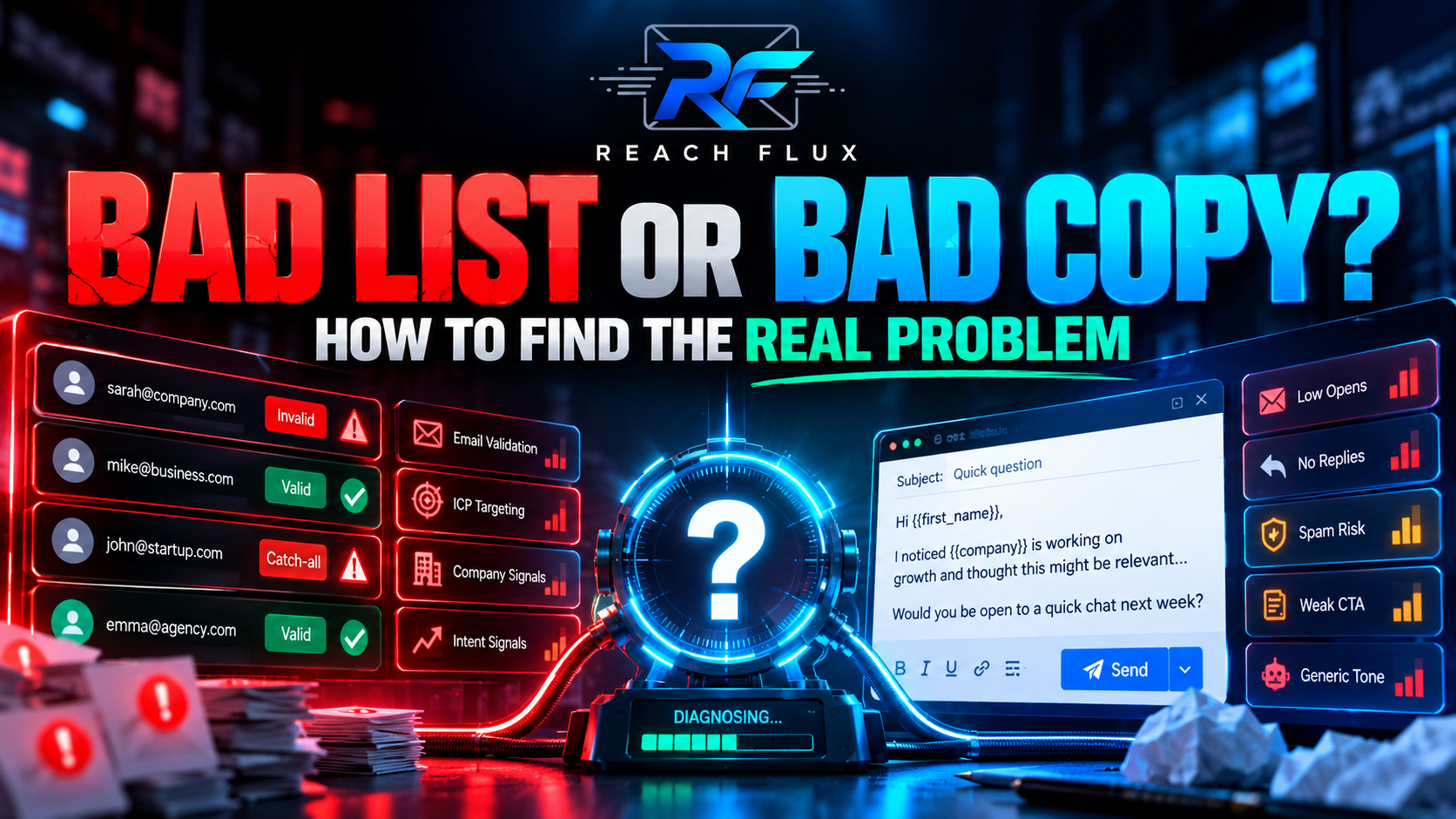
If cold email is underperforming, don't begin by rewriting the opening line. First confirm that you are contacting the right people, the addresses are usable, and messages are actually reaching them. If delivery and audience fit look healthy but relevant prospects repeatedly ignore the message, then investigate the offer and copy. The important part is changing one major variable at a time. Otherwise, you may improve results without ever learning what was broken.
“Is it my list or my copy?” sounds like a simple question.
In practice, it is usually missing several layers.
I have found this especially important while building outbound workflows because the sending application sees events that the final campaign report can hide.
A campaign with poor results can have perfectly reasonable copy.
The messages may be going to the wrong people.
Or some recipients may not exist.
Or delivery may be deteriorating.
Or the audience may be right, but the offer gives them no reason to reply.
Or the first email may be fine and the follow-up process is weak.
All of those situations can end with the same dashboard result:
“Sent 500 emails. Barely got any replies.”
Same symptom.
Very different fixes.
How do I know if my outbound problem is the list or the copy?
Start with the list and delivery before blaming the copy. Check whether the contacts are valid, whether they match your ideal customer profile, and whether the messages are being accepted by recipient servers. If those layers look healthy but relevant prospects consistently ignore the outreach, investigate the offer, positioning, subject line, opening, body, CTA, and follow-ups.
There is a useful reason for checking the system in this order.
Copy only matters after someone has a realistic chance of seeing it.
If the chain breaks at step one, polishing step five will not fix it.
“List or copy?” is often the wrong first question
Cold outbound is a system.
The list and the copy are two parts of it.
A more useful diagnostic model is:
Is the mailbox usable?
Is this actually the right person and company?
Does the message have a reasonable chance of reaching the recipient?
Is there a credible reason for this prospect to care?
Does the email communicate that reason clearly?
Are interested-but-busy prospects getting another chance to respond?
Are real conversations being noticed and progressed?
Looking only at “list versus copy” compresses seven possible failure points into two.
That makes diagnosis harder than it needs to be.
Diagnose cold email in the order the prospect experiences it
I prefer to work from the beginning of the outbound path rather than jumping straight to the visible symptom.
Every stage depends on the stage before it.
Imagine that 30% of a list contains companies that would never buy your service.
Better wording does not turn those companies into qualified buyers.
Or imagine a significant portion of addresses are stale.
Better personalization cannot make a nonexistent mailbox read an email.
7 signs your cold email list is the problem
“Bad list” can mean two different things.
The contact data can be bad.
Or the data can be accurate while the prospects themselves are a poor fit.
Those are separate problems.
1. Too many addresses fail
If a new batch of prospects creates a noticeable increase in permanent recipient failures, start with the data.
Look at where those addresses came from.
Were they old?
Were they guessed from a naming pattern?
Were they collected months before sending?
Did one lead source produce most of the failures?
A copy rewrite has no relationship to those questions.
2. Job titles look relevant, but the people do not own the problem
Job-title targeting is convenient.
It is not the same as problem targeting.
Two people with the same title can have completely different responsibilities depending on company size, team structure, industry, and maturity.
If you sell an API integration service, for example, the right contact is not simply anyone with “technology” in their title.
The better question is:
Does this person have enough proximity to the problem I am describing to understand why it matters?
3. Your list contains companies outside the real ICP
Broad targeting can make perfectly reasonable copy look weak.
Imagine a service designed for agencies managing several client websites.
Sending the same pitch to freelancers, manufacturers, local shops, SaaS companies, agencies, and enterprise IT departments creates completely different relevance levels.
The message cannot rescue an audience that was never coherent.
4. One segment performs very differently from another
This is one of the most useful clues.
Suppose the same offer and similar copy are sent to:
- marketing agencies,
- SaaS companies,
- construction companies,
- and healthcare practices.
If one segment repeatedly creates conversations while another does almost nothing, the difference may be telling you more about audience fit than copy quality.
5. Replies repeatedly say “not relevant”
Negative replies are still data.
“Not interested” can mean many things.
But repeated responses such as:
- “We don't handle that,”
- “Wrong department,”
- “We don't use this type of system,”
- or “This isn't something we need”
should make you inspect targeting before rewriting every sentence.
6. Personalization keeps producing irrelevant details
Personalization cannot repair weak segmentation.
If your personalization system struggles to find a meaningful connection between the prospect and the problem, that can be a clue that the prospect should not have been included.
Mentioning somebody's recent blog post does not create product fit.
7. Your “ideal customer” definition is mostly demographics
Industry, employee count, geography, and job title are useful.
They are rarely enough on their own.
Better outbound targeting also considers context:
- What problem might exist?
- Why might it exist now?
- Who experiences it?
- Who can act on it?
- What would make the problem expensive enough to solve?
List quality asks whether the contact data is accurate and usable. Targeting quality asks whether those contacts should have been in the campaign at all. You can have a technically clean list full of the wrong people.
Bad list vs bad targeting: don't confuse them
This distinction deserves more attention because teams often say “the list is bad” when the addresses are perfectly valid.
Invalid mailboxes, stale contacts, duplicates, incorrect addresses, outdated company information, or unusable recipient records.
The person exists and receives the message, but the company, role, need, timing, or use case does not fit the offer.
These require different fixes.
Validation helps with the first.
Better segmentation and ICP thinking help with the second.
8 signs your cold email copy may be the problem
Once the list, targeting, and delivery look reasonable, the message deserves much more scrutiny.
1. The email starts with you instead of the prospect
A lot of outbound still begins like this:
“We are a leading software development company providing innovative solutions to businesses around the world...”
Nothing is technically wrong with the sentence.
The problem is that a cold prospect has no context for why they should care.
The opening should establish relevance quickly.
2. The problem is too generic
“Are you looking to grow your business?”
Almost every business wants growth.
That does not make the statement specific.
Good cold email usually becomes more interesting when the problem sounds recognizably connected to the recipient's situation.
3. You are listing services instead of creating a reason to reply
A service list is easy to write:
Web Development • Mobile Apps • SEO • AI • CRM • ERP • APIs • Automation • Cloud Solutions
But it pushes the qualification work onto the prospect.
They now have to figure out which service matters and why.
A stronger email normally chooses one relevant problem or outcome instead of presenting the company catalogue.
4. The email could have been sent to anybody
This does not mean every email needs a handcrafted paragraph.
It means the message should make sense for the segment receiving it.
If you can replace “dentist” with “construction company” and the entire pitch still reads the same, your segmentation probably is not doing much work.
5. The email asks for too much too early
A cold prospect has not yet agreed that the problem matters.
Asking for a 30-minute meeting, a product demo, a requirements document, and a decision in the first interaction can create unnecessary friction.
A lighter CTA can make the next step easier.
6. The message is difficult to scan
Long blocks of text are not automatically bad.
But cold email is often read quickly.
If the recipient has to dig through company history, feature lists, qualifications, and multiple CTAs to understand the point, the message is making them work.
7. Your follow-ups repeat the same pitch
“Just following up.”
“Checking whether you saw this.”
“Bringing this to the top of your inbox.”
Those reminders can occasionally work, but a sequence becomes more useful when a follow-up adds context, clarification, a different angle, or a smaller next step.
8. Prospects reply, but they misunderstand the offer
Replies are not automatically proof that the copy works.
If prospects consistently ask questions that reveal they understood the offer incorrectly, your message may be generating attention without communicating clearly.
That is a copy problem worth fixing.
Sometimes neither the list nor the copy is the real problem
This is the part that gets missed most often.
You can have the right prospect.
You can reach the inbox.
You can write a clear email.
And still get weak results because the offer is not compelling.
Copy communicates value.
It cannot manufacture value that the prospect does not perceive.
Ask these questions about the offer
- Does the prospect recognize the problem?
- Is the problem important enough to address now?
- Is the outcome specific?
- Is there a believable reason you can help?
- Is the next step proportionate to their level of interest?
- Does the offer sound meaningfully different from generic alternatives?
If those answers are weak, rewriting the subject line twenty times is unlikely to transform the campaign.
Does zero replies mean your cold email copy is bad?
No. Zero replies tells you the campaign is not creating visible conversations. It does not tell you why. Before blaming copy, inspect recipient validity, targeting, delivery, sample size, offer relevance, follow-up coverage, and whether replies are being captured correctly.
This is where teams can make expensive decisions from a single metric.
Imagine two campaigns.
- Valid prospects
- Good-fit segment
- No obvious delivery failures
- Weak, generic offer
- Old prospect list
- Several permanent failures
- Broad job-title targeting
- Mixed industries
The headline metric is identical.
The diagnosis is not.
Why I would not use open rate alone to judge the copy
Open tracking can be useful as one signal, but I would not make a copy decision from open rate alone.
Tracking depends on how the message and email client handle the tracking mechanism, and privacy features can make opens an imperfect representation of human attention.
More importantly, an “open” does not tell you:
- whether the prospect understood the offer,
- whether they were the right person,
- whether they had the problem,
- whether they trusted the sender,
- or whether the CTA made sense.
I would rather combine delivery evidence, replies, reply quality, segment performance, and downstream pipeline behavior.
Cold email diagnostic table: symptom → likely layer → next check
| What you see | Possible layer | What to inspect next |
|---|---|---|
| Many permanent recipient failures | List quality | Validation, data age, source, address accuracy |
| Valid contacts but clearly irrelevant companies | Targeting | ICP, segmentation, role relevance, problem fit |
| Failures cluster around one sender | Infrastructure | Account health, authentication, provider responses |
| Mail accepted but spam placement is suspected | Deliverability | Reputation, authentication, sending pattern, content |
| Right audience but almost no meaningful engagement | Offer / copy | Problem relevance, positioning, opening, CTA |
| Replies say “wrong person” repeatedly | Targeting | Role selection and buying responsibility |
| Replies show confusion about what you offer | Copy | Clarity, specificity, unnecessary complexity |
| First email gets little response and no real follow-up exists | Sequence | Follow-up timing, angles, number of touches |
| Replies exist but few become qualified conversations | Targeting / offer | Intent, problem severity, qualification, offer fit |
| Performance drops after increasing volume | Infrastructure / list mix | New senders, new sources, provider responses, traffic changes |
How to test whether the list or copy is the problem
The most important rule is simple:
Don't change the audience, offer, copy, sending infrastructure, and follow-up sequence at the same time.
You might get better results.
But you will learn almost nothing from the test.
Test 1: Hold the segment steady and change the message
Use comparable prospects from the same segment.
Keep the underlying offer and sending conditions as stable as practical.
Then test a meaningful message difference.
For example:
Explains what your company does and asks whether the prospect needs it.
Starts from a specific operational problem relevant to the segment and offers a low-friction next step.
The point is not that version B automatically wins.
The point is that you changed something interpretable.
Test 2: Hold the message steady and change the segment
This is useful when you suspect targeting.
Keep the core problem and offer stable, but send to two clearly defined prospect groups.
If one group consistently produces more relevant conversations, audience fit deserves more attention.
Test 3: Compare lead sources
If your prospects come from several sources, track them separately.
Do not throw everything into one CSV and forget where it came from.
One source may produce:
- more invalid addresses,
- more outdated job information,
- more catch-all uncertainty,
- or simply worse-fit companies.
Source-level visibility can save you from blaming your sending system for an upstream data problem.
Test 4: Separate positive replies from all replies
A reply count alone can hide important information.
Twenty responses that all say “wrong person” tell a different story from five responses asking for details.
Read the conversations.
Outbound metrics become more useful when they remain connected to what prospects are actually saying.
What if one list works and another does not?
That is valuable evidence.
Don't immediately assume the winning list contains “better emails.”
Compare the two groups.
You are looking for the characteristic that changes the meaning of your offer.
For example, a workflow automation service may be far more relevant to a company handling hundreds of repetitive operations than to a very small team with little process complexity.
Both contacts can be valid.
Only one may have enough pain for the message to matter.
What if the list is good but cold emails still go to spam?
Then you have left the list-versus-copy problem and entered deliverability diagnosis.
Check the sending layer separately.
Look at authentication, sender behavior, reputation, provider responses, sending changes, recipient patterns, and whether one account behaves differently from the others.
A clean prospect list does not guarantee inbox placement.
What if results became worse after scaling?
This is another case where copy gets blamed too quickly.
Scaling often changes more than volume.
You may have added:
- new sender accounts,
- new domains,
- new lead sources,
- broader targeting,
- more follow-up traffic,
- and less selective prospecting.
If results deteriorate after scaling, compare the system before and after the change.
Do not assume the original message suddenly stopped working.
CONTINUE READING How to Scale Cold Email Campaigns Without Hurting Deliverability → Learn how to increase outbound capacity without changing so many variables that performance becomes impossible to diagnose.A 15-minute cold email diagnosis before you rewrite anything
If I had a campaign in front of me and only fifteen minutes to decide where to investigate, this is the order I would use.
Are invalid or permanently rejected addresses unusually common?
Read 20–30 prospect records manually. Would you genuinely choose these companies for this offer?
Do these people own, influence, or directly experience the problem?
Is one sending account behaving differently from the rest?
Are provider rejections, spam symptoms, or authentication problems present?
In one sentence, what does the prospect gain by replying?
Can someone understand the relevance, problem, offer, and next step within seconds?
Look for patterns: wrong person, bad timing, no need, confusion, interest, or objection.
Did the campaign give prospects another reasonable chance to respond?
Change the variable with the strongest evidence against it.
The metric I care about more than “did they reply?”
Replies matter.
But for commercial outbound, I care even more about whether the campaign creates relevant conversations.
A message can generate replies by being provocative, confusing, or annoying.
That does not make it effective.
Likewise, a highly targeted campaign may create fewer total replies but more conversations with people who actually have the problem.
That is why I would look downstream:
If replies are high but qualified conversations are weak, your problem may be targeting or offer fit rather than email wording.
How ReachFlux approaches the problem
One reason I prefer treating outbound as a system is that the campaign itself is only one part of the workflow.
ReachFlux supports recipient validation before sending, distribution across connected email accounts, campaign activity, replies, follow-up workflows, and lead stages.
That means the useful question is not simply:
“Did this email template work?”
It is:
“Where did this outbound path start losing good prospects?”
Sometimes the answer is the list.
Sometimes it is delivery.
Sometimes the copy is genuinely weak.
And sometimes people reply, but the process after the reply is where opportunities disappear.
Seeing those layers separately makes optimization much less random.
Cold email list vs copy FAQ
How do I know if my outbound problem is the list or the copy?
Start with recipient quality, targeting, and delivery. If addresses are usable, prospects fit the offer, and delivery looks healthy, then investigate the offer and copy. Avoid changing the audience and message simultaneously when you need a clear diagnosis.
Can a good cold email fail because of a bad list?
Yes. Good copy cannot compensate for invalid recipients, stale data, irrelevant companies, wrong roles, or prospects who do not experience the problem behind the offer.
Can a bad cold email list have valid email addresses?
Yes. Technical list quality and targeting quality are different. Every mailbox can be valid while the companies and people are still a poor fit for the campaign.
Does zero replies mean my cold email copy is bad?
No. Zero replies can also result from poor targeting, delivery problems, a weak offer, insufficient follow-up, small samples, or replies not being captured correctly.
Should I change my cold email list and copy at the same time?
Usually not when diagnosing performance. Changing several major variables together makes the result difficult to interpret. Hold as much of the system steady as practical while testing the suspected layer.
How do I know if my cold email targeting is wrong?
Common clues include repeated “wrong person” responses, large performance differences between segments, prospects that do not own the problem, and valid contacts who clearly have little reason to care about the offer.
What makes a cold email list high quality?
A useful list contains current, usable recipient data and prospects that match the campaign's actual problem and offer. Address validity alone does not make a list commercially relevant.
How can I tell if my cold email offer is the problem?
If relevant prospects receive and understand the message but still have little reason to act, inspect the offer. Ask whether the problem is important, the outcome is clear, the value is credible, and the requested next step is reasonable.
Should I judge cold email copy by open rate?
Open data can be one signal, but it should not be the only basis for judging copy. Delivery conditions and email-client privacy behavior can affect tracking, while an open does not tell you whether the prospect understood or valued the offer.
What should I check first when cold email stops working?
Work through the outbound path in order: recipient data, targeting, delivery, offer, copy, follow-up, and reply handling. Start with the earliest layer where the evidence shows a problem.
Don't rewrite the email until you know the email is the problem.
A weak campaign result is a symptom, not a diagnosis. Check recipient quality, targeting, delivery, offer, copy, follow-up, and reply handling in order. Once you identify where good prospects are being lost, you can fix that layer instead of rebuilding the entire campaign from guesswork.
Stop guessing which part of your cold email workflow is broken.
ReachFlux brings campaign sending, recipient validation, multiple sending accounts, replies and lead activity into one outbound workflow.