How do you write a cold email that gets read?
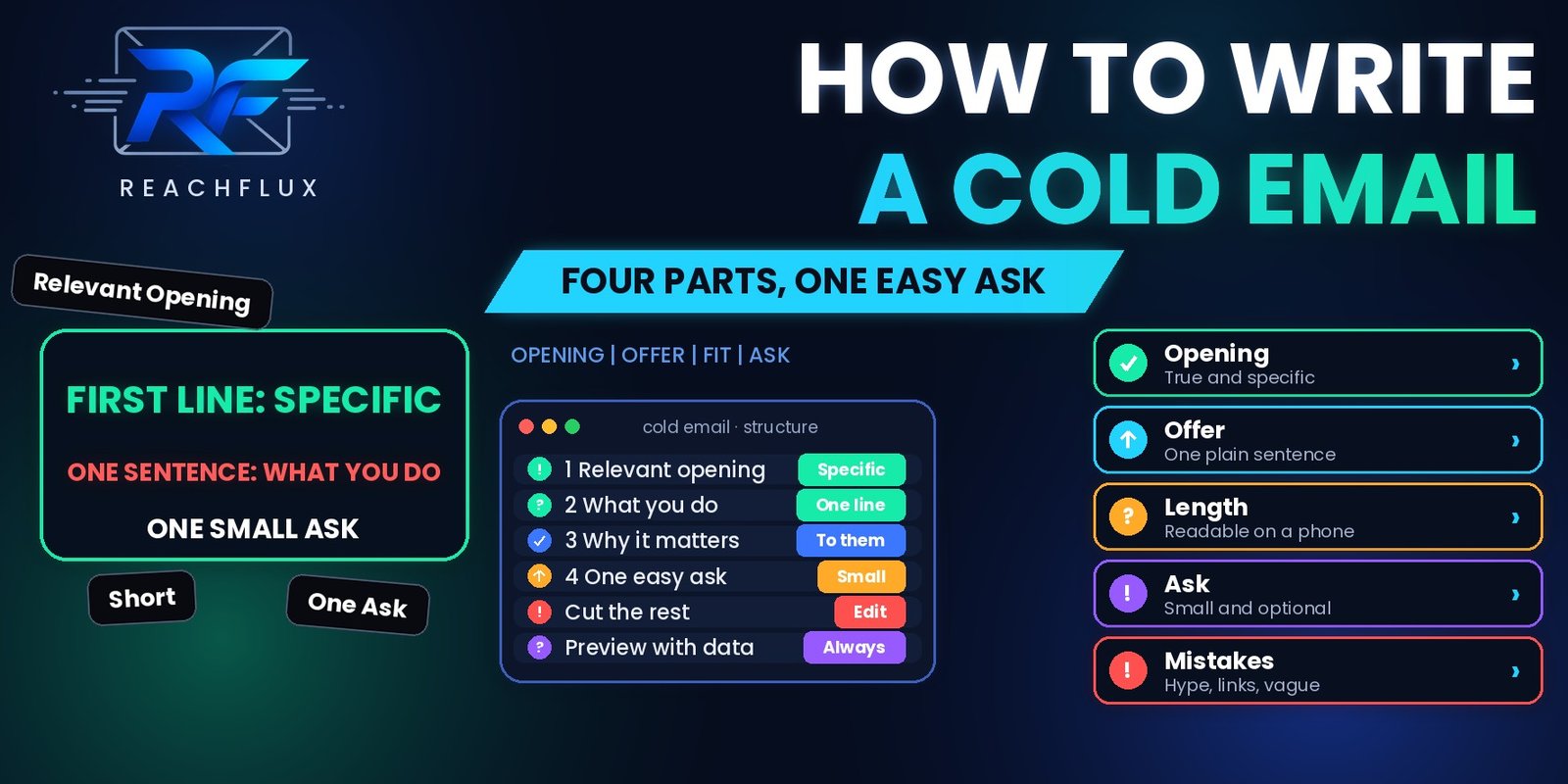
Write it for one person, keep it short, and give them a reason to care in the first sentence. A strong cold email has four parts: a relevant opening that shows why you are writing to this person, a one-line statement of what you do and for whom, a specific reason it might matter to them, and one easy ask. Everything else is optional, and most of it can be cut.
People do not read cold emails the way they read letters. They scan, on a phone, between other things, deciding in a few seconds whether this is relevant. The structure below is designed for that reality. It is not a magic formula, and you should adapt it to your audience, but it removes the most common reasons cold emails fail.
A four-part structure that works for most audiences
| Part | Job | Example idea (placeholders) |
|---|---|---|
| 1. Relevant opening | Show why this person and why now | I saw [company] recently [specific change], or Teams like [company] often deal with [problem] |
| 2. What you do | State it in one plain sentence | We help [type of team] with [problem] by [how] |
| 3. Why it might matter | Connect it to their situation | For a team at your stage, that usually means [specific benefit] |
| 4. One easy ask | Make the next step small | Would a short summary be useful, or is a quick call easier? |
A complete example, annotated
This is an invented example using placeholders. The note beneath each line explains what it is doing.
Hi [first name],
I saw that [company] recently [specific, verified change].
We help [type of team] with [problem], mainly by [short how].
For a team at your stage, that usually means [specific benefit].
Would it be useful if I sent a short summary? If not, no problem at all.
[Name], [Company]
The opening earns attention with something specific and true. The second line says what you do in plain words. The third ties it to the reader. The ask costs them almost nothing, and the final sentence removes pressure. Notice that nothing here brags, asks for a meeting at the first touch or attaches a document.
How long it should be, and how it should sound
Short emails are easier to read on a phone and easier to answer. Many effective cold emails fit in a handful of short lines, and few need more than a short paragraph or two. The right length depends on how much context the reader needs, but a useful test is whether each sentence changes what they understand or what they do. If not, cut it.
Write the way you would speak to a respected peer: plain, direct and courteous, without jargon or inflated claims. Avoid exclamation marks, corporate filler and flattery. Use the reader’s own words where you can, and keep paragraphs to a line or two so the message is easy to scan.
The first sentence does most of the work
A cold email lives or dies on its opening. A generic start, such as an introduction of yourself and your company, gives the reader nothing to hold on to. A specific, relevant start tells them immediately that this was written for them. That can be a verified observation, a shared situation of their segment or a direct question about something they care about.
The detail on how to find good observations, and how much effort to invest by account, is in Cold Email Personalization That Does Not Look Scripted: First Lines, Research and Scale. Whatever you choose, make sure it is true and connected to why you are writing.
Say what you do in one plain sentence
Most people over-explain. A clear sentence naming who you help, with what and how is enough for a first email. Avoid buzzwords, avoid listing every feature and avoid claims you cannot support. Specifics beat superlatives: “we reduce manual scheduling work for operations teams” says more than “we are the leading innovative solution”.
If you cannot say what you do in one sentence, the problem is not the email. It is the positioning, and fixing that first will improve everything else you write.
Ask for something small
Ask a question rather than demanding time
A question such as “is [topic] on your radar?” is easy to answer and starts a conversation.
Offer to send something short
A brief summary or example costs the reader nothing to say yes to.
Save the meeting request for when interest is shown
Asking for thirty minutes from a stranger is a big ask. Earn it with a smaller step first.
Make it clear they can say no
Politely removing pressure makes people more willing to reply, and it keeps the exchange respectful.
Use one ask only
Two or three requests split attention and lower the chance of any reply.
Why most cold emails fail
Starting with yourself
A paragraph about your company before the reader knows why they should care loses them immediately.
Being vague
“Improve your business” could mean anything. Specific problems and specific results are more credible.
Writing for everyone
A message that could be sent to anyone is rarely relevant to anyone. See Cold Email List vs Copy: How to Find What’s Hurting Results.
Stuffing in links and attachments
They add risk and distract from the one thing you want. See Links in Cold Emails: Should You Add a Calendar Link or Use Link Tracking?.
Overpromising
Claims you cannot back up destroy trust and invite complaints.
Sounding automated
Identical text and template errors are easy to spot. See How to Make Cold Emails Look Less Automated to Spam Filters (Without Losing Scale).
The subject line and the first line work as a pair
The recipient sees the subject and the beginning of your first line before deciding to open. Make them work together: a plain, specific subject, and an opening line that confirms why it is relevant. Both should be short enough to survive truncation on a phone.
Subject lines have their own principles, covered in Cold Email Subject Lines: How to Write Them, Test Them and Avoid the Traps, including why to avoid fake replies, urgency and capital letters.
Plan the follow-ups before you send
Most replies come after more than one touch, but only if each follow-up adds something new. Write the sequence in advance, decide how many touches and how far apart, and make sure it stops on any reply. Examples and templates are in Cold Email Follow-Up Sequence Examples: Structures, Templates and What Each Step Should Do, and spacing is covered in Cold Email Follow-Up Timing: How Long Should You Wait Before Following Up?.
Test and learn, fairly
You will not get the wording right first time, and nobody does. Test one element at a time on comparable groups, judge by replies rather than opens and keep a log. The method is in Cold Email A/B Testing: How to Test Copy, Offers and Lists Without Fooling Yourself. Read the replies you receive, including the objections, because they tell you what to change in the next version.
Before you send
- The email is written for one specific person or a clearly defined segment.
- The first sentence is specific, true and relevant.
- What you do is stated in one plain sentence.
- The reader can see why it matters to them.
- There is exactly one small ask, and a polite way to decline.
- There are no unnecessary links, attachments or claims you cannot support.
- The message is short enough to read at a glance on a phone.
- Merge fields are previewed with real data.
Questions about writing cold emails
How do I write a cold email that gets read?
Write for one person, keep it short and lead with a specific, relevant opening. Use four parts: a relevant opening, one sentence on what you do, a reason it matters to them and one easy ask.
How long should a cold email be?
Short enough to read at a glance on a phone, often a handful of short lines. Test whether every sentence changes what the reader understands or does, and cut anything that does not.
What should the call to action be in a cold email?
One small, easy ask, such as a question or an offer to send a short summary. Save meeting requests for when the reader has shown interest.
Should I attach files or add links to a first cold email?
Usually not. Links and attachments add risk and distract from the single ask. Offer to send material once the person replies.
How do I make a cold email sound less like an advert?
Write plainly, avoid hype and flattery, be specific and true, and sound like a thoughtful stranger writing to a peer.
How many follow-ups should I plan?
A small number, each adding something new, with widening gaps and an automatic stop on any reply. Review which steps earn replies and remove the rest.
Short, specific and easy to answer.
A good cold email respects the reader’s time. It shows why it was written for them, says what you do in a sentence, connects it to their situation and asks for something small.
Write it, cut it, read it as a stranger would, and then test and learn from the replies.
Write and preview campaigns in rich text, plain text or HTML.
ReachFlux supports AI-assisted drafting that you review and edit, with previews before anything is sent.