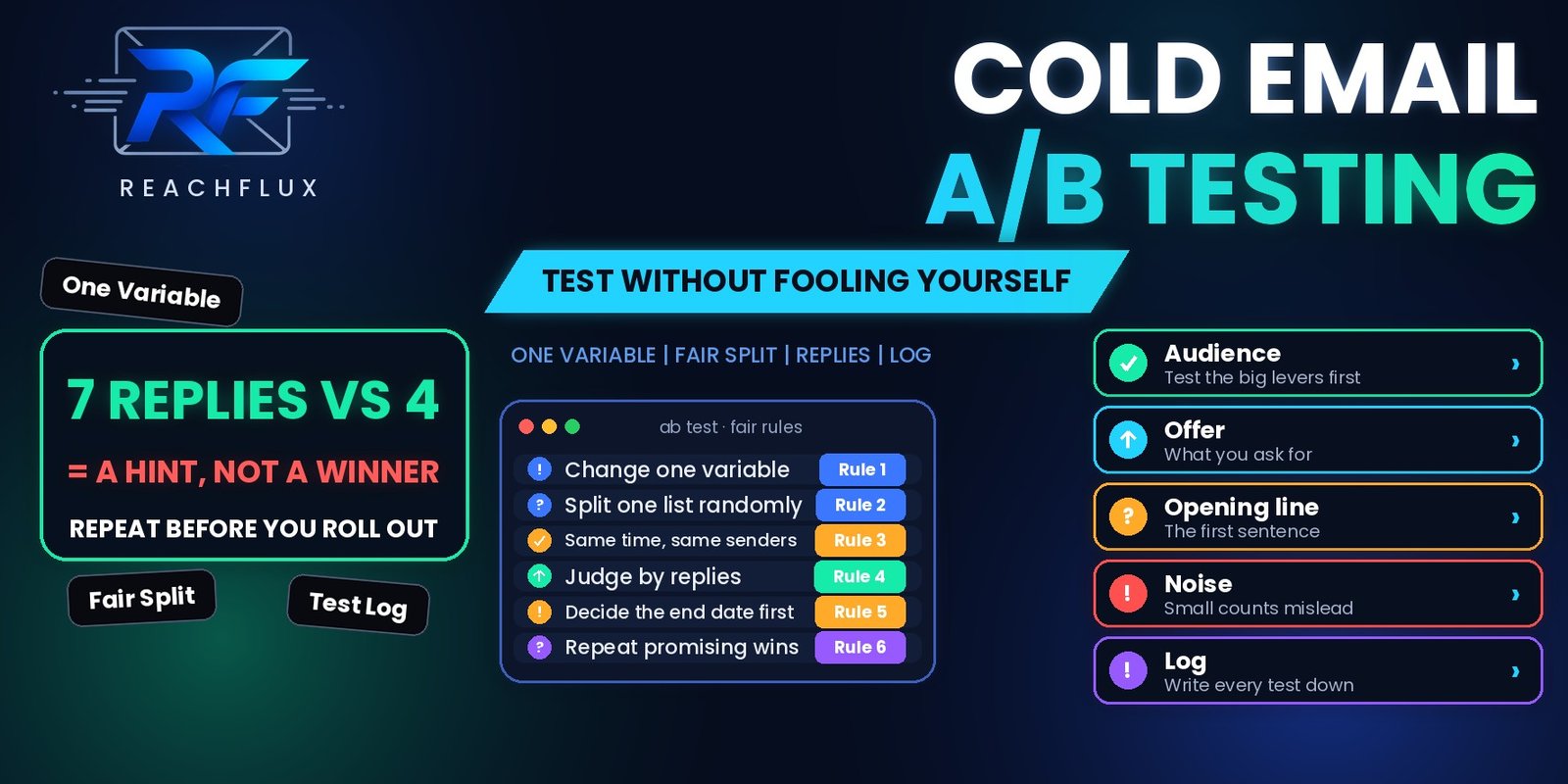
How do you A/B test cold email properly?
Test one variable at a time, on comparable audiences, at the same time, from comparable senders, and judge the result by replies rather than opens. Start with the things that move results most, which are usually the audience and the offer, then the opening line and the call to action, and leave small details such as punctuation until last. Above all, be honest about sample size: cold email produces few replies, so small differences are usually noise.
Most failed tests fail the same way. Someone changes three things at once, sends version A to one list and version B to a different one, sees a difference of a couple of replies and declares a winner. This guide gives you the rules that prevent that, and a simple log that keeps your learning honest.
Test the big levers before the small ones
Time and attention are limited, so test in order of likely impact. The audience you choose usually matters more than any wording, which is why the question of whether the problem is the list or the copy is worth settling first. See Cold Email List vs Copy: How to Find What’s Hurting Results.
| Variable | Likely impact | Effort to test | Notes |
|---|---|---|---|
| Audience or segment | Very high | Medium | Compare comparable segments, not a good list against a bad one |
| Offer or reason to reply | High | Medium | The promise and what you ask for |
| Opening line | High | Low | The first sentence is what people read |
| Call to action | Medium | Low | A question versus an offer to send details |
| Subject line | Medium | Low | Affects whether it is opened, which you cannot measure reliably |
| Length and structure | Medium | Low | Shorter is not always better |
| Send time and day | Low to medium | Low | Easy to test, easy to over-read |
| Punctuation and wording tweaks | Low | Low | Rarely worth the effort early on |
Six rules of a fair test
One variable at a time
If you change the opening line and the call to action together, you cannot know which one caused the difference.
Comparable audiences
Split a single list randomly into two groups. Never compare a list from one source with a list from another and attribute the gap to the copy.
Same time window
Send both versions over the same days, so seasonality and news cannot favour one side.
Comparable senders
If one version goes out from a stronger domain or inbox, you are testing the sender, not the message. Spread both versions across the same mailboxes.
A fixed measure, chosen in advance
Decide what counts as success before you look. Replies, and positive replies in particular, are better than opens. See Links in Cold Emails: Should You Add a Calendar Link or Use Link Tracking? for why opens mislead.
A fixed duration
Decide when the test ends before it starts, and do not stop early because one side looks ahead.
Why small differences are usually noise
Cold email replies are rare events. If a version of your email produces five replies and the other produces three, it is tempting to call the first a winner. In reality, with numbers that small, the same email could easily produce either result by chance. You need a meaningful number of replies in each group, not just a large number of sends, before a difference can be trusted.
Here is a simple illustration with invented numbers. Suppose both versions are sent to 200 people. Version A gets 6 replies and version B gets 4. That looks like a 50% improvement, but the real difference is two replies, and a repeat of the same test could easily reverse it. If you ran it again and A won again, and a third time as well, you would have something worth acting on. A single result is a hint, and repeated results are evidence.
How to split your audience fairly
Both groups must come from the same source and the same quality. Validate before splitting, not after.
Shuffle the list and assign alternate contacts to A and B, rather than splitting by company size, region or alphabet, which can introduce hidden differences.
Send each version from the same set of mailboxes in equal proportion.
Schedule both versions over the same days and similar times.
Do not send both versions to different people at the same company. See How to Prevent Campaign Collisions: Stop Prospects Getting Conflicting Emails From Multiple Sequences.
Measure replies, then positive replies, then meetings
The best test metric is the one closest to what you want. Replies are a good first measure, but not every reply is useful, so classify them and look at positive replies as well. If you have enough volume, track meetings booked per version too, since a message that gets more replies but fewer meetings may be attracting the wrong people.
Be careful with opens. Privacy features and link scanning can record opens that no person made, so a subject line test judged on opens can be quietly misleading. Judge subject lines by replies over the whole sequence instead. Reply classification and funnel thinking are covered in Cold Outreach Conversion Rates Dropping? How to Diagnose the Funnel From Sent to Booked.
Keep a log, or you will forget what you learned
A simple log turns scattered experiments into knowledge. Record every test in the same format so you can read it again in six months.
| Field | What to write |
|---|---|
| Hypothesis | What you think will happen and why |
| Variable | The single thing that differs between A and B |
| Audience and size | The segment, list source and number in each group |
| Dates and senders | When it ran and which mailboxes were used |
| Success measure | Replies, positive replies or meetings, chosen in advance |
| Result | The numbers for A and B |
| Decision | Adopt, reject or repeat, with a reason |
| Follow-up | What you will test next |
How tests produce winners that are not real
Stopping when one side is ahead
Early leads often shrink. Stop at the planned end.
Testing a few things at once
Multiple changes make the cause unknowable.
Different list quality in each group
A cleaner list wins regardless of copy.
A deliverability change mid-test
If one version lands in spam more often, you are measuring placement, not message. Check bounces and provider replies alongside the result.
Cherry-picking the metric
Choosing the metric after you see the data lets you find a winner in anything.
Treating a lucky streak as a rule
One good week is not a trend. Repeat before you adopt.
Roll out winners carefully
When a test produces a result you trust, roll it out gradually. Move it to a larger share of a similar audience, and keep a small control group on the old version so you can confirm the improvement holds. Remember that results can fade as an audience sees similar messages, so retest from time to time.
Keep the volume discipline from your sending setup while you do this. A winning message sent at too high a pace can still damage reputation, as the guidance in Cold Email Capacity Calculator: How Many Domains and Inboxes You Need for Your Daily Volume and the Cold Email Deliverability: The Complete Guide to Inbox Placement, Reputation and Fixes explains.
A worked example: testing an opening line
Suppose you want to know whether an opening line about a specific market change beats a general opening about the team’s workload. The numbers here are invented to show the method.
An opening that names a relevant market change will earn more replies than a generic opening.
One validated list of 400 contacts, shuffled and split into two groups of 200, sent from the same mailboxes over the same five days.
Positive replies per group, chosen before sending, with total replies recorded as a secondary check.
Version A produces 7 positive replies and version B produces 4. That is encouraging but small.
Repeat the test on a fresh, similar list. If A wins again, roll it out gradually. If B wins or they tie, treat the first result as noise.
Notice that nothing in this method needs fancy statistics. It needs discipline: one variable, a fair split, a measure chosen in advance and a willingness to repeat.
Six test ideas worth running
Two segments of the same list
Compare roles or company sizes within one source, to learn who responds best.
Two offers to the same segment
Test a call versus a short summary, or two different reasons to reply.
Specific versus general opening
Compare an opening tied to something concrete with a broader one.
Question versus statement ending
See whether asking a direct question outperforms offering to send details.
Short versus slightly longer
Test length without changing the offer.
Follow-up angle
Test two different second emails, since follow-ups often drive replies. See Cold Email Follow-Up Timing: How Long Should You Wait Before Following Up?.
A/B testing checklist
- You are testing one variable only, chosen from the high-impact list first.
- Both groups come from one validated list and were assigned randomly.
- Both versions are sent from the same mailboxes over the same dates.
- The success measure and the end date were set before the test began.
- You are judging by replies or positive replies, not opens.
- The sample is large enough to produce a meaningful number of replies, or you plan to repeat it.
- The result is written in a test log with a decision and a next step.
- Winners are rolled out gradually and re-tested later.
Questions about cold email A/B testing
How do I A/B test cold email?
Test one variable at a time, split one validated list randomly into two groups, send both versions from the same mailboxes over the same dates, decide the success measure and end date in advance, and judge by replies rather than opens.
What should I A/B test first in cold email?
Start with the audience or segment and the offer, then the opening line and call to action. Leave small details such as punctuation until later.
How many emails do I need for a cold email A/B test?
Enough to produce a meaningful number of replies in each group, not just a large number of sends. Because replies are rare, small differences are often noise, so repeat promising results.
Are open rates a good way to test subject lines?
Not reliably, because privacy features and link scanning can record opens that no person made. Judge subject lines by replies over the whole sequence.
Can I test two things at once?
It makes the result impossible to interpret, because you cannot tell which change caused the difference. Test one variable at a time.
How long should a cold email test run?
Decide in advance and keep to it. Stopping early because one version looks ahead is a common way to produce false winners.
A fair test is worth ten lucky winners.
The point of testing is not to find a trick. It is to learn what your audience responds to, with enough honesty that you can trust the answer. Change one thing, split fairly, measure replies and repeat what looks promising.
Keep the log, and your results will compound instead of resetting every time you try something new.
Track which campaigns produce replies, leads and meetings.
ReachFlux brings sending status, replies and pipeline stages into one view so you can compare what each campaign produced.