How do you calculate cold email ROI?
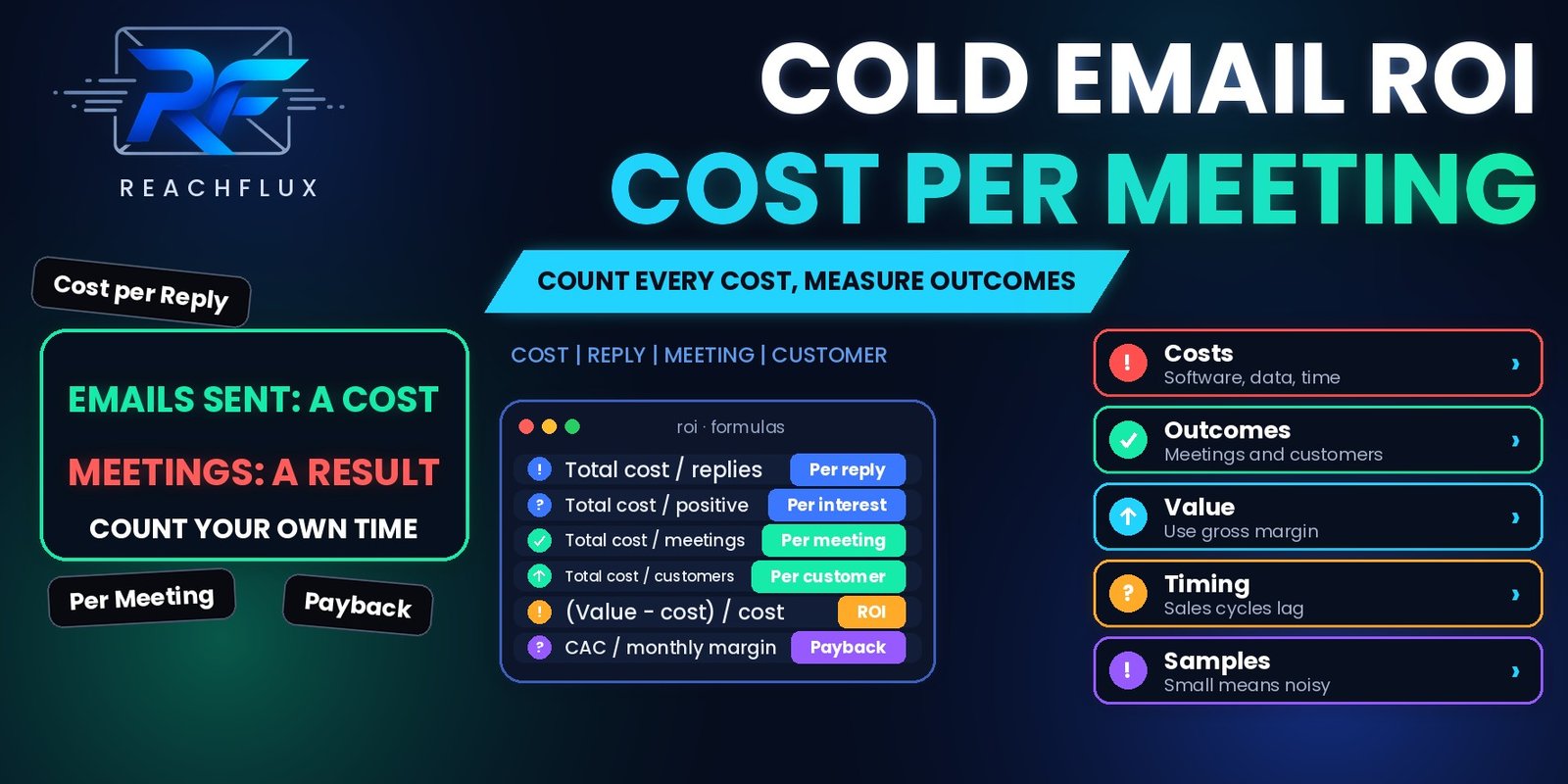
Add up everything that outreach costs, count the outcomes it produced, and divide. The key numbers are cost per reply, cost per positive reply, cost per meeting and cost per customer, set against the value of a customer. ROI is then the value of the customers won minus the total cost, divided by the total cost. The arithmetic is simple. The discipline is in counting costs honestly, especially your own time, and in being realistic about how long customers take to appear.
Cold email numbers are small and noisy, and sales cycles can be long, so treat any ROI figure as an estimate that improves with data. This guide gives you the formulas, a worked example with invented numbers, the costs people forget and the ways ROI calculations mislead.
Everything that outreach costs
| Cost | What to include | Often forgotten |
|---|---|---|
| Infrastructure | Domains, mailboxes and DNS | Extra domains added as you scale |
| Software | Sending platform, validation, any research tools | Per-user and per-mailbox charges |
| Data and research | Lead sources and the time spent researching | Hours spent per contact, which are the largest cost for small teams |
| People | Time writing, managing, replying and following up | Founder or salesperson time, which has a real cost |
| Testing and mistakes | Domains damaged, campaigns that failed | Recovery time after a deliverability problem |
The core calculations
| Metric | Formula | What it tells you |
|---|---|---|
| Cost per reply | Total cost ÷ replies | How much attention costs |
| Cost per positive reply | Total cost ÷ positive replies | How much interest costs |
| Cost per meeting | Total cost ÷ meetings held | How much a real conversation costs |
| Cost per customer | Total cost ÷ customers won | The cost of acquisition through this channel |
| ROI | (Value of customers won − total cost) ÷ total cost | The return relative to what you spent |
| Payback period | Customer acquisition cost ÷ monthly gross margin per customer | How long until the customer repays the cost |
A worked example with invented numbers
Suppose a small team runs a campaign for a month. These figures are made up purely to show the method. Infrastructure and software cost 400. Research and writing take 40 hours, valued at 30 per hour, so 1,200. Replying and follow-up take 15 hours, so 450. Total cost: 2,050.
The campaign produces 60 replies, 18 positive replies, 9 meetings held and 2 customers. Cost per reply is about 34. Cost per positive reply is about 114. Cost per meeting is about 228. Cost per customer is 1,025. If each customer is worth 6,000 in gross margin over their lifetime, the value is 12,000, giving an ROI of (12,000 minus 2,050) divided by 2,050, roughly 4.9 times the investment.
Be careful how you value a customer
ROI depends heavily on the value you assign to a customer. Use gross margin rather than revenue, since revenue ignores the cost of delivering the product. Consider the time frame: lifetime value can be large but takes years to realise, while first-year value is smaller and more certain. Be conservative, and note your assumptions so you can revisit them.
Different customers are worth different amounts. If outreach brings in smaller customers than other channels, a cost-per-customer comparison alone will mislead you. Compare on value as well as on count.
Sales cycles make ROI arrive late
A campaign launched this month may produce customers months from now. If you measure ROI too early, it will look worse than it is. If you attribute later customers to the wrong source, it will look better. Track each lead from the first email to the outcome, so that customers can be traced back to the campaign that started the conversation. The pipeline view is covered in Cold Email Lead Handoff: How to Move Replies Into Your CRM and Pipeline Without Dropping Leads.
Until enough time has passed, use leading indicators such as qualified conversations and meetings, and treat customer numbers as provisional.
How to use benchmarks without being misled
Published benchmarks for reply rates and cost per meeting are tempting, but they come from other businesses with other audiences and offers. Use them as a sanity check, not as a target. A far-off number is a prompt to investigate, not proof that something is broken. Your own trend over time, measured consistently, is a better yardstick than anyone else’s average.
Where ROI actually improves
Better targeting
Sending to better-fit contacts raises replies and meetings without raising cost. See How to Build a Cold Email Prospect List: Sources, Research and Validation.
Better deliverability
Fewer messages lost to spam means more of your spend reaches people. See the Cold Email Deliverability: The Complete Guide to Inbox Placement, Reputation and Fixes.
Faster, better reply handling
Converting more positive replies into meetings is cheaper than finding more replies. See Cold Email Reply Templates: How to Answer Interested, Not Now, Wrong Person and Objection Replies.
Fixing the weakest funnel stage
Improve where the funnel leaks most. See Cold Outreach Conversion Rates Dropping? How to Diagnose the Funnel From Sent to Booked.
Cutting wasted effort
Stop steps, segments and sources that never produce meetings.
Ways these numbers fool people
Ignoring your own time
If the founder does the work, it is still a cost. Leaving it out makes outreach look free.
Tiny samples
A few meetings or customers can swing the numbers wildly. Wait for more data before drawing conclusions.
Counting sends as results
Emails sent is activity, not output.
Attributing customers to the wrong channel
Buyers often meet several touches. Be clear about how you assign credit, and apply it consistently.
Comparing different customer values
A cheaper customer is not better if they are worth far less.
What to record to calculate ROI later
Set up simple tracking from the start. For each campaign, record the dates, the segment and list source, the volume sent, replies, positive replies, meetings booked and held, opportunities, customers and the value of each. Record your time as well as your spend. A weekly review, as in Cold Email Operating Rhythm: Daily, Weekly and Monthly Routines for Managing Outreach at Scale, makes this routine rather than a chore.
Use the same yardstick across channels
ROI is most useful when it lets you compare options. Calculate cost per meeting and cost per customer for each channel with the same rules, and include time for all of them. The comparison in Cold Email vs LinkedIn Outreach vs Cold Calling: Which Channel Fits Your Business? shows why the channels differ in cost and where each fits.
A one-page ROI sheet you can copy
| Row | What goes in it |
|---|---|
| Campaign and dates | Name, segment, source and the period measured |
| Costs | Infrastructure, software, data and hours at an hourly value |
| Volume | Emails sent, delivered and contacts reached |
| Outcomes | Replies, positive replies, meetings booked and held, opportunities, customers |
| Value | Gross margin per customer and its time frame |
| Results | Cost per reply, positive reply, meeting and customer; ROI and payback |
| Notes | Assumptions, anything unusual and what you will change next |
Keep one sheet per campaign and one summary sheet across campaigns. Over several months the pattern becomes far more reliable than any single result.
ROI checklist
- All costs are counted, including software, data and your own time.
- You track replies, positive replies, meetings, opportunities and customers.
- Cost per meeting and cost per customer are calculated, not just cost per email.
- Customer value uses gross margin and states its assumptions.
- You allow for sales cycle delay before judging results.
- Samples are large enough, or results are marked provisional.
- Credit for customers is assigned consistently.
- Numbers are reviewed on a regular schedule.
Questions about cold email ROI
How do I calculate cold email ROI?
Add up all costs, count outcomes, and divide. Calculate cost per reply, positive reply, meeting and customer, then ROI as the value of customers won minus total cost, divided by total cost.
What is a good cost per meeting for cold email?
It varies widely by industry and offer, so compare against your own customer value and against other channels rather than a generic figure.
Should I include my own time in cold email costs?
Yes. Time spent on research, writing and replies is often the largest cost for small teams, and leaving it out makes outreach look cheaper than it is.
How long should I wait before judging cold email ROI?
Long enough for your typical sales cycle to play out. Use meetings and qualified conversations as leading indicators until customers appear.
Why does cold email ROI look different month to month?
Small numbers and long sales cycles make results noisy. Track from first email to outcome and look at trends over several periods.
What improves cold email ROI most?
Better targeting, better deliverability, faster reply handling and fixing the weakest funnel stage usually do more than sending more emails.
Measure conversations and customers, and count every cost.
ROI turns outreach from activity into an investment you can judge. Count all costs including time, track outcomes from first email to customer and compare channels with the same rules.
Treat early numbers as provisional, and let the data accumulate before you make big decisions.
Track sending status, replies and lead stages in one place.
ReachFlux brings sending status, replies and pipeline stages together so you can connect campaigns to outcomes.