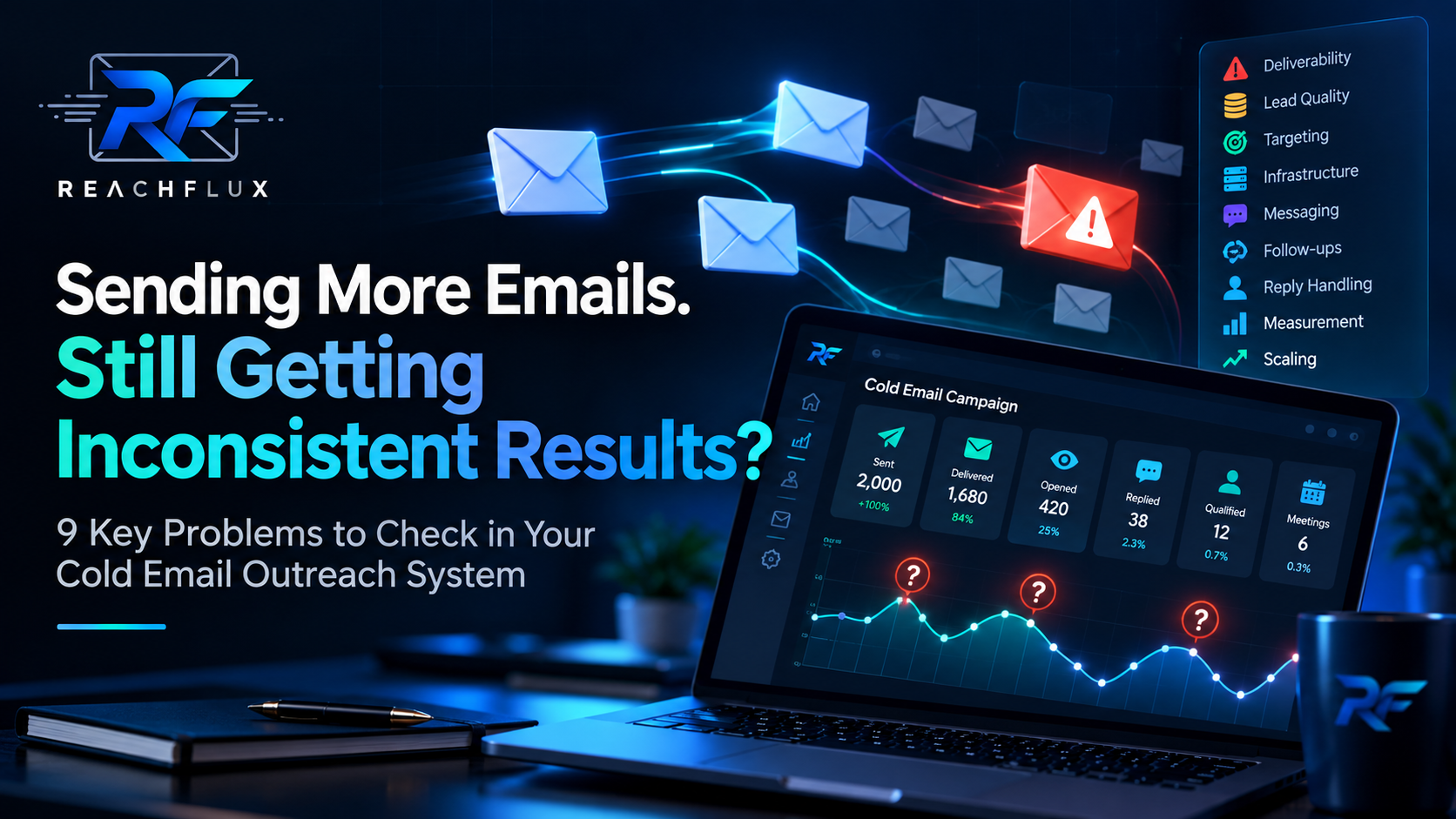
If your cold email outreach is inconsistent despite high sending volume, the problem is usually not that you need to send even more. Your outbound system has several conversion stages, and instability at any one of them can make the final results unpredictable.
One week can produce several promising conversations. The next can produce almost nothing.
That does not automatically mean cold email has stopped working.
Your deliverability may have changed. Your prospect list may be weaker. One sending domain may be struggling. Your targeting may have widened. Your offer may fit one segment better than another. Replies may arrive but never become qualified opportunities.
Increasing volume before identifying the unstable stage can make the problem harder to diagnose.
Why is cold email outreach inconsistent?
Cold email becomes inconsistent when one or more stages between sending an email and creating an opportunity are unstable.
The most common areas to investigate are:
Your messages do not reach recipients consistently.
Different lists contain very different prospect quality.
Your audience becomes broader as you chase more volume.
Domains and inboxes do not perform equally.
The offer does not resonate equally across segments.
Later touches add pressure instead of new value.
Interested prospects fall through operational gaps.
You optimize sends or opens instead of pipeline outcomes.
Volume increases before the campaign is repeatable.
More volume amplifies the system you already have. If the system is stable, volume can expand its output. If the system is unstable, volume can expand the instability.
The mistake: treating sending volume as the result
Sending 2,000 emails is activity.
It is not automatically progress.
This distinction matters because outbound teams can easily measure activity.
Dashboards can show:
- emails queued,
- emails sent,
- campaigns launched,
- inboxes connected,
- opens recorded,
- and clicks tracked.
Those numbers can rise while qualified conversations stay flat.
A measure of outbound volume.
A result produced by several conversion stages working together.
If you only watch sending volume, you cannot tell whether the problem sits before delivery, after delivery, after the reply, or after qualification.
Diagnose the outbound funnel before changing the campaign
A cold email campaign is better understood as a chain of stages.
These stages are not equally observable.
A successful SMTP handoff, for example, does not prove that the recipient saw the message in their primary inbox.
Open tracking also has limitations and should not be treated as a perfect measurement of human attention.
Still, thinking in stages gives you a much better diagnostic model.
| If this changes... | Investigate first |
|---|---|
| Bounces rise | Lead validation, mailbox/provider responses, authentication |
| Delivery appears normal but replies collapse | Targeting, inbox placement, message, offer |
| Replies exist but few are positive | Audience fit, positioning, offer, qualification |
| Positive replies exist but meetings stay low | Reply handling and sales process |
| Only some inboxes struggle | Account/domain health and traffic distribution |
| Performance drops after scaling | Volume change, infrastructure, list expansion, targeting drift |
Instead of rebuilding the entire campaign after one bad week, identify which stage changed first.
1. Your deliverability is not as consistent as your sending volume
You can send the same number of emails on Monday and Friday without achieving the same effective reach.
Sending volume tells you how much traffic left your system.
It does not tell you how receiving providers treated every message.
Deliverability can be influenced by:
SPF, DKIM and DMARC configuration and alignment.
Recipient validity and bounce behavior.
Sending patterns and sudden changes in traffic.
Domain and sending reputation.
Recipient engagement, complaints and unwanted-email signals.
That means a campaign can look stable at the sending layer while becoming unstable further downstream.
If reply performance changes sharply, compare it with changes in:
- sending domains,
- sending accounts,
- daily traffic,
- recipient sources,
- bounce patterns,
- authentication,
- and provider responses.
2. Your lead quality changes from list to list
Two prospect lists with 1,000 contacts each are not equivalent.
One might contain businesses that clearly fit your offer.
Another might contain outdated records, weak-fit companies, generic addresses, wrong job functions, or businesses with no reason to care about the problem you solve.
Sending the same email volume to both lists can produce completely different outcomes.
- Clear industry fit
- Relevant company profile
- Appropriate role
- Current contact data
- Broad industry mix
- Weak company fit
- Mixed job functions
- Questionable contact freshness
If List A generates conversations and List B does not, the answer is not necessarily to send List B twice as many emails.
Your campaign inputs changed.
Before blaming copy or infrastructure, ask: “Did the audience change when the results changed?”
3. You expanded volume by weakening your targeting
This happens frequently during scaling.
A narrow campaign starts working.
The team wants more results, so it needs more prospects.
To find them, the targeting criteria become broader.
The sending dashboard now looks better because more emails leave the system.
But the average relevance of each email may have declined.
That can create an illusion:
“We scaled outbound, but performance became inconsistent.”
In reality, the infrastructure may have scaled while the audience definition changed underneath it.
Compare performance by segment instead of treating every prospect as part of one giant campaign population.
4. Your sending infrastructure is uneven
If you use several sending accounts, do not assume they all have identical health.
Imagine a campaign distributed across six inboxes.
At campaign level, the aggregate numbers may hide the differences.
The same problem applies to domains.
If several inboxes share a sending domain, a domain-level issue can affect more than one account.
This is why infrastructure should be monitored below the overall campaign level.
Look for differences between:
- sending accounts,
- sending domains,
- providers,
- campaign segments,
- and time periods.
5. Your message works for one segment but not another
Good cold email copy is not good in isolation.
It is good for a particular audience, problem, context, and offer.
A message can perform well with one segment and poorly with another even if the wording stays identical.
For example, imagine a software development company contacting:
They may care about extra development capacity and client delivery.
They may care more about product engineering, APIs, integrations, or backend scalability.
They may respond better to operational automation, internal systems, or replacing manual workflows.
One generic message sent to all three groups may produce unstable results because the problem framing is not equally relevant.
Instead of asking:
“Which cold email template gets the best reply rate?”
Ask:
“Does this message make sense for this specific prospect segment?”
That question is much more useful.
6. Your follow-ups repeat instead of progressing the conversation
A campaign is not only its first email.
If a large part of your sequence traffic consists of follow-ups, weak follow-ups can drag down the performance of the entire campaign.
Consider these two approaches.
Same context. Same value. More pressure.
New angle. New context. Lower friction.
A follow-up can:
- clarify the original value proposition,
- introduce another relevant problem,
- reduce the size of the ask,
- provide useful context,
- or simply make the message easier to answer.
It should not exist only because the automation says another email is due.
7. Your outreach gets replies, but the pipeline leaks afterward
This is where teams can misdiagnose a sales-process problem as a cold-email problem.
Suppose outreach generates interested replies.
But:
- the reply sits unread for hours or days,
- nobody owns the conversation,
- the response is generic,
- meeting coordination becomes slow,
- the lead is never moved through a pipeline,
- or there is no follow-up after the prospect shows interest.
Sending more emails does not repair this stage.
If positive replies are reasonably stable but meetings are not, investigate what happens after the reply.
That is a different problem from inbox placement.
8. You are measuring the easiest metrics instead of the useful ones
Some metrics are attractive because they move quickly.
That does not make them the best indicators of business outcomes.
Open tracking can still provide useful directional information, but it should not become the only definition of success.
Privacy protections, image loading behavior, security scanners, and email clients can make open data imperfect.
For most B2B outbound teams, replies and qualified conversations are closer to the real objective.
9. You scaled before the campaign became repeatable
This is perhaps the most expensive version of the problem.
A campaign gets a few encouraging replies.
The team assumes it has found a repeatable system.
Volume jumps.
More domains are added. More inboxes are connected. More prospects are sourced. More segments are included.
Then performance becomes unpredictable.
Several variables changed at the same time.
This makes diagnosis difficult.
A better approach is to scale one controlled dimension at a time where practical.
For example:
Confirm that the problem and offer resonate.
Avoid declaring victory from a handful of sends.
Understand first-touch and follow-up behavior.
Increase infrastructure as real workload requires it.
Watch whether the underlying conversion stages remain stable.
A practical framework for diagnosing inconsistent cold email
When results drop, resist the urge to change everything.
Work from the top of the system downward.
Compare lead source, audience, company size, geography, job roles, validation quality, and campaign segmentation.
Compare domains, accounts, authentication, sending patterns, bounces, failures, and provider responses.
Look at subject lines, opening context, offer, CTA, personalization, and follow-up progression.
Separate positive, negative, neutral, referral, and irrelevant replies instead of treating all replies equally.
Measure response time, qualification, meeting scheduling, pipeline movement, and eventual opportunity creation.
If you change the audience, copy, infrastructure, volume, and offer simultaneously, you may never know what fixed or damaged performance.
Find the first stage where performance changed. That is usually more useful than starting from the final symptom — “we are not getting enough meetings.”
How to make cold email results more consistent
No outbound system produces identical results every day.
Prospects are human. Sample sizes vary. Timing changes. Markets change.
The goal is not to eliminate normal variation.
The goal is to reduce avoidable instability.
Know which segment each campaign is actually testing.
Do not sacrifice relevance merely to keep send volume high.
Look below aggregate campaign statistics at accounts and domains.
Avoid turning a small working campaign into a completely different system overnight.
Give later touches a purpose beyond reminding the recipient that you emailed.
Do not let interested prospects become operational leakage.
Connect campaign activity to qualified conversations and opportunities.
Change enough to learn, but not so much that the result becomes impossible to explain.
Where ReachFlux fits into a more controlled outbound workflow
As outbound grows, consistency becomes partly an operational problem.
ReachFlux brings campaign sending, multiple sending accounts, recipient activity, replies, lead stages, and follow-up workflows into the same system.
Campaigns can distribute recipients across connected accounts, replies can return to the application, and leads can move through pipeline stages instead of disappearing inside separate inboxes. AI Assist can help draft replies, while Auto-Pilot can handle supported lead actions, including meeting-scheduling workflows when configured.
Those tools can reduce operational fragmentation.
They do not replace the fundamentals.
You still need:
- relevant prospects,
- valid contact data,
- properly configured sending infrastructure,
- a credible offer,
- useful messaging,
- and a process for turning replies into opportunities.
Run this consistency check.
Frequently asked questions
Why is our outbound inconsistent even though we send a high volume of emails?
High volume only measures how much email you send. Consistent results also depend on deliverability, prospect quality, targeting, sender infrastructure, message relevance, follow-ups, reply handling, and conversion after the reply. Diagnose those stages separately before increasing volume.
Does sending more cold emails generate more leads?
More volume can create more opportunities when the underlying campaign already works and the additional audience remains relevant. Increasing volume does not guarantee proportional results, especially if targeting, lead quality, deliverability, or sender health decline while scaling.
Why did my cold email campaign suddenly stop getting replies?
Compare the period before and after the decline. Check whether lead sources, targeting, sending accounts, domains, volume, authentication, bounce behavior, copy, or the offer changed. Finding the first changed stage is more useful than immediately rewriting the entire campaign.
Can poor deliverability cause inconsistent cold email results?
Yes. The number of emails your system sends does not guarantee that receiving providers treat every message identically. Domain reputation, authentication, recipient quality, complaints, bounces, and sending behavior can all affect delivery outcomes.
Should I track open rate to judge cold email performance?
Open data can provide directional information, but it has measurement limitations. Replies, qualified conversations, meetings, and opportunities are generally closer to the business outcome an outbound campaign is trying to create.
How do I know whether the problem is my email copy or my lead list?
Compare controlled segments. If the same message performs very differently across prospect groups, audience quality or relevance may be a major factor. If several strong-fit segments react poorly to the same positioning, the message or offer deserves closer investigation.
When should I scale a cold email campaign?
Scale after you have enough evidence that the audience, offer, message, sending process, and reply workflow can produce useful conversations repeatedly. Add capacity gradually so you can observe whether performance changes as the campaign grows.
If outbound is inconsistent, do not automatically solve it with more outbound. Find the first unstable stage. Check your prospects, infrastructure, delivery behavior, message, follow-ups, replies, and pipeline separately. Then fix the stage that is actually limiting the system.
Sending volume is only one part of the system.
Manage campaigns, multiple sending accounts, replies, lead activity, follow-ups, and pipeline movement from one outbound workflow.