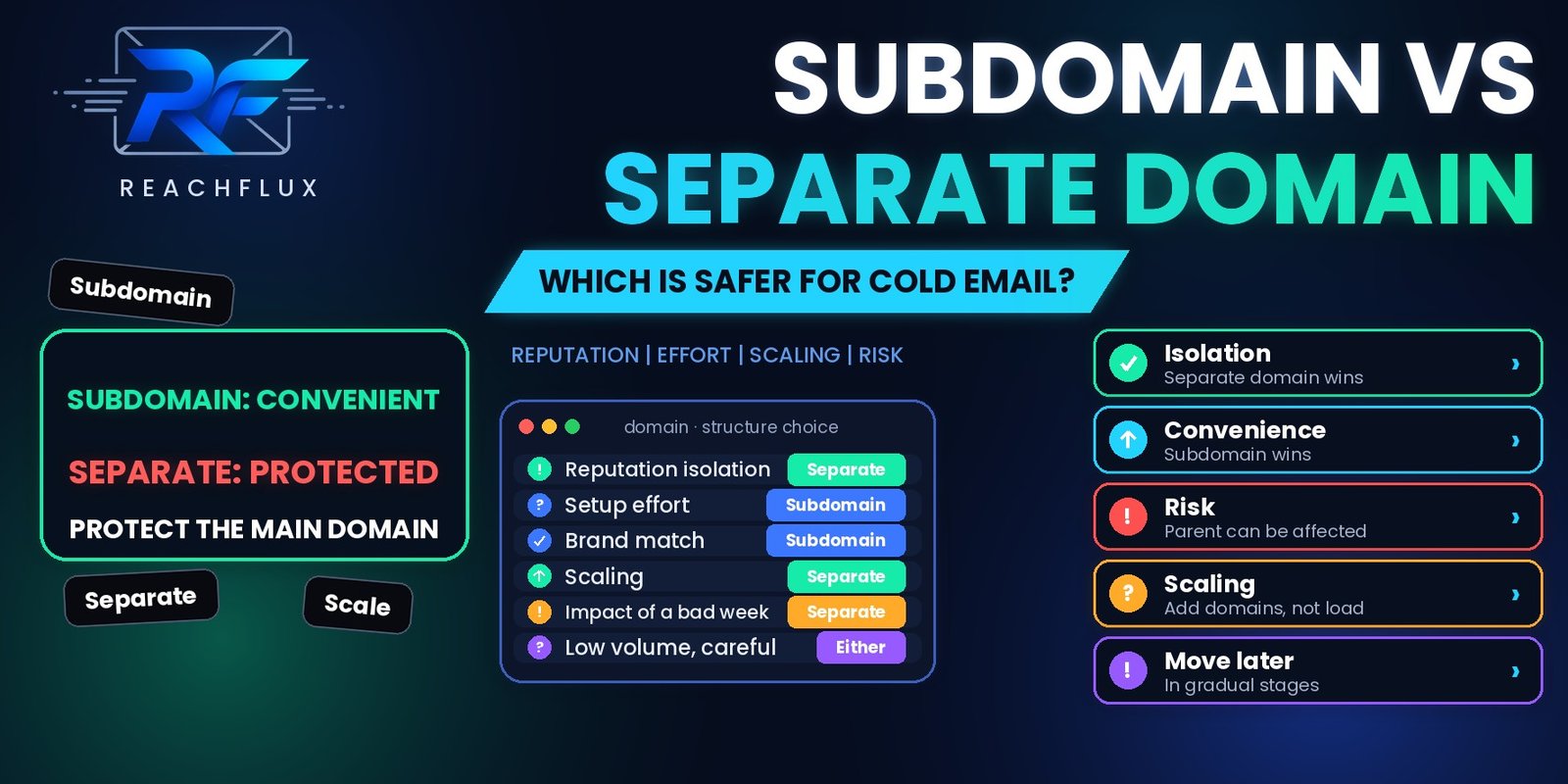
Should you use a subdomain or a separate domain for cold email?
For anything beyond very low volume, a separate domain is the safer choice. A subdomain of your main domain is quick to set up and looks closely tied to your brand, but receiving systems may associate it with the parent domain, so serious problems on the subdomain can still touch the reputation of the domain your staff and customers use. A separate, plainly related domain isolates that risk.
A subdomain can be acceptable for small, careful programmes where the convenience is worth the exposure. The right answer depends on how much you send, how much damage a bad week would do, and how much effort you are willing to put into extra infrastructure. This guide lays out the trade-offs so you can decide.
Subdomain versus separate domain side by side
| Factor | Subdomain of your main domain | Separate, related domain |
|---|---|---|
| Reputation isolation | Weaker, because it can be associated with the parent domain | Stronger, with risk kept away from the main domain |
| Setup effort | Low, because you already control the DNS | Higher, because you register and configure a new domain |
| Brand match | Very close, sharing your exact brand domain | Close but not identical |
| Cost | Minimal | Domain and mailbox costs per domain |
| Scaling | Hard to spread across several domains | Easy to add more domains as volume grows |
| Impact of a bad week | May affect parent domain reputation | Usually contained to the outreach domain |
| Best for | Small, low-volume, careful programmes | Most ongoing outreach programmes |
The real advantages of a subdomain
A subdomain has genuine appeal. It needs no new registration, it is already under your control, and it carries your brand’s name exactly, which recipients may find reassuring. For a small team sending a modest number of messages to a well-researched list, it can be a reasonable choice.
Some businesses also use subdomains for clear separation of purposes, for example a different one for marketing, transactional and outreach mail. That separation can help, but it is a weaker barrier than a separate domain. Treat it as a convenience rather than as complete protection.
What can go wrong with a subdomain
Shared reputation signals
Mailbox providers may evaluate subdomains partly on the basis of the parent domain, especially when a subdomain has little history of its own.
Spread of damage
A serious problem, such as spam complaints or blocklist listing, can make people distrust the whole domain, not just the subdomain.
Difficulty scaling
Spreading volume across several subdomains of one parent concentrates risk on that parent rather than distributing it.
Pressure on the main brand
If outreach damages the main domain, the consequences reach customer and staff email, which is far more costly than losing an outreach domain.
Five scenarios and what to choose
These are hypothetical situations, included to make the trade-offs concrete.
A solo founder sending a few carefully researched emails a day
A subdomain can be acceptable. Volume is small, the list is hand-picked and the risk is low, though a separate domain is still safer if the main domain handles critical email.
A small team planning a few hundred sends a day
A separate domain. At this volume, a problem would be noticeable, and protecting customer email is worth the small extra setup.
An agency running outreach for several clients
Separate domains, ideally per client, so one client’s issues never touch another’s. See Why Do Some Client Cold Email Domains Keep Landing in Spam? An Agency Diagnostic Guide.
A company in a sensitive sector
A separate domain with extra care on naming and wording, because filters are stricter in sectors such as finance.
A business that already has a damaged main domain
Do not add more risk to it. Use a clean, separate domain and let the main domain recover.
A simple decision guide
| Your situation | Better choice |
|---|---|
| Very small volume, a carefully researched list and a tolerant risk profile | A subdomain can be acceptable |
| Ongoing outreach at moderate or high volume | A separate domain |
| Sending to sensitive sectors such as finance | A separate domain, with extra care. See Why Do My Finance Cold Emails Keep Landing in Spam? 9 Causes and Fixes for Financial Services Outreach |
| You expect to scale across several mailboxes and domains | Separate domains, planned with the capacity calculation |
| Your main domain handles critical customer email | A separate domain |
How authentication behaves across domains and subdomains
SPF and DKIM are checked for the domain a message is sent from, so a subdomain needs its own records. DMARC is a little different. A DMARC policy published for a parent domain can apply to its subdomains unless they have their own policy, so check what your parent policy says and whether you want subdomains to follow it.
Whichever structure you choose, verify on a delivered message that SPF, DKIM and DMARC pass and align for the domain in the visible From address. Do not assume that records on the parent cover the subdomain. The explanation of each record is in SPF vs DKIM vs DMARC: What Cold Email Senders Need to Know.
How to set up a separate domain well
Choose a plain name that is clearly connected to your brand, avoiding hyphens, odd spellings and lookalikes. Register it early so it can build history, point it at a simple website or a redirect to your main site, then create mailboxes with real sender identities and publish SPF, DKIM and DMARC. Ramp volume gradually and keep each domain within sensible limits.
The detailed steps are in How to Set Up Cold Email Inboxes and Domains: A Step-by-Step Guide, naming ideas are in Cold Email Domain Name Ideas: Safe Naming Patterns and What to Avoid, and the capacity maths is in Cold Email Capacity Calculator: How Many Domains and Inboxes You Need for Your Daily Volume.
How to reduce the risk of a subdomain
- Keep volume modest and ramp up gradually.
- Use only validated, well-researched contacts.
- Pass and align SPF, DKIM and DMARC for the subdomain.
- Keep complaints and bounces far below your usual levels, and stop at the first sign of trouble.
- Use a distinct, plain prefix and do not reuse it for other mail types.
- Plan to move to a separate domain if volume grows.
Questions people ask when choosing
Can I use both a subdomain and a separate domain?
Yes. Some teams use a subdomain for low-volume, high-touch outreach and separate domains for scaled programmes.
Does a subdomain share blocklist problems with its parent?
Listings are made at different levels depending on the list, so a problem can sometimes extend to related names. Treat the possibility as a reason for caution.
Is a subdomain better than sending from the primary domain?
Yes, because it adds some separation, but it is weaker than a separate domain.
Will recipients notice the difference?
Mostly not. What matters to them is that the sender name and address look legitimate and relevant.
Moving from a subdomain to a separate domain
If you start on a subdomain and outgrow it, plan the move carefully. Set up the new domain in parallel, ramp it gradually and move volume across in stages, as covered in Cold Email Platform Migration Checklist: How to Switch Tools or Mailboxes Without Losing Deliverability. Do not switch everything at once, and keep an eye on results while the new domain builds its own history.
The earlier you make the move, the less reputation you have riding on the subdomain, and the easier it is to separate the two.
Counting the real cost of separation
A separate domain costs a registration fee and the time to set it up and monitor it, plus mailboxes for each sender. Set that against the cost of a damaged main domain: missed customer replies, failed invoices and months of repair. Seen that way, separation is cheap insurance. If budget is tight, start with a single separate domain and a conservative volume, and add more as your results justify it.
Document the structure so it survives staff changes
Domain structures tend to grow messy. A few simple habits keep them manageable. Keep a register of every domain and subdomain you use, what each is for, who owns it and which mailboxes sit on it. Store registrar and DNS access in a shared, secure place so more than one trusted person can reach it. Record the date each domain was registered and when it began sending, so you can see its age at a glance.
Review the register every quarter. Retire domains that are no longer needed or that have been damaged, and note why. A tidy record makes audits, migrations and troubleshooting far quicker, and it prevents the situation where nobody remembers which domain carries which risk.
Domain structure checklist
- You know how much volume you plan to send and how much a bad week would cost you.
- Your main domain handles customer and staff email and is protected from outreach risk.
- You have chosen a separate domain for ongoing outreach, or accepted the limits of a subdomain.
- Authentication passes and aligns on the domain you choose.
- Volume is capped and ramped gradually.
- You have a plan for adding domains as you grow.
Questions about subdomains and separate domains
Should I use a subdomain or a separate domain for cold email?
For anything beyond very low volume, a separate, plainly related domain is safer because it isolates reputation risk from your main domain. A subdomain is easier to set up but can still be associated with the parent domain.
Does a subdomain protect my main domain from cold email problems?
Only partly. Mailbox providers may associate a subdomain with its parent domain, so a serious problem can still affect the reputation of the main domain.
Is a subdomain good enough for low-volume outreach?
It can be acceptable for small, careful programmes using validated contacts, provided you keep volume modest and pass authentication, and you accept the exposure.
Can I send cold email from my primary domain?
It is generally not recommended, because outreach risk could affect the email your staff and customers rely on.
How many domains do I need for cold email?
It depends on your daily volume and safe limits. Work it out with a capacity calculation rather than guessing.
Can I switch from a subdomain to a separate domain later?
Yes, but do it gradually. Set up the new domain in parallel, ramp it carefully and move volume in stages while monitoring results.
Protect the domain your business runs on.
A subdomain is a convenience. A separate domain is protection. For serious, ongoing outreach, protection is usually worth the extra setup.
Choose deliberately, keep volume modest while you learn, and move to a separate domain before a subdomain becomes a liability.
Connect the accounts you control and manage sending in one workflow.
ReachFlux works with the SMTP and IMAP accounts you connect, so your domains and authentication stay under your control.