How should an agency run cold email for several clients?
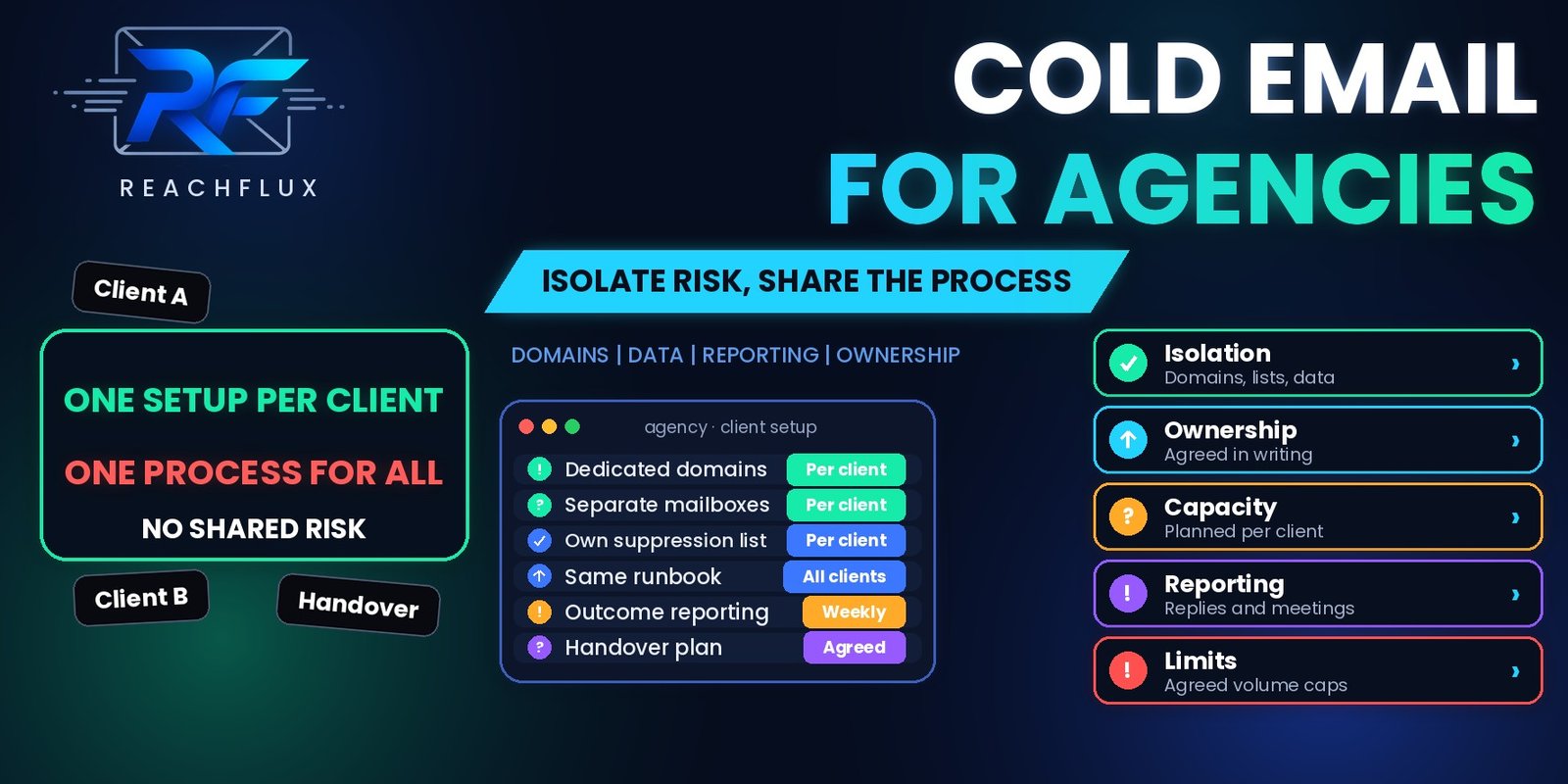
Give every client their own isolated setup, their own domains and mailboxes, their own lists and suppression data, and their own reporting, and keep the process the same across all of them. Isolation protects each client from the others’ mistakes, and a shared process keeps quality consistent and your team efficient. Be explicit with clients about ownership, expectations and compliance from the very start.
The danger for agencies is not any single campaign. It is shared risk. One careless list, one aggressive client or one damaged domain can ripple across accounts if they share infrastructure. This guide lays out how to structure the work so that problems stay small and results stay explainable.
What to keep separate for each client
| Asset | Why it must be separate | Notes |
|---|---|---|
| Sending domains | Reputation lives on the domain | Dedicated outreach domains per client. See Subdomain vs Separate Domain for Cold Email: Which Is Safer for Deliverability? |
| Mailboxes | Identity and limits belong to one client | Never share mailboxes between clients |
| Lead lists | Different audiences and sources | Keep client data apart and records clear |
| Suppression lists | Opt-outs belong to the client’s brand | One list per client, applied to all their campaigns |
| Reporting | Each client needs their own results | Separate dashboards and summaries |
| Credentials and access | Security and clean handover | Per-client access, with clear owners |
Decide who owns what before you start
Agree in writing who owns the domains, mailboxes, lists, content and reports, and what happens to them if the relationship ends. The safest arrangement for the client is that they own the domains and data, with the agency holding delegated access. It also protects the agency from disputes. Reputation is built on domains, so a client who loses theirs when they leave has lost months of work.
The same questions appear from the buyer’s side in Cold Email Expert: What They Actually Do, What to Ask and How to Judge One, which is worth reading when you design your own terms.
A repeatable client onboarding process
Agree who the client wants to reach, what they offer and how success will be judged, in terms of qualified conversations rather than emails sent.
Check any existing domains, mailboxes, lists and authentication before touching anything.
Create dedicated domains and mailboxes, publish and verify authentication, and ramp up gradually. See How to Set Up Cold Email Inboxes and Domains: A Step-by-Step Guide.
Source, validate and segment, and set up the client’s suppression list from day one.
Start small, review replies and bounces together, and agree adjustments before scaling.
Plan capacity per client, not for the agency as a whole
It is tempting to pool mailboxes and spread volume across everything. Resist it. Each client should have the capacity their own volume needs, planned with the same method every time. The calculation in Cold Email Capacity Calculator: How Many Domains and Inboxes You Need for Your Daily Volume works well as a per-client template.
When a client wants to scale, add domains and mailboxes for that client, not extra load on the existing ones. That keeps every client within comfortable limits and makes costs easy to explain.
One process, applied to every client
Isolation protects the clients. Process protects your team. Use the same daily, weekly and monthly routine for every account, the same alert rules and the same reporting format, so anyone on the team can step in. The structure in Cold Email Operating Rhythm: Daily, Weekly and Monthly Routines for Managing Outreach at Scale and the alerts in Cold Email Monitoring and Alerts: What to Watch So Campaigns Never Stop Silently are good foundations to adapt.
Document the process in a short runbook, with a place for client-specific details such as audience, tone and exclusions. New team members become productive faster, and quality does not depend on one person’s memory.
Report outcomes, not activity
| Include | Leave out or downplay |
|---|---|
| Replies and positive replies by segment | Emails sent as a success measure |
| Meetings booked and held | Open rates, which are unreliable |
| Bounces and complaints, with notes on causes | Vanity totals without context |
| What was tested and what was learned | Unexplained changes |
| Next steps and requests of the client | Vague promises |
Honest reporting builds trust. If results are weak, show what you think is causing it and how you plan to fix it. See Cold Outreach Conversion Rates Dropping? How to Diagnose the Funnel From Sent to Booked for a method clients can follow.
Onboarding two clients with very different risk profiles
Imagine an agency taking on two clients in the same month. Client A sells project software to mid-sized firms, brings a researched list and wants modest volume. Client B is in a sensitive financial sector, has a purchased list and wants to start at high volume. The method is the same for both. The treatment is not.
For Client A, the agency builds dedicated domains and mailboxes, validates the list, runs a short pilot and scales gradually. For Client B, the agency explains that the list must be validated and trimmed before any sending, agrees conservative caps in writing, chooses careful domain naming and wording for the sector, and starts with a small pilot. Both clients get separate infrastructure and reporting. If Client B’s domain has a bad week, Client A never notices. That is what isolation is for.
Manage the risks that are specific to agencies
A client with aggressive expectations
Agree volume limits and list standards in writing. If a client insists on practices that harm deliverability, be ready to decline them.
Poor client lists
Validate every list, and push back on sources you cannot trust. See Why Do Half of Your Prospect Emails Bounce? Fixing Bad Data From Paid Databases and LinkedIn.
Compliance responsibilities
Be clear about who is responsible for what, make sure opt-outs are honoured for each client, and check local rules. See Cold Email Compliance and Deliverability: Opt-Outs, Sender Identity and Complaint Rates.
Key-person dependence
If one person holds all the knowledge, absence becomes an incident. Keep the runbook current.
Domain damage
Treat any damaged domain as a client-specific problem, pause it and follow the diagnostic order in the Cold Email Deliverability: The Complete Guide to Inbox Placement, Reputation and Fixes.
What your tools need to support
Agencies need to manage several clients’ lead files, sender accounts, replies and opportunities without them bleeding into each other. ReachFlux’s agencies page describes this situation, with lead imports, multi-account sending, reply management and pipeline in one workflow. Whatever you choose, test that it keeps clients cleanly separated, that suppression applies per client and that reporting can be split by client.
No tool removes the need for isolated domains and a disciplined process. It makes the process easier to run.
Commercial terms that protect both sides
Clear terms prevent most agency disputes. Put in writing what is included, what the client must provide, such as a list or approvals, and how success is measured. State plainly that results cannot be guaranteed, because mailbox providers and recipients decide outcomes, and describe the activities and reports the client can expect.
Cover ownership and handover, volume limits and list standards, who is responsible for compliance in the client’s market, and what happens if a domain is damaged. Prefer a short initial scope with a review point over a long commitment, and be wary of pricing that rewards sending more rather than achieving more. Good terms make hard conversations easier because everyone already agreed on the rules.
Plan for the end of the relationship
Clients leave, and a clean handover protects everyone. Provide the domains, mailbox access, lists, suppression data, templates and reports they are entitled to, and document the DNS and authentication setup. Remove your access in an orderly way and confirm the handover in writing. A tidy ending leaves the client able to continue and leaves your reputation intact.
Agency cold email checklist
- Every client has dedicated domains, mailboxes, lists and suppression data.
- Ownership of assets and the handover terms are agreed in writing.
- Onboarding follows the same steps for every client.
- Capacity is planned per client with a consistent method.
- Daily, weekly and monthly routines and alerts are the same across accounts.
- Reports focus on replies, meetings, bounces and learning.
- Volume limits and list standards are agreed with each client.
- A current runbook exists and offboarding is planned.
Questions about agency cold email
How should an agency run cold email for multiple clients?
Give each client isolated domains, mailboxes, lists, suppression data and reporting, run every account with the same process, and agree ownership, expectations and compliance responsibilities in writing from the start.
Should agencies share domains across clients?
No. Reputation lives on the domain, so sharing lets one client’s behaviour damage another. Use dedicated domains and mailboxes per client.
Who should own the domains in an agency arrangement?
Typically the client, with the agency holding delegated access, so the client keeps their reputation if the relationship ends.
What should an agency report on to clients?
Replies, positive replies, meetings booked and held, bounces and complaints with notes, what was tested and what was learned, rather than emails sent or open rates.
How do agencies plan capacity for each client?
Calculate steady daily volume, mailboxes and domains per client using the same method, and add domains and mailboxes for that client when they want to scale.
What if a client wants practices that hurt deliverability?
Agree limits and list standards in writing at the start, explain the risks plainly and be ready to decline practices that put their domains, or your reputation, at risk.
Isolate the risk, share the process.
Agencies win when each client is protected and each account runs the same disciplined routine. Keep infrastructure and data separate, agree ownership early, report outcomes honestly and plan for the end of every relationship from the beginning.
Do that, and growth means more clients, not more shared risk.
Manage lead files, sender accounts, replies and opportunities together.
ReachFlux helps agencies keep lead files, sender accounts, replies and pipeline stages organised across client work.