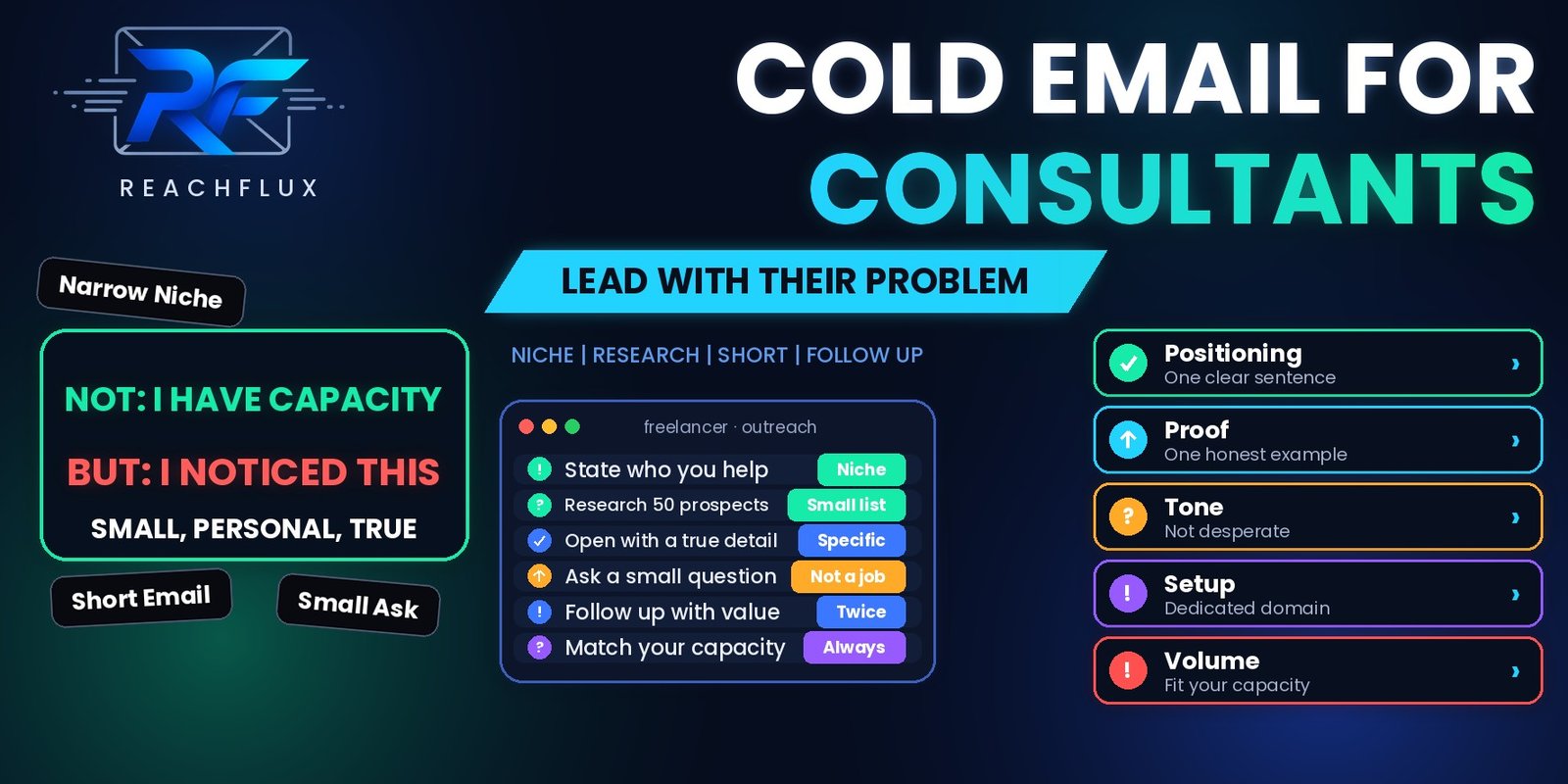
How can consultants and freelancers use cold email to find clients?
Pick a narrow type of client with a problem you can solve, write short and specific emails that show you understand their situation, and ask for a conversation rather than a job. Consultants and freelancers have an advantage over larger firms: they can be personal, quick and credible about their own work. The risk is the opposite tone, which is sounding desperate, generic or like a mass mailing.
Cold email suits independent professionals because volume does not need to be high. A carefully researched list of a few dozen well-matched prospects, contacted thoughtfully, can produce real conversations. This guide covers positioning, targeting, example messages, follow-ups and the mistakes that make freelancers sound like spam.
Be specific about who you help and with what
“I help businesses grow” tells nobody anything. A narrow statement, such as who you work with, what problem you solve and for what kind of result, makes you memorable and credible. You can be broader later. Narrow first is easier to write, easier to target and easier for a reader to say yes to.
Try completing this sentence: I help [type of client] with [specific problem] so they can [outcome]. If you cannot complete it clearly, work on that before you write any emails.
Choose clients you can actually reach and help
| Ask yourself | Why it matters |
|---|---|
| Which clients have I helped before, or could credibly help? | Credibility is your strongest asset |
| Who feels this problem enough to pay for help? | Interest requires pain |
| Who decides, and who can I find? | You need to reach the right person |
| Which businesses show signs of a need? | Timing makes outreach feel relevant |
| Who should I avoid? | Poor-fit clients cost more than they pay |
Build a small, researched list using the process in How to Build a Cold Email Prospect List: Sources, Research and Validation. For an independent, a list of fifty carefully chosen prospects is better than five thousand scraped addresses.
A message structure that suits independents
Keep it short and personal. Open with something true and relevant about their business, say plainly what you do, connect it to their situation and ask a small question. Avoid long biographies, lists of services and rate cards. The general structure is in How to Write a Cold Email: A Simple Structure, Real Examples and What to Avoid.
Hi [first name],
I noticed [specific, true observation about their business]. I help [type of client] with [specific problem], most recently by [brief, honest example].
Is [topic] something you are looking at this quarter? Happy to share a couple of ideas either way.
[Name]
The email offers help before asking for anything, and the ask is a question. It does not claim availability, discount or urgency.
Show credibility without bragging
One short, specific example
A brief, honest description of a similar piece of work is more convincing than a list of credentials.
Results you can stand behind
Mention outcomes only if they are true and you can explain them. Confidentiality may limit detail, so describe the situation rather than naming the client.
Relevant experience
Say why your background fits their problem, in a sentence.
A link, sparingly
A single link to a relevant piece of work can help after they reply. Avoid putting a portfolio in the first email. See Links in Cold Emails: Should You Add a Calendar Link or Use Link Tracking?.
What makes freelancers sound like spam
Opening with availability or discounts
It signals that you need work, which weakens your position.
Pitching a list of services
Buyers want a solution to one problem, not a menu.
Mass mailing the same text
Identical messages are obvious, and they undermine your credibility.
Overpromising results
Guarantees are rarely believable from an independent, and may be untrue.
Flattery without substance
Generic compliments about the company add nothing.
Giving away unpaid work in the first email
Offering free full audits in a first message devalues your work and attracts the wrong clients.
Follow up with something useful
Independents often send one email and stop. A small number of thoughtful follow-ups, each adding something new, can double the chance of a reply. Offer a relevant observation, a short example or an easier question. Stop when they reply or decline. The structures are in Cold Email Follow-Up Sequence Examples: Structures, Templates and What Each Step Should Do, and the principles of replying well in Cold Email Reply Templates: How to Answer Interested, Not Now, Wrong Person and Objection Replies.
Keep the technical side simple, but do it properly
Even a small outreach effort needs a clean setup. Use a dedicated domain rather than your main business domain, a mailbox with a proper sender name and signature, and authentication that passes and aligns. Keep volume modest and ramp up gradually. The basic order is in How to Set Up Cold Email Inboxes and Domains: A Step-by-Step Guide, and sender details in Cold Email Signature and Sender Name: What to Include and What to Leave Out.
Plan outreach around your capacity to deliver
Win more clients than you can serve and quality falls. Decide how many new engagements you can take each month, work backwards to the conversations you need and size your outreach accordingly. A small, steady stream of outreach each week is usually healthier than a burst followed by silence. Consistency is the quiet advantage, and the routine is in Cold Email Operating Rhythm: Daily, Weekly and Monthly Routines for Managing Outreach at Scale.
An independent designer reaches ten ideal clients
Imagine a freelance product designer who works with early-stage software companies. They define their ideal client as seed-stage startups that have just launched a product. They research ten companies, noting each one’s recent launch and a specific usability issue they could improve. They write a short email to each founder, referencing the launch and one concrete observation, and asking whether design is a priority this quarter.
They follow up once with a short example of a similar problem they solved, without naming the client. Of the ten, a few reply, two want to talk and one becomes a project. The numbers are small, but so was the effort, and every message was relevant. That is how independents win with cold email.
Handle pricing and scope questions early and calmly
When a prospect asks about price, answer honestly and explain what drives it, such as scope, timeline and complexity. A range with context is better than avoiding the question or quoting a single number you cannot support. If the project is unclear, propose a short paid discovery step instead of a free, open-ended proposal. This filters out poor-fit clients and shows that your time has value.
Use outreach to earn referrals as well as projects
Not every conversation becomes a project, but many become introductions. A polite follow-up that asks whether the person knows someone facing the problem costs nothing and often works better than a second pitch. Keep a simple record of who helped and thank them. A steady flow of referrals reduces how much cold outreach you need over time.
Freelancer cold email checklist
- You can state who you help and with what in one sentence.
- The list is small, researched and well matched.
- Each email opens with something true and specific about the client.
- You describe a short, honest example of relevant work.
- The ask is a small question, not a request for a job.
- Follow-ups add something new, and stop on any reply.
- You use a dedicated domain with proper authentication and a real signature.
- Volume matches your capacity to take on work.
Questions about cold email for freelancers
How can freelancers use cold email to find clients?
Choose a narrow type of client with a problem you can solve, research a small list, write short, specific emails that show you understand their situation and ask a small question rather than for a job.
What should a freelancer say in a cold email?
Open with something true and relevant about the client, say plainly what you help with, give a brief, honest example and ask a small question. Avoid lists of services, rate cards and claims of availability.
Should I offer free work in a cold email?
Generally not in a first message. Free audits and unpaid work can devalue your services and attract the wrong clients. A useful observation is enough.
How many emails should a consultant send?
Fewer than you think. A small, carefully researched list of well-matched prospects, contacted thoughtfully, can produce conversations without any mass mailing.
Do I need a separate domain for freelance cold email?
It is advisable. A dedicated domain protects your main business email from outreach-related problems, and it should have proper authentication and a gradual ramp.
How do I stop sounding desperate in cold emails?
Lead with the client’s problem rather than your availability, avoid discounts and urgency, and be specific, honest and relaxed about whether they reply.
Lead with their problem, and keep it small and personal.
You do not need volume. You need a narrow focus, a researched list, short and specific emails and a few thoughtful follow-ups. Be honest about what you have done, relaxed about whether they reply and consistent week after week.
Match the outreach to the number of clients you can serve well.
Prepare a small list, send with care and manage replies in one place.
ReachFlux helps small teams and independents prepare lists, send paced campaigns from their own accounts and manage replies.