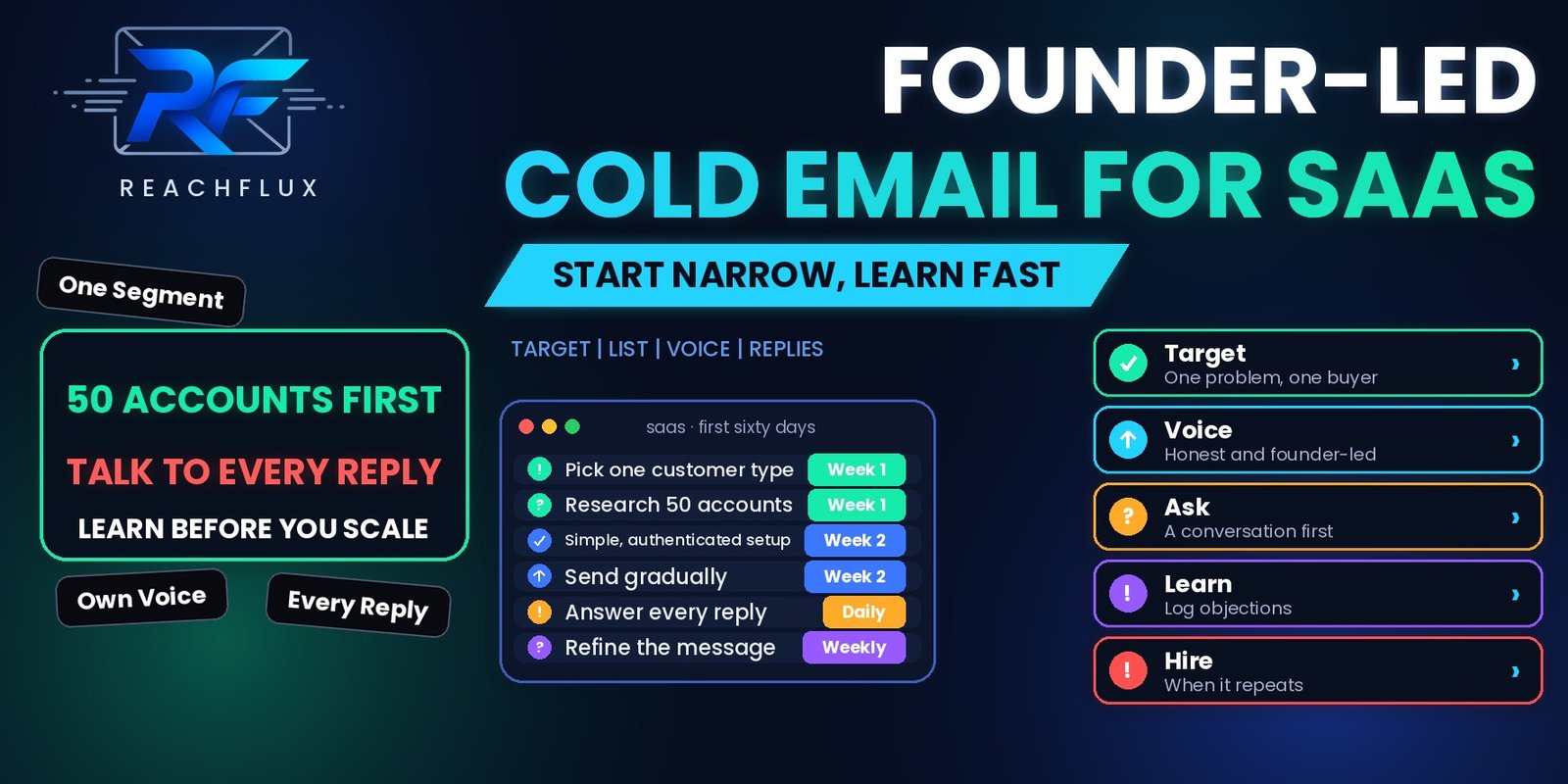
How can SaaS founders start cold email outbound without a sales team?
Start narrow and do it yourself. Choose one type of customer with a clear problem, build a small researched list, write short emails in your own voice and talk to every person who replies. Founder-led outbound is not about volume. It is the fastest way to learn who needs your product, what they call the problem and what makes them say yes, and those lessons are worth more than the first few customers.
The common mistake is to treat outbound as a machine to be switched on. Early on it is a learning tool. This guide covers how to choose a target, set up simply, write and follow up, handle replies and know when to bring in help.
Pick one customer type and one problem
| Question | Why it matters |
|---|---|
| Who has the problem most sharply? | Sharp pain produces replies |
| Who can decide or influence a purchase? | You need the right person |
| Can I find a list of them? | If you cannot find them, you cannot reach them |
| Do I understand their language? | Your words must match theirs |
| Is the value clear in one sentence? | Complexity kills cold outreach |
Start with fifty to a hundred well-researched accounts
Resist the temptation to go big. A small list lets you personalise, notice patterns and respond to every reply. Research each account enough to write a genuine opening, and note the source of each contact. The process is in How to Build a Cold Email Prospect List: Sources, Research and Validation, and personalization in Cold Email Personalization That Does Not Look Scripted: First Lines, Research and Scale.
Keep the technical setup simple but correct
You do not need a large stack. A dedicated outreach domain, a few mailboxes with real sender identities, proper authentication, a validated list and one sending and reply tool are enough. Ramp up gradually and keep volume modest. The lean setup is in The Cold Email Tech Stack: What Tools You Actually Need and What Each One Does and the order of steps in How to Set Up Cold Email Inboxes and Domains: A Step-by-Step Guide.
Use your own name and role. Founder emails get read because they come from a person who built the thing. That advantage disappears if the message sounds like a template.
Write like a founder, not a marketing team
Your credibility comes from knowing the problem. Explain what you built, who it is for and why, in a few plain lines, then ask a small question. Avoid feature lists and growth-hack language.
Hi [first name],
I am the founder of [product]. We built it because [honest reason related to the problem], and it now helps [type of team] with [specific outcome].
I noticed [specific, true observation about their company]. Is [problem] something you deal with? Happy to share what we have learned either way.
[Name], founder, [Company]
The structure is the same as in How to Write a Cold Email: A Simple Structure, Real Examples and What to Avoid. What is distinctive here is the honest origin story and the invitation to share learning, which suit a founder and lower the barrier to replying.
Ask for a conversation, not a sale
Early on, you want to understand the problem, not close a deal. Asking “could I ask you a few questions about how you handle [process]” is easier to say yes to than asking for a demo, and it often leads to a demo anyway. If the person is clearly interested, move to a short call or a trial, and keep the next step simple.
Be honest if you are early. Many people are happy to help a founder who is clear about what they are building and why.
Talk to every reply, and write down what you learn
Each reply is data. Note the exact words people use for the problem, the alternatives they mention, the objections they raise and the reasons they decline. Patterns will appear quickly, and they should change your messaging, your target and sometimes your product. Respond fast, in your own voice, using the approaches in Cold Email Reply Templates: How to Answer Interested, Not Now, Wrong Person and Objection Replies.
Plan a short, useful sequence
Write three or four emails in advance, each adding something new, such as a concrete use case, a short story of a customer problem or an easier question. Stop on any reply. The structures and templates are in Cold Email Follow-Up Sequence Examples: Structures, Templates and What Each Step Should Do, and spacing in Cold Email Follow-Up Timing: How Long Should You Wait Before Following Up?.
Measure learning and conversations
Positive replies
How many people want to talk, by segment and message.
Conversations held
The real unit of progress at this stage.
Objections and reasons for no
They show you where positioning breaks.
Trials or demos started
A step closer to value.
Time spent
Your hours are the main cost. See Cold Email ROI: How to Calculate Cost per Reply, Cost per Meeting and Payback.
A worked example: the first sixty days
Imagine a founder with a scheduling tool for care homes. In week one they pick a single segment, independent care homes with more than one site, and research fifty accounts. In week two they set up a dedicated domain, three authenticated mailboxes and a short, honest email in their own voice. They send gradually and answer every reply the same day.
By week four they have had eleven conversations. Several people describe the problem in the same words, and one objection appears repeatedly: staff do not want another login. The founder changes the messaging to lead with simplicity and adds a one-page walkthrough to send on request. By week eight they have two trials and a clearer idea of price. The outbound volume was tiny, but the learning shaped the product and the pitch. That is the real return of founder-led outbound.
Mistakes founders make with outbound
Going broad too soon
A wide list means generic messages and thin learning.
Hiding behind automation
Early on, founder involvement is the advantage. Automate scheduling, not thinking.
Ignoring deliverability
A rushed setup damages a new domain. Start gently and verify authentication. See the Cold Email Deliverability: The Complete Guide to Inbox Placement, Reputation and Fixes.
Pitching features
Describe the problem and the outcome, not the dashboard.
Giving up after one campaign
Early results are noisy. Iterate on target, message and offer.
Signs it is time to hand it over
Founder-led outbound should produce a repeatable approach: a clear target, a message that works and a sense of the sales process. When you can describe those and the work is more than you can do alongside the product, consider help. That might be a first salesperson, a contractor or a more structured programme. Evaluate options carefully, using the questions in Cold Email Expert: What They Actually Do, What to Ask and How to Judge One.
Turn replies into messaging
Keep a running document of the exact phrases people use to describe the problem, the alternatives they mention and the outcomes they care about. Use those phrases in your next emails, your landing page and your demo. Messaging built from customers’ own words usually outperforms messaging built from internal language, and it costs nothing but attention.
Founder outbound checklist
- You have chosen one customer type and one problem.
- Your first list is small, researched and sourced.
- The setup is simple, authenticated and ramped gradually.
- Emails are in your own voice, specific and short.
- The ask is a conversation, not a sale.
- You respond to every reply quickly and record what you learn.
- You track conversations and objections, not only emails sent.
- You know the signs that it is time to hire help.
Questions about founder-led outbound
How can a SaaS founder start cold email outbound?
Choose one customer type and problem, build a small researched list, write short emails in your own voice, talk to every reply and use what you learn to refine your target and message. Treat outbound as learning first and scale second.
How many emails should a founder send?
Fewer than you think. A list of fifty to a hundred well-matched accounts, contacted thoughtfully, is enough to learn a great deal.
Should a founder ask for a demo in the first email?
Usually a smaller ask works better, such as a question about how they handle the problem. A demo can follow when interest is clear.
What should a SaaS founder measure from cold email?
Positive replies, conversations held, the objections and reasons people give, trials or demos started and the time spent.
When should a founder stop doing outbound themselves?
When you have a repeatable approach, with a clear target, a message that works and a sense of the sales process, and the workload exceeds what you can handle alongside the product.
Does founder-led outbound need special tools?
No. A dedicated domain, a few authenticated mailboxes, a validated list and one sending and reply tool are enough to start.
Start narrow, talk to everyone and learn fast.
Founder-led outbound is your fastest route to understanding your market. Keep the list small, the setup simple and the messages honest, and use each reply to sharpen what you build and say.
When the approach is repeatable and the work outgrows you, that is the moment to bring in help.
Prepare a small list, send paced campaigns and manage replies in one place.
ReachFlux describes its fit for startups: outbound that lives in one workflow instead of a spreadsheet, a mailbox and a founder doing everything by hand.