What does a cold email expert actually do?
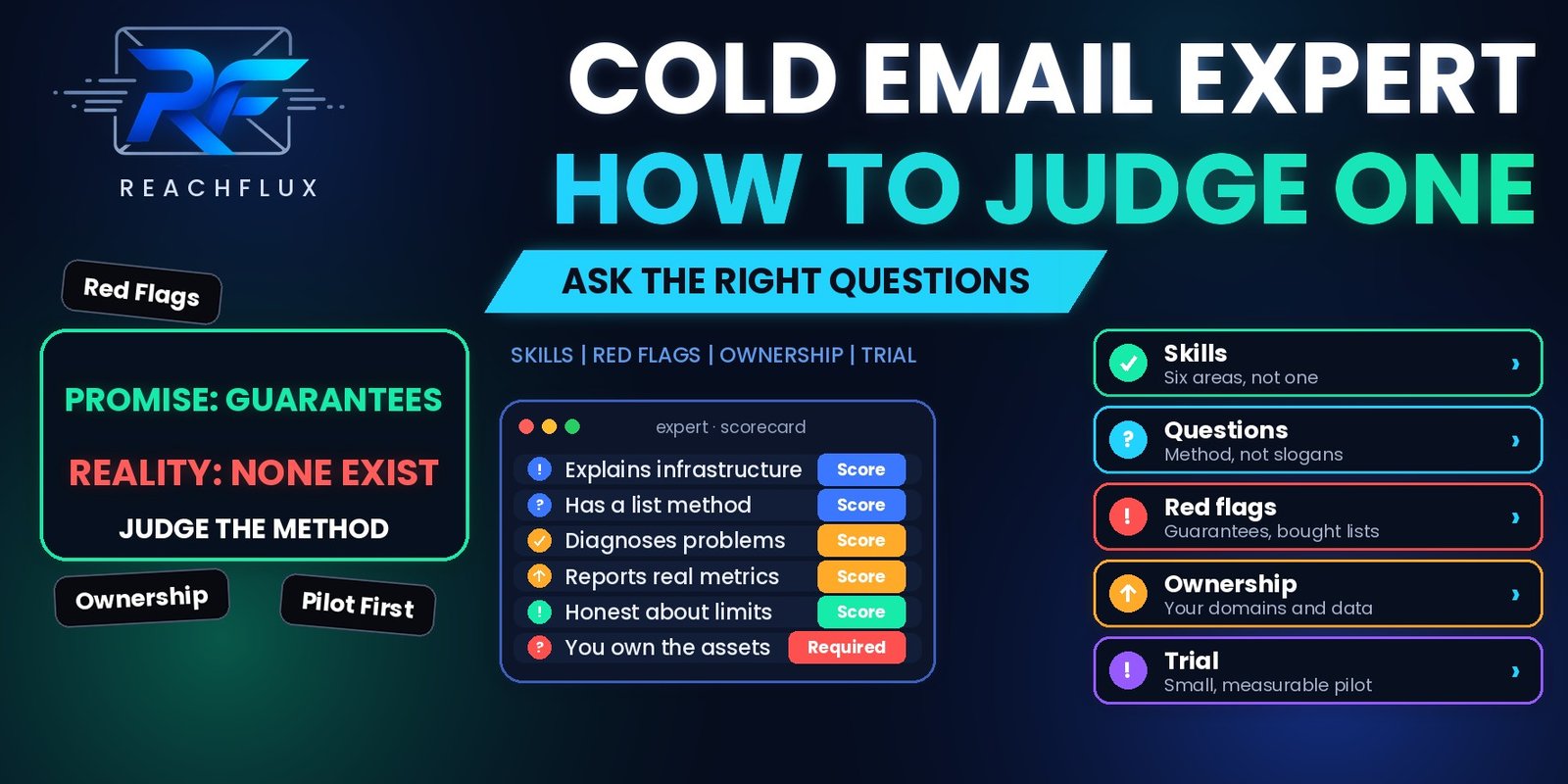
A genuine cold email expert runs outbound as a system rather than as a template. That means setting up and protecting the sending infrastructure, sourcing and validating lists, defining the audience and offer, writing and testing messages, operating campaigns day to day, reading the data honestly, and keeping everything compliant. The title says nothing by itself, so the way to judge one is to see whether they can explain each part clearly, show how they diagnose problems, and be candid about what cannot be promised.
If you are hiring, the single most useful test is simple: ask what happens when deliverability drops, and listen for a method rather than a slogan.
The six skill areas behind good cold email
“Cold email expert” usually bundles several different jobs. Few people are excellent at all of them, which is why it helps to know what each involves.
| Skill area | What it covers | What good looks like |
|---|---|---|
| Strategy and targeting | Who to contact, why they should care, and how to segment | A clear ideal customer profile and reasons to prioritise some segments over others |
| Infrastructure and deliverability | Domains, mailboxes, authentication, volume and reputation | Can explain SPF, DKIM and DMARC alignment, sensible limits and how to monitor health |
| List sourcing and hygiene | Where leads come from and how they are checked | Prefers researched, validated lists and talks about bounces and data decay |
| Copy and offer | The message, the ask and the follow-ups | Short, specific, relevant messages with a testing plan |
| Operations | Running campaigns, handling replies and keeping consistency | A routine, owners and rules to avoid collisions and gaps |
| Measurement and compliance | Reporting, honest metrics and legal basics | Reports on replies and meetings, treats opens as weak, handles opt-outs properly |
What a good expert does in practice
Starts with an audit, not a send
Before launching anything, they check authentication, domain history, list quality and the offer. Skipping this is how accounts get damaged in the first week.
Fixes foundations before scaling
Volume comes after the setup is healthy. They will usually propose a conservative start and a gradual ramp. See How to Scale Cold Email From 250 to 1,000 Emails a Day Without Landing in Spam.
Segments and tests deliberately
They change one thing at a time and keep a record, so results mean something.
Monitors and reacts
They watch bounces, complaints and replies by segment and sender, and have thresholds that trigger a pause.
Documents the system
Naming, limits, templates and incidents are written down so the work survives personnel changes.
Reports honestly
They show replies, qualified conversations and meetings, flag what did not work, and do not hide behind open rates.
Red flags to watch for
Most bad outcomes can be spotted in the first conversation.
Guaranteed inbox placement or results
No one controls how mailbox providers treat your mail. A guarantee tells you the person either does not understand the system or is selling a promise.
Huge volume from a handful of inboxes
Pushing thousands of messages a day through a few mailboxes burns domains quickly. Ask how many inboxes and domains they plan and why. See How Many Domains and Inboxes Do You Need for Cold Email Outreach?.
Large purchased lists
Bought data decays, bounces and attracts complaints. A credible expert will ask about your list source. See Why Do Half of Your Prospect Emails Bounce? Fixing Bad Data From Paid Databases and LinkedIn.
Opens as the headline metric
Opens are unreliable because of privacy features and link scanning. Replies and meetings are the metrics that matter.
One template for everyone
If there is no discussion of your audience and offer, the work will be generic and so will the results.
Silence on compliance
Anyone running outreach should talk about opt-outs, suppression and the rules in your market without being prompted.
Secrecy about process
If they will not explain how they work, you cannot judge or learn from it.
Control without ownership for you
If they own your domains, mailboxes or data and will not hand them over, you are renting your own pipeline.
Questions to ask, and what the answers should sound like
These questions separate people who have run outbound from people who have only sold it.
| Question | A strong answer sounds like | A weak answer sounds like |
|---|---|---|
| How do you decide how many domains and inboxes we need? | Starts from target volume, safe per-inbox limits and ramp-up, and explains the reasoning | Gives a fixed number with no explanation |
| How do you validate and source lists? | Describes research, validation, handling catch-all and role addresses, and the source | “We have a database of millions” |
| What will you report each week? | Replies, positive replies, meetings, bounces and complaints, by segment | Sent volume and open rates |
| What do you do when deliverability drops? | A diagnostic order: authentication, bounces by provider, list, volume, then content | “We rotate to new domains” |
| How do you handle opt-outs and complaints? | A single suppression list applied to every campaign, with prompt removal | Vague, or leaves it to the client |
| Who owns the domains, mailboxes and data? | You do, with access from day one | The agency, or unclear |
Insist on ownership and access
Whoever you work with, you should own the assets that outreach is built on: the sending domains, the mailboxes, the lead data and the content. Insist on admin access to your domain registrar and mail accounts from the start, and on read access to campaign data and reports. If the relationship ends, you should be able to carry on without rebuilding from scratch.
This is more than a convenience. Sender reputation lives on your domains, so losing control of them can mean losing months of reputation work. The foundations are explained in Cold Email Infrastructure: Domains, Inboxes, DNS and Sending Limits.
In-house, freelancer, agency or platform plus adviser
There is no single right model. The best one depends on your volume, budget and how much you want to learn.
| Model | Strengths | Watch out for | Often suits |
|---|---|---|---|
| In-house hire | Deep knowledge of your market and continuity | Cost, and one person becoming a single point of failure | Teams with steady, long-term outbound |
| Freelancer | Flexible, often hands-on and affordable | Availability and depth across all six skill areas | Early stage or focused projects |
| Agency | Broader team and established processes | Template-driven work, less control and unclear ownership | Teams that need capacity fast |
| Platform plus adviser | You keep control and learn the system | Needs your time to run it | Teams that want ownership and a repeatable workflow |
A simple scorecard for comparing candidates
When you speak to more than one person, memory blurs. Score each candidate on the same criteria right after each call, and compare the notes afterwards. A rough one-to-five score is enough. The point is to force evidence rather than impressions.
| Criterion | Evidence to ask for |
|---|---|
| Explains infrastructure clearly | Can describe domains, mailboxes, authentication and ramp-up in plain language, with reasons |
| Has a list method | Describes sourcing, validation and how risky addresses are handled |
| Talks about diagnosis | Gives an ordered method for when deliverability or replies drop |
| Reports the right metrics | Replies, positive replies, meetings, bounces and complaints, not just sends and opens |
| Is candid about limits | Says plainly what cannot be guaranteed and what depends on you |
| Respects ownership and compliance | You own the assets, and opt-outs and suppression are discussed unprompted |
| Shows relevant experience | Can discuss work with similar audiences or offers, without breaking confidentiality |
A candidate who scores well on explanation and candour but has less experience in your niche is often a better bet than a confident one who cannot explain how things work.
A low-risk way to trial anyone
Whatever model you choose, start small and make success measurable before committing.
Write down who you want to reach, the offer and what a good result looks like, in terms of qualified conversations rather than emails sent.
Review authentication, domains, mailboxes and list quality before any sending begins.
Run a small campaign with conservative volume and per-company limits.
Look at replies, bounces, complaints and meetings by segment, and read the actual replies.
Scale only when the foundations and early results justify it, and keep records of what changed.
How to think about pricing and contract terms
Prices vary widely, so this is about structure rather than numbers. Retainers pay for ongoing operation, projects pay for a defined piece of work such as a setup and audit, and some arrangements tie part of the fee to outcomes. Each can work. What matters is that you understand what you are paying for and how you would leave.
Be cautious of long lock-ins before any evidence exists. A short initial scope with a clear review point protects both sides. Check what happens to the domains, mailboxes, lists and reports when the contract ends, and make sure the answer is that they remain yours. Be wary too of pricing that rewards volume sent, since sending more is not the same as getting more conversations.
If you want to become the expert
You can build real competence with a small amount of focused effort. Start with authentication, using SPF vs DKIM vs DMARC: What Cold Email Senders Need to Know and the Cold Email Deliverability Glossary: 30 Terms Every Sender Should Understand, then learn list hygiene, then copy and testing. Run small campaigns with careful caps, read bounce messages instead of ignoring them, and keep a change log of what you tried and what happened.
A routine matters more than genius. Review your numbers on a schedule, and the pattern of what works becomes visible quickly. A companion piece on running that routine is Cold Email Operating Rhythm: Daily, Weekly and Monthly Routines for Managing Outreach at Scale.
What a good proposal contains
- A clear statement of the audience, the offer and the success measures.
- An infrastructure plan covering domains, mailboxes, authentication and ramp-up.
- A list plan describing sources, validation and exclusions.
- A testing plan that changes one variable at a time.
- A reporting plan built on replies, meetings, bounces and complaints.
- A compliance section covering opt-outs, suppression and relevant rules.
- Statements of ownership and access for domains, mailboxes and data.
- Honest language about what cannot be guaranteed.
Questions about cold email experts
What does a cold email expert do?
A cold email expert runs outbound as a system: setting up and protecting sending infrastructure, sourcing and validating lists, defining audience and offer, writing and testing messages, operating campaigns and reporting honestly, while keeping everything compliant.
How do I know if a cold email expert is any good?
Ask how they decide on domains and inboxes, how they validate lists, what they report and what they do when deliverability drops. Strong answers describe a method. Weak ones rely on slogans or guarantees.
Can anyone guarantee inbox placement or replies?
No. Mailbox providers decide where mail lands, and replies depend on your market, offer and list. Be cautious of anyone who promises specific outcomes.
Who should own the domains and mailboxes?
You should. Sender reputation lives on your domains, so you should have admin access from the start and be able to continue without the provider if the relationship ends.
Is it better to hire an agency or do cold email in-house?
It depends on volume, budget and how much you want to learn. Agencies add capacity, in-house builds continuity and a platform plus adviser gives you control. A small paid pilot is a sensible way to test any option.
How long does it take to learn cold email yourself?
You can learn the fundamentals of authentication, list hygiene and testing in a few focused weeks. Developing judgement takes longer and comes from running small campaigns and reviewing the data regularly.
Judge the method, not the promise.
A real expert can explain each part of the system, show how they diagnose trouble and say plainly what is outside their control. A weak one leans on guarantees, volume and secrecy. Ask the questions in this guide, insist on ownership of your assets and begin with a small, measurable pilot.
Whether you hire help or learn it yourself, the same principles apply: healthy foundations first, honest measurement always.
Run campaigns, replies and pipeline from a workflow you own.
ReachFlux brings list preparation, sending controls, reply management and lead tracking into one workflow, whoever operates it.