Is cold email still effective?
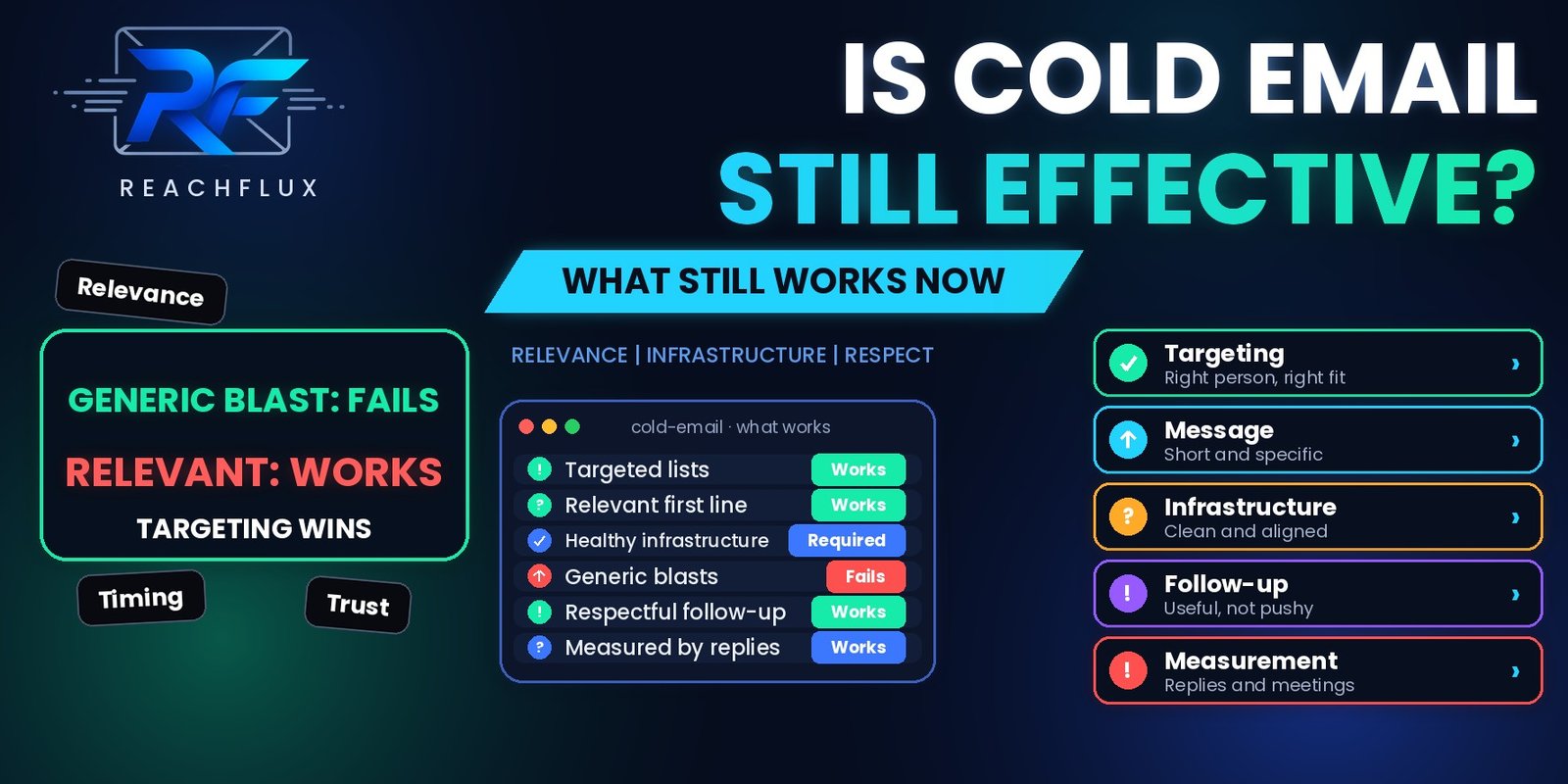
Yes, cold email is still effective, but the bar is higher than it used to be. It works when you contact a narrowly defined audience with a relevant reason to care, send from authenticated infrastructure with healthy habits, write like a person and respect opt-outs. It does not work well as high-volume generic outreach, which is exactly the form most people mean when they say it is dead.
So the honest answer to "does it still work" is another question: which version are you running? The version built on volume, templates and luck has been getting weaker for years. The version built on relevance, infrastructure and discipline is still one of the most direct ways to start a business conversation.
What actually changed in cold email
Several shifts happened at once, and together they explain why the old playbook underperforms.
Mailbox providers now expect SPF, DKIM and DMARC, with stricter rules for larger senders.
Spam-rate thresholds make recipient feedback a central signal.
Cheap tools and AI writing mean far more outreach lands in the same inboxes.
Buyers recognize templated structures and dismiss them quickly.
Compliance expectations and corporate security gateways are tighter than before.
Stricter sender rules. Google and Yahoo introduced stronger requirements for bulk senders in 2024, including authentication, easy unsubscribe and low complaint rates, and Microsoft has announced similar expectations for high-volume senders to its consumer mail domains. Whatever your volume, those rules describe the direction of travel: providers want senders who are identifiable, authenticated and wanted.
Easier sending, harder attention. Writing and sending a thousand emails costs almost nothing now, and recipients feel it. When anyone can generate a plausible personalized opener, personalization alone stops being a signal of effort.
Filters learn from behavior. Modern filtering weighs what recipients do. Messages that get ignored, deleted or reported train systems to treat that sender worse, and messages that get replies do the opposite. The sender with relevant outreach gets a quiet advantage.
For the technical side of these requirements, read How to Improve Cold Email Deliverability: 17 Fixes That Actually Matter.
What still works in cold email
A narrow, well-defined audience
The strongest results come from a specific kind of company with a specific, current problem you can solve. When you can describe the audience precisely, the message almost writes itself and the list stays small enough to research properly.
A reason to write to this person, now
A timely trigger such as a hire, a launch, a funding event or a change in their market gives the email a reason to exist. It separates "I noticed something about you" from "I am writing to everyone."
Short, plain, human messages
Emails that read like a note from one professional to another outperform polished marketing copy. One idea, one question, easy to answer.
Infrastructure that behaves consistently
Authenticated domains, workload spread across senders, steady volume and clean lists keep your mail in front of people. This is invisible when it works and fatal when it does not.
The infrastructure side is covered in Cold Email Infrastructure: Domains, Inboxes, DNS and Sending Limits.
Respect for the recipient
Clear identity, easy opt-out and prompt removal reduce complaints and protect your sender reputation, which is what keeps future campaigns working.
Patient follow-up
Most replies to a well-run sequence come after the first message, but follow-ups must add something. A sequence that politely brings new information beats one that repeats the ask.
For spacing and content of follow-ups, see Cold Email Follow-Up Timing: How Long Should You Wait Before Following Up?.
What to stop doing
- Mass blasting to broad lists. Low relevance means low replies and high complaints.
- Generic templates with a swapped first name. Recipients can tell, and so can filters that see similar messages sent in bulk.
- Chasing volume as a goal. A bigger number of sends rarely produces a bigger number of conversations.
- Ignoring infrastructure. Skipping authentication, overloading single inboxes or using your primary domain for outreach puts everything at risk.
- Trusting open rates. Privacy features and scanners make them unreliable, so decisions based on them are often wrong.
- Judging after a week. Campaigns need a full sequence cycle and a real sample before conclusions mean anything.
Most "cold email does not work" stories contain at least three of these. The channel is fine; the execution matches the pattern the market has learned to ignore.
If you suspect your campaigns are failing before anyone sees them, start with Cold Email Inbox Placement: How to Measure It, Test It and Improve It.
Is cold email spam?
It can be, and it does not have to be. The difference is not the channel, it is the behavior around it.
Spam is unwanted, irrelevant, bulk or deceptive mail. A single, truthful, relevant message from a real person to someone with a plausible business interest, with a clear way to opt out and prompt respect for the answer, is outreach. In legal terms the boundaries vary by country, so check the rules in each market you contact.
In practical terms, recipients and filters draw the line through complaints and engagement. If many people report your mail, it is spam to the providers whatever the intent was. That is why relevance and respect matter as much for results as they do for ethics.
For the compliance and opt-out side, read Cold Email Compliance and Deliverability: Opt-Outs, Sender Identity and Complaint Rates.
How to judge whether cold email is working
Most debates about effectiveness fall apart because people measure different things. Decide in advance what success means, and measure it the same way every time.
| Metric | Why it matters | Caution |
|---|---|---|
| Qualified conversations per contacted prospect | The closest measure to business value | Needs a clear definition of qualified |
| Positive reply rate | Shows whether the message resonates | Separate positive, neutral and negative replies |
| Hard bounce and complaint rates | Shows whether infrastructure and targeting are healthy | Break down by sender and source |
| Reply rate by segment | Shows where the offer fits | Small samples need more time |
| Cost per qualified conversation | Connects effort to outcome | Include time, tools and data costs |
| Open rate | Weak hint only | Distorted by privacy features and scanners |
If you track only sends and opens, you will find it easy to believe cold email works or does not, whichever you already thought. Qualified conversations and cost per conversation make the argument harder to fudge.
AI writing, other channels and where cold email is heading
Two trends shape how to run cold email from here: AI-generated writing and the move toward combined channels.
AI can help, and it can flatten your voice
AI tools are useful for research, drafting variations and summarizing a prospect's situation. They are risky when used to produce high volumes of near-identical personalized openers, because recipients and filters see the same shape everywhere. Use AI to do the thinking about the recipient, then write the message in plain language that sounds like you. Always read what goes out under your name.
Email works best as part of a sequence of touches
A relevant social interaction, a referral, a short phone call or a useful piece of content can make a later email feel familiar. Keep each channel respectful, and make sure opt-outs on one channel are honored on all of them.
Expect stricter, not looser
Provider requirements, compliance expectations and recipient patience all trend toward more scrutiny. The senders who adapt, with solid authentication, tight targeting and honest practice, will be the ones left with a working channel.
For a practical way to keep several campaigns organized as you grow, read How to Manage Multiple Cold Email Campaigns Without Losing Control.
A 30-day reality test to see if cold email works for you
Instead of arguing about whether cold email works in general, run a clean test on your own market. Thirty days is enough to see a first cycle if you keep it disciplined.
Authenticate sending domains, connect senders, validate a small, tightly targeted list and write one simple offer.
Keep volume modest, keep patterns steady and check provider responses daily.
Add follow-ups that each bring something new, and handle every reply promptly.
Compare replies and qualified conversations by segment, and check bounces and complaints.
Double down on what produced conversations, fix what produced failures and drop what did neither.
- Sending domains authenticated and verified.
- List tightly targeted and validated.
- Volume modest and steady for the first batch.
- Every reply handled within a working day.
- Results tracked by segment, not only in total.
- Opt-outs honored across all campaigns.
- Only one major variable changed at a time.
- Decision made on conversations, not opens.
ReachFlux supports this kind of controlled test, with sender accounts, workload distribution, validation, reply handling and activity tracking in one place. It cannot decide whether your offer is strong, but it keeps the experiment clean enough to learn from.
Questions about whether cold email still works
Is cold email still effective in 2026?
Yes, for businesses that target carefully, send from properly authenticated infrastructure, write relevant messages and follow the rules. It performs poorly for mass, generic outreach, which filters and recipients have both learned to ignore.
Why do cold emails not work anymore?
Usually because of a combination of stricter authentication and filtering, crowded inboxes, generic messaging and poor targeting. Many campaigns also fail at the delivery stage without the sender noticing, so the problem looks like a weak message when the message was never seen.
Is cold email considered spam?
It depends on relevance, honesty and consent rules. A targeted, truthful message to someone with a plausible business reason to care is a different thing from bulk unsolicited mail. Recipients and filters decide partly by complaints, so relevance matters as much as legality.
What is a good result for cold email?
It depends on your market, offer and list quality, so avoid chasing generic benchmarks. A better measure is qualified conversations relative to the number of people you contacted, tracked over several weeks and compared across segments.
How long should I test cold email before deciding it does not work?
Run a structured test for at least a few weeks, covering a full sequence cycle on a properly targeted segment with working infrastructure. Judging after a handful of sends mostly measures setup problems.
Should I combine cold email with other channels?
Often yes. Email plus a relevant social touchpoint, a referral or a phone follow-up can raise the chance a message is recognized. Keep each channel respectful and consistent so the combined effect feels coordinated rather than pushy.
Cold email works for people who treat it as a craft.
The channel did not die. It got more demanding. Filters pay more attention to what recipients do, buyers have seen every template, and rules around identity and opt-outs are tighter. Those pressures punish careless senders and reward careful ones.
If you narrow your audience, build clean infrastructure, write like a person and respect the people you contact, cold email remains one of the fastest ways to start the right conversations. Run the thirty-day test and let your own data settle the argument.
Manage senders, campaigns, validation and replies in one workflow.
ReachFlux helps teams run outbound as a controlled, measurable system.